Specifications
How to Read a Water Heater Label
Researched from the DOE test procedures, NFPA 54 and NEC code tables, and manufacturer specifications. Updated .
Quick answer
Every new water heater ships with a bright yellow EnergyGuide label, the same style used on refrigerators and dishwashers, plus a separate manufacturer data plate that looks nothing like it. Shoppers usually only see the yellow label; installers and inspectors care mostly about the data plate. Knowing what each one is for, and where the specific numbers you need actually live, saves a trip back to the store or a call to the manufacturer.
This page walks through both labels field by field, so an unfamiliar spec sheet stops being intimidating.
What is on the yellow EnergyGuide label, and what is it for?
The EnergyGuide label exists to let shoppers compare models before buying, not to guide installation. It shows the Uniform Energy Factor (UEF), a single number representing overall efficiency on the standardized DOE test, an estimated yearly operating cost range compared against similar models, and the first hour rating for storage-type heaters or the maximum flow rate for tankless units. A higher UEF means less energy wasted per unit of hot water delivered; the estimated cost range on the label is a comparison tool between listed models, not a guarantee of what your own utility bill will show.
What is Uniform Energy Factor, and how should I use it?
Uniform Energy Factor is the DOE's standardized measure of a water heater's overall efficiency, replacing the older Energy Factor rating, and it accounts for a unit's use pattern category so that a small household model and a whole-house model are tested and rated on comparable terms within their own class. UEF is most useful for comparing two units of the same type and use-pattern category against each other; comparing a UEF figure across very different categories, such as a small point of use tankless against a whole-house tank, tells you less than comparing two similar units side by side. The UEF comparison chart lays out figures across common categories for that kind of side-by-side look.
What does the input rating on the data plate actually mean?
| Fuel type | How input is expressed | What it tells you |
|---|---|---|
| Natural gas or propane | BTU per hour | How much raw heat the burner can produce; higher input generally means faster recovery |
| Electric | Watts, per element | How fast the element can reheat the tank; a 4,500 watt element recovers faster than a 3,800 watt element |
| Heat pump | Watts for the compressor, plus a backup electric resistance element rating | The compressor handles normal recovery; the backup element covers high-demand or cold-air situations |
Published standard Source: Manufacturer data plate conventions for residential water heaters, consistent with UL and ANSI listing requirements for nameplate data.. Input rating is not the same figure as output or delivered hot water capacity; two units with the same input can still post different first hour ratings depending on tank insulation and design.
What do tank capacity, working pressure and the T&P rating tell me?
Tank capacity on the data plate is the actual measured storage volume, close to but not always identical to the nominal size in the model name. Maximum working pressure, commonly 150 psi on residential tanks, is the ceiling the tank itself is built to hold; it is a separate figure from the pressure setting stamped on the temperature and pressure relief valve, which is the safety device that actually protects the tank if pressure or temperature climbs past a safe limit. Both figures matter for a plumber checking a specific installation against local static pressure, which the water heater pressure too high guide covers in more depth.
How does the serial number encode the manufacture date?
Most manufacturers build a date code directly into the serial number, commonly as a letter representing the month combined with digits representing the year, positioned near the start of the string, though the exact scheme is manufacturer-specific and is not standardized across brands. A ten or twelve year old tank nearing the end of its typical service life is often easier to confirm by decoding the serial than by asking whoever owned the house before you. When a manufacturer does not publish its decoding scheme on the data plate itself, its customer service page or warranty documentation is the reliable source, since guessing at a format from a different brand produces a wrong date.
Where does the model number fit in, separate from the serial number?
The model number identifies the specific product line, capacity and configuration, the figure needed to order a matching replacement part such as an element, thermostat or anode rod. The serial number is unique to that individual unit and is what carries the manufacture date and often the warranty registration reference. Confusing the two when calling for a part or a warranty claim is a common and easily avoided mistake; both numbers are usually printed together on the same data plate but serve different purposes.
Reading the label is step one, measuring is step two

BOMATA Digital Water Thermometer, IPX7
$9.99The dial on the heater is not a measurement. This is how you find the delivered temperature at the tap.
Best for: Checking tap temperature at several fixtures
Check price on Amazon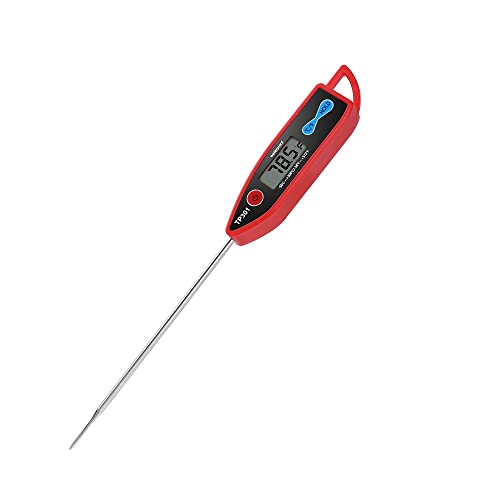
Digital Water Thermometer, Long Probe
$9.88A long probe reads a glass of water from the tap, which is what the setpoint discussion actually turns on.
Best for: Checking the actual delivered temperature
Check price on Amazon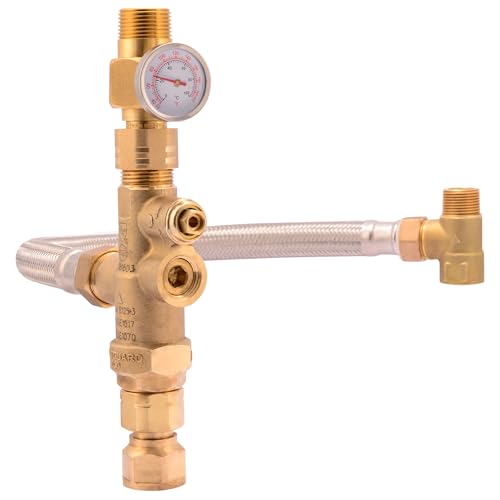
Cash Acme 3/4 in Tank Booster with TMV
$145.00If the label shows a first hour rating below your peak hour demand, a mixing valve gets more usable gallons from the same tank.
Best for: Getting more usable hot water without a bigger tank
Check price on AmazonFrequently asked questions
- What is the difference between the EnergyGuide label and the data plate?
- The yellow EnergyGuide label is a federally required shopping aid comparing efficiency, estimated operating cost and first hour rating against similar models. The data plate is the manufacturer's technical rating plate listing input rating, tank capacity, maximum working pressure and the model and serial numbers, the figures an installer or inspector actually needs for a safe, correct installation.
- What does UEF mean on a water heater label?
- UEF stands for Uniform Energy Factor, the Department of Energy's standardized efficiency rating that replaced the older Energy Factor. It measures how efficiently a water heater converts input energy into delivered hot water, tested within a specific use-pattern category so similar-sized units can be compared fairly against each other.
- Is input rating the same as output or delivered hot water capacity?
- No. Input rating, expressed in BTU per hour for gas units or watts for electric units, describes how much raw energy the burner or element can consume, not how much hot water actually reaches a tap. Two units with identical input ratings can still post different first hour ratings depending on tank insulation, heat exchanger design and recovery efficiency.
- Can I tell how old my water heater is from the serial number?
- Usually, yes. Most manufacturers encode a manufacture date directly into the serial number, often as a letter for the calendar period paired with digits for the year, near the start of the string. The exact format varies by brand, so checking that manufacturer's published decoding guide, rather than guessing from a different brand's format, gives an accurate date.
- What is the maximum working pressure listed on a water heater data plate?
- It is the pressure the tank itself is engineered to withstand, commonly 150 psi on residential storage tanks, and it is a separate figure from the relief setting stamped on the temperature and pressure relief valve. Comparing a home's actual static water pressure against both figures is part of confirming a safe installation.
- Why do two water heaters with the same tank capacity have different first hour ratings?
- First hour rating combines stored capacity with recovery speed, and recovery speed depends on input rating and tank design, not capacity alone. A unit with a higher BTU or wattage input, or better internal heat transfer, reheats faster during that first hour, so its published FHR can be noticeably higher than another tank of the identical nominal size.
Photograph both labels before you call for service or a part. A clear picture of the yellow EnergyGuide label and the manufacturer data plate, model and serial number included, is the fastest way to get an accurate answer from a manufacturer, a parts counter or a plumber quoting a replacement.