Efficiency
Water Heater UEF Comparison Chart
Researched from the DOE test procedures, NFPA 54 and NEC code tables, and manufacturer specifications. Updated .
Quick answer
Uniform Energy Factor, or UEF, is the ratio of hot water energy delivered to a household over one simulated day, divided by the total energy the water heater consumes over that same day. Because the test runs an entire simulated day rather than a single draw, standby loss, the heat that leaks out of a tank between uses, is already baked into the number rather than needing to be added separately. A higher UEF simply means more of the energy put in came back out as usable hot water.
The figure printed on a specific model's yellow EnergyGuide label always governs over the typical category ranges in the tables below, since individual units vary within a category and the label reflects an actual test of that exact model. The operating cost calculator and the operating cost chart on this site turn a UEF figure into an actual annual dollar estimate once a fuel price is added.
What does UEF actually measure?
UEF is calculated as energy delivered to hot water divided by energy consumed by the water heater, both measured over the DOE's standardized simulated-use day. That single ratio folds together combustion or resistance efficiency, standby heat loss between draws, and, for a heat pump, the extra heat it pulls from the surrounding air rather than generates itself. A water heater with a UEF of 0.60 delivers 60 percent of the energy it consumes as usable hot water, with the rest lost mainly up a flue or through the tank jacket. A water heater with a UEF of 3.5 delivers three and a half times more usable heat than the raw energy it draws from the wall, which is only possible because it is relocating heat rather than making it from scratch.
What is a typical UEF for each water heater type?
These are typical published ranges by category, not a measurement of any single model. A specific unit's own EnergyGuide label always governs over the figure in this table.
| Water heater type | Typical UEF |
|---|---|
| Heat pump water heater | About 3.5 |
| Electric tankless | About 0.98 |
| Condensing gas tankless | About 0.93 |
| Electric resistance tank | About 0.92 |
| Non-condensing gas tankless | About 0.81 |
| Condensing gas tank | About 0.80 |
| Atmospheric gas tank | About 0.60 |
| Propane tank | About 0.60 |
Convention Source: Typical published UEF ranges compiled from manufacturer specifications and ENERGY STAR and DOE product listings by category. Individual models vary, and the figure printed on a specific unit's own EnergyGuide label governs.. A single model can land above or below its category's typical figure. Always confirm the tested UEF on that model's own label before comparing units.
How can a heat pump water heater have a UEF above 1.0?
A heat pump water heater does not generate heat the way a resistance element or a gas burner does. Instead, it runs a small refrigeration cycle in reverse, pulling ambient heat out of the surrounding air and concentrating it into the tank, so it moves several times more thermal energy into the water than the electrical energy it consumes to run its compressor and fan. That is exactly why its UEF, a ratio of heat delivered to energy consumed, comes out well above 1.0, while every combustion or resistance category in the table above tops out below 1.0. Neither a gas burner nor an electric element can exceed 1.0 on this scale, because both convert a fuel source into heat directly rather than relocating heat that already exists nearby.
What draw pattern is a UEF figure actually tested against?
The DOE test procedure assigns every water heater to one of four simulated daily draw patterns based on its rated capacity, and the resulting UEF figure is only valid for comparison within that same draw pattern.
| Draw pattern | Simulated daily use |
|---|---|
| Very small | About 10 gallons a day |
| Low | About 38 gallons a day |
| Medium | About 55 gallons a day |
| High | About 84 gallons a day |
Published standard Source: DOE water heater test procedure, 10 CFR Part 430 Subpart B, Appendix E, which defines the simulated-use daily draw volumes used to calculate UEF.. The draw pattern a given unit is tested under is printed on its EnergyGuide label alongside the UEF figure itself. Most residential storage tanks fall into the medium or high pattern; the operating cost chart on this site uses the medium pattern's 55 gallon figure as its working example.
How much more input energy does a lower UEF actually require?
Because UEF is the ratio of energy delivered to energy consumed, dividing a fixed amount of delivered energy by each category's typical UEF shows directly how much more input energy a lower-UEF unit needs to deliver the identical hot water.
| Water heater type | Typical UEF | Input BTU needed for 100,000 delivered BTU |
|---|---|---|
| Heat pump water heater | 3.5 | 28,571 BTU |
| Electric tankless | 0.98 | 102,041 BTU |
| Condensing gas tankless | 0.93 | 107,527 BTU |
| Electric resistance tank | 0.92 | 108,696 BTU |
| Non-condensing gas tankless | 0.81 | 123,457 BTU |
| Condensing gas tank | 0.80 | 125,000 BTU |
| Atmospheric gas tank | 0.60 | 166,667 BTU |
| Propane tank | 0.60 | 166,667 BTU |
Published standard Source: Derived directly from the UEF definition, where input energy equals delivered energy divided by UEF, applied here to a fixed 100,000 BTU of delivered hot water using each category's typical UEF figure from the table above.. This is the arithmetic behind why a heat pump water heater costs so much less to run than an atmospheric gas or propane tank delivering the same hot water. The operating cost chart on this site carries this same relationship into dollar figures.
Why can't a tankless UEF be compared directly against a tank UEF from a different draw pattern?
A unit tested under the high draw pattern is evaluated against a larger simulated daily volume than one tested under the low draw pattern, and both standby loss and recovery behavior scale differently across that range. Two units with an identical UEF but different draw pattern assignments are not necessarily equivalent in real use, and two units with different UEF figures under the same draw pattern assignment are the only pairing the DOE test actually intends to be compared head to head. The draw pattern label printed next to the UEF figure is what makes that comparison valid rather than coincidental.
Always check the draw pattern before comparing two UEF numbers. A high-draw-pattern unit and a low-draw-pattern unit are not tested under the same simulated day, even when both post a similar-looking UEF figure on their labels.
Representative units across the UEF range
These correspond to the categories in the table below. Check a specific model's own EnergyGuide label for its exact tested UEF rather than relying on a category typical.

Senville Hybrid Heat Pump 50 Gallon
$1,099.99Representative of the heat pump category's typical UEF near 3.5, the highest efficiency tier in the comparison below.
Best for: A first heat pump water heater in a warm garage or basement
Check price on Amazon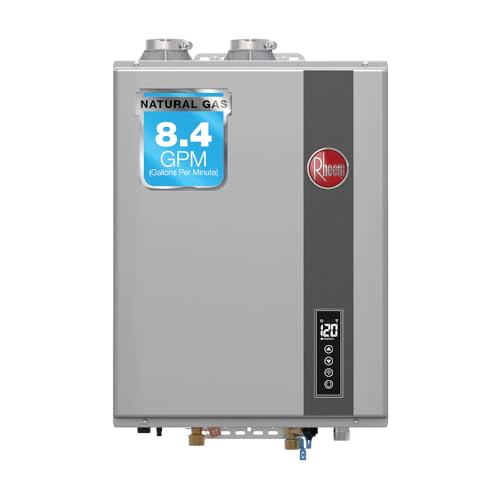
Rheem RTGH 8.4 GPM Natural Gas Indoor
$1,168.99Representative of the condensing gas tankless category's typical UEF near 0.93, the highest UEF among combustion water heaters.
Best for: The common two to three bathroom whole house replacement
Check price on Amazon
GE RealMAX Choice 40 Gallon Natural Gas
$1,051.49Representative of a gas storage tank, illustrating where atmospheric and condensing gas tank UEF figures fall relative to electric and heat pump options.
Best for: A like-for-like swap into an existing masonry or B-vent flue
Check price on Amazon
Rheem PROE50 M2 50 Gallon
$945.99Representative of the electric resistance tank category's typical UEF near 0.92, the baseline most other categories get compared against.
Best for: A straight 50 gallon electric replacement
Check price on AmazonFrequently asked questions
- What is a good UEF for a water heater?
- It depends on the category being shopped. A heat pump water heater with a UEF near 3.5 is excellent for that category, while an atmospheric gas tank with a UEF near 0.60 is typical, not poor, for its own category. Compare a specific model's UEF against its own category's typical range in the table above rather than against a different fuel type's numbers, since the categories are not built on the same heating mechanism.
- Why does a heat pump water heater have a UEF greater than 1?
- Because it moves heat rather than generating it. A heat pump runs a refrigeration cycle that extracts ambient heat from the surrounding air and transfers it into the tank, delivering several times more thermal energy to the water than the electrical energy its compressor consumes. That ratio of delivered heat to consumed energy is exactly what UEF measures, which is why the heat pump category alone posts figures near 3.5 in the comparison table above.
- Does a higher UEF always mean lower operating cost?
- For the same fuel and the same delivered hot water, yes, since input energy needed equals delivered energy divided by UEF. A water heater with a UEF of 0.93 needs roughly 35 percent less input energy than one with a UEF of 0.60 delivering identical hot water. Fuel price still matters between different fuels, so the operating cost chart on this site works the actual dollar comparison across electricity, gas and propane.
- Can I compare the UEF of a tankless unit to a storage tank?
- Only if both units were tested under the same DOE draw pattern, printed on the label next to the UEF figure itself. A tankless unit and a storage tank tested under different draw patterns are not evaluated against the same simulated daily volume, so their UEF numbers, even if similar in size, do not describe an equivalent test and should not be read as directly interchangeable.
- Where do I find UEF on a water heater?
- UEF is printed on the yellow EnergyGuide label required on every residential water heater sold in the United States, usually alongside the estimated yearly operating cost and, for storage tanks, the first hour rating. The label also states which DOE draw pattern the UEF figure was tested against, which is the context needed before comparing that number to a different model.
- Why is an atmospheric gas tank's UEF so much lower than a condensing gas tank's?
- An atmospheric gas tank vents combustion exhaust while it is still hot, carrying a meaningful share of the burner's energy straight up the flue and out of the building. A condensing gas tank cools that exhaust further, in some designs low enough to condense water vapor out of it, recovering additional heat before it leaves the vent, which is why the condensing category posts a UEF near 0.80 versus about 0.60 for atmospheric.
The EnergyGuide label always governs over this chart. These are typical figures by category, useful for comparing fuel types and technologies before shopping, but the tested UEF and draw pattern printed on a specific model's own label are what actually determine its real-world efficiency.