Skip to content
WaterHeaterCalc

Running cost calculator

Hot Water Recirculation Loop Calculator

Quick answer

A recirculation loop trades waiting time for standing heat loss. Eighty feet of insulated 3/4 inch pipe run 24 hours a day loses about 23,000 BTU a day, roughly 2,500 kilowatt hours a year, and a timer that cuts the run to six hours removes three quarters of it.

Your numbers

Results update as you type. Nothing you enter leaves your browser.

Result

Standing loss per day 23,040 BTU Convention
Equivalent per year 2,465 kWh Convention
Or per year 84.1 therm Convention
Saved against running always 0 kWh Convention

Insulate the loop before buying a smarter pump. Insulation on the first stretch of pipe costs a few dollars, needs no electricity, and cuts standing loss by roughly 60 percent, which is more than most timers achieve.

The formula

Loss per day = loss per foot per hour x loop length x hours running. Adjusted for the temperature difference between the pipe and the room.

The per foot loss figures are conventions drawn from published pipe loss tables at roughly a 50 F difference between pipe and room. They are planning figures, not a measurement of your basement. The comparison between insulated and bare pipe is the reliable part: insulation cuts standing loss by roughly 60 percent, and it is the cheapest thing on this page.

The figures above are computed with these exact inputs: Total loop length 80 ft, Pipe size 3/4, Pipe insulated yes, Hours the pump runs 24, Pipe to room difference 50 F.

What this calculator assumes

Some of these are published test procedures or code tables and some are planning conventions. They are not the same kind of number, so each one is labeled.

AssumptionKindWhere it comes from
Standing heat loss per foot of hot water pipeConventionStanding heat loss per foot of hot water pipe, bare and insulated, at roughly a 50 F difference to the room
Residential recirculation loops run at roughly 0ConventionResidential recirculation loops run at roughly 0.5 to 4 gallons per minute. Every pump sold for the job sits inside that band
Btu Per Kwh: 3412.14Published standardExact conversion between the international table BTU and the kilowatt hour

Gear that matches this result

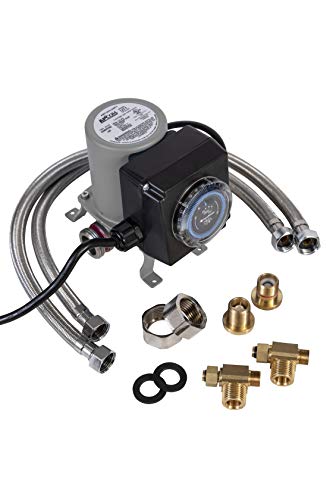
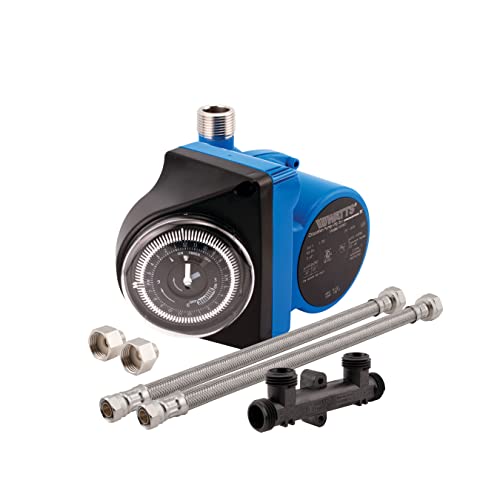
Every card below is in the page source. The calculator re-ranks them against your numbers and marks anything that falls short of what you just calculated.

Frequently asked questions

Does a recirculation pump waste energy?
Yes, and that is the honest trade. Keeping hot water standing in the loop means the pipe loses heat continuously, which on 80 feet of insulated 3/4 inch pipe is on the order of 2,500 kilowatt hours a year if the pump runs constantly. What you buy with it is hot water at the far tap immediately instead of after a two minute wait.
Should I use a timer or a thermostat on a recirculation pump?
Both, ideally, and most kits include both. A timer stops the loop running overnight and through the working day, which is where most of the waste is. A thermostat stops the pump once the loop is up to temperature rather than circulating continuously. Together they typically cut standing loss by three quarters against running the pump all day.
Do I need a dedicated return line?
No. A dedicated return line is the better installation, but a retrofit kit uses a crossover valve under the furthest fixture and returns hot water through the cold line instead. That works and it is far cheaper, at the cost of briefly warm water at the cold tap. On new construction, run the dedicated return.
Is insulating the pipe worth it?
It is the single best value item in this whole subject. Foam sleeve for the first six feet off the heater costs less than ten dollars and cuts the fastest heat loss on the system. Insulating the whole recirculation loop roughly halves its standing loss, which saves more than most of the smart controls and needs nothing switched on.

Researched guidance, not professional advice. These results are planning figures from published test procedures, code tables and manufacturer specifications, and they do not replace a sizing done by the person who will sign the permit. A water heater is a pressure vessel: never cap, plug or remove the temperature and pressure relief valve, and replace one that will not open when the test lever is lifted. Gas line, flue and vent work belongs to a licensed plumber or gas fitter, because improper venting produces carbon monoxide. Water at 140 F scalds a child in seconds. Turn off the breaker before touching an element, and never energise an element that is not submerged.