Elements
Water Heater Element Wattage Chart
Researched from the DOE test procedures, NFPA 54 and NEC code tables, and manufacturer specifications. Updated .
Quick answer
A water heater element's wattage rating determines three things at once: how much current it draws, how fast it recovers hot water, and, if it is ever run at a lower voltage than it was built for, how much less power it actually delivers. All three come from the same two relationships, Ohm's law and the heat equation, applied to a fixed physical resistance built into the element itself.
This chart works those relationships for the common residential wattages, at both a 240 volt supply and a 120 volt supply, and the recovery rate calculator runs the same recovery math for a rating or a temperature rise not listed here.
The wattage stamped on an element is a fixed physical property of how it was wound, not something the installer sets, but the actual power it delivers on a given day depends on the supply voltage it is fed, which is why the same element in two different services, one at a clean 240 volts and one sagging closer to 220, delivers measurably different recovery even though nothing about the element itself has changed.
How much current and resistance does each element have?
Resistance is fixed by how the element is built and does not change with voltage; wattage and current do change with voltage, because power equals current times voltage, and current equals voltage divided by resistance. At a 240 volt supply, current is watts divided by 240, and resistance is 240 squared divided by watts.
| Element rating (240 V) | Resistance | Current at 240 V | Power at 120 V | Current at 120 V | Recovery at 90 F rise |
|---|---|---|---|---|---|
| 1500 W | 38.4 ohms | 6.3 A | 375 W | 3.1 A | 6.8 GPH |
| 2000 W | 28.8 ohms | 8.3 A | 500 W | 4.2 A | 9.1 GPH |
| 2500 W | 23.0 ohms | 10.4 A | 625 W | 5.2 A | 11.4 GPH |
| 3000 W | 19.2 ohms | 12.5 A | 750 W | 6.3 A | 13.7 GPH |
| 3800 W | 15.2 ohms | 15.8 A | 950 W | 7.9 A | 17.3 GPH |
| 4500 W | 12.8 ohms | 18.8 A | 1125 W | 9.4 A | 20.5 GPH |
| 5500 W | 10.5 ohms | 22.9 A | 1375 W | 11.5 A | 25.0 GPH |
| 6000 W | 9.6 ohms | 25.0 A | 1500 W | 12.5 A | 27.3 GPH |
Published standard Source: Resistance R = V^2 / W at 240 V. Current I = W / V at each voltage. Power at 120 V = V^2 / R, using the resistance derived from the 240 V rating. Recovery GPH = (kW x 3,412) / (8.33 x 90), at 8.33 lb per gallon and 3,412 BTU per kWh.. Wiring a 240 volt element to a 120 volt supply does not change its resistance; it changes the power delivered, since power falls with the square of the voltage.
Why does a small drop in voltage matter more than it seems?
Because power scales with the square of voltage, not with voltage directly. A supply running at 220 volts instead of a clean 240 delivers only about 84 percent of an element's rated wattage, a bigger loss than the roughly 8 percent voltage drop itself suggests, since a 0.92 voltage ratio squared works out to about 0.84. A weak or undersized service, a long thin feeder run, or a house pulling heavy loads elsewhere at the same time can all shave real recovery performance off an element that is otherwise correctly rated and wired, without ever tripping a breaker or showing an obvious fault.
How does recovery rate change at a smaller temperature rise?
Recovery rate depends on the temperature rise the element has to produce, not just its wattage; the same element recovers more gallons per hour through a smaller rise, since less heat energy is needed per gallon.
| Element rating | 60 F rise | 70 F rise | 90 F rise |
|---|---|---|---|
| 1500 W | 10.2 GPH | 8.8 GPH | 6.8 GPH |
| 2000 W | 13.7 GPH | 11.7 GPH | 9.1 GPH |
| 2500 W | 17.1 GPH | 14.6 GPH | 11.4 GPH |
| 3000 W | 20.5 GPH | 17.6 GPH | 13.7 GPH |
| 3800 W | 25.9 GPH | 22.2 GPH | 17.3 GPH |
| 4500 W | 30.7 GPH | 26.3 GPH | 20.5 GPH |
| 5500 W | 37.5 GPH | 32.2 GPH | 25.0 GPH |
| 6000 W | 41.0 GPH | 35.1 GPH | 27.3 GPH |
Published standard Source: GPH = (kW x 3,412) / (8.33 x temperature rise), using 8.33 lb per gallon and 3,412 BTU per kWh, evaluated at each listed rise..
Why does only one element run at a time?
A standard residential electric tank with two elements is wired non-simultaneously: the upper thermostat controls a switching contact that gives the upper element priority, and the lower element only receives power once the upper thermostat is satisfied and that contact hands control down to the lower thermostat. The two elements are never both drawing current at once under normal operation. That single fact is also why the breaker and wire for a two-element tank are sized to whichever single element is largest, not to the sum of both elements' wattage, since the circuit never has to carry both loads simultaneously.
This is also why recovering the whole tank from cold takes longer than the single-element recovery figures in the tables above might suggest: the upper element first satisfies only the top portion of the tank near its own thermostat, then hands off, and the lower element works through the remaining, larger volume on its own. The two stages add together rather than running in parallel, which any recovery-time expectation for a full cold tank should account for.
What breaker and wire does a specific element wattage need?
Because only one element energizes at a time, the water heater's circuit is sized to the single largest element wattage installed, using the same NEC 422.13 continuous load method as the breaker and wire chart on this site: draw is watts divided by 240, design load is draw times 1.25, and the breaker is the next standard size at or above that design load.
| Element rating | Draw at 240 V | Design load (125%) | Breaker | Copper conductor |
|---|---|---|---|---|
| 1500 W | 6.3 A | 7.8 A | 15 A | 14 AWG |
| 2000 W | 8.3 A | 10.4 A | 15 A | 14 AWG |
| 2500 W | 10.4 A | 13.0 A | 15 A | 14 AWG |
| 3000 W | 12.5 A | 15.6 A | 20 A | 12 AWG |
| 3800 W | 15.8 A | 19.8 A | 20 A | 12 AWG |
| 4500 W | 18.8 A | 23.4 A | 25 A | 10 AWG |
| 5500 W | 22.9 A | 28.6 A | 30 A | 10 AWG |
| 6000 W | 25.0 A | 31.3 A | 35 A | 8 AWG |
Published standard Source: NEC 422.13 continuous load rule (125 percent of nameplate draw), NEC Table 310.16 75 C copper ampacity, and NEC 240.4(D) small conductor overcurrent limits, applied to a single element circuit.. See the water heater breaker and wire chart for the same math worked at coarser kilowatt increments and for larger tankless ratings.
Does the thermostat setpoint change which recovery figure applies?
Yes, indirectly. The recovery tables above are built around a specific temperature rise, the gap between incoming cold water and the tank's target output temperature, not around a fixed setpoint number by itself. A tank set to 120 F drawing from 50 F groundwater is working a 70 F rise; the same tank set to 140 F on the same incoming water is working a 90 F rise, and needs noticeably more recovery time per gallon for that reason alone, independent of anything about the element itself. Reading a manufacturer's published recovery rate without checking what incoming water temperature and setpoint it assumes is a common source of a real-world recovery rate that looks slower than the spec sheet promised.
Can I install a higher wattage element in my tank?
Only if two separate limits both allow it: the tank manufacturer's maximum rated element wattage for that model, printed on the tank's data plate, and the existing circuit's breaker and wire capacity from the table above. A higher wattage element draws more current at the same 240 volts, and installing one beyond either limit means either exceeding what the tank's thermostat and wiring were built for, or overloading a breaker and wire sized for the smaller element that was removed.
Turn the breaker off and verify it is dead with a meter before touching an element. Never energize an element that is not fully submerged in water; a dry element reaches destructive temperatures within seconds of power being applied.
Elements and the tool to install them
Match a replacement element's wattage and thread pattern to the one being removed; a different wattage changes the breaker and wire requirement covered on the breaker chart.

Camco 4500W 240V Foldback Element
$12.85A commonly stocked screw-in element available across the standard residential wattages shown below.
Best for: Hard water, where elements scale and burn out
Check price on Amazon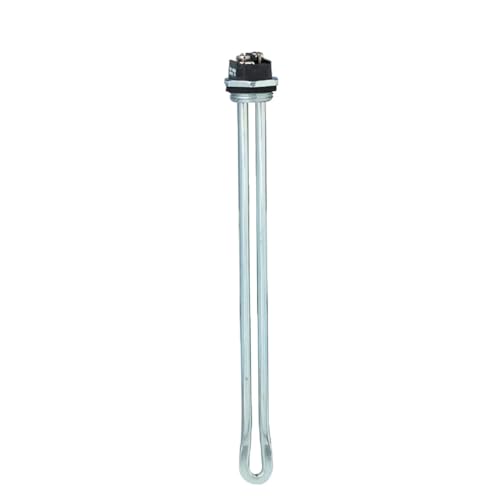
Reliance 4500W 240V Screw-In Element
$12.92A flange-style element for tanks that use a bolted flange mount rather than a screw-in element.
Best for: A straightforward element replacement
Check price on Amazon
Reliance Electric Water Heater Repair Pack
$40.02A combined element and thermostat kit for a job that is replacing both at once rather than the element alone.
Best for: Diagnosing a no-hot-water electric tank
Check price on Amazon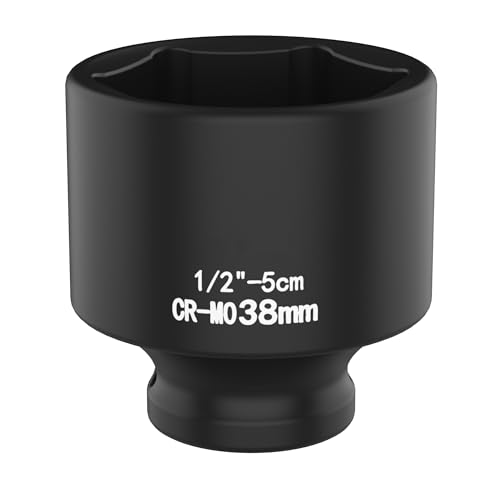
Timsec 1-1/2 in Element Socket, 1/2 in Drive
$13.99An element wrench sized for the hex on a standard screw-in element, needed to break the old one loose without rounding it off.
Best for: Any residential element replacement
Check price on AmazonFrequently asked questions
- How many amps does a 4,500 watt water heater element draw?
- At a 240 volt supply, a 4,500 watt element draws 18.75 amps, calculated from current equals watts divided by volts. That draw is what feeds into the NEC 422.13 continuous load calculation, which adds a 25 percent margin and lands on a 25 amp breaker for that element.
- Can I run a 240 volt water heater element on 120 volts?
- Physically, yes, but it only delivers a quarter of its rated wattage, since power falls with the square of the voltage. A 4,500 watt element wired to 120 volts produces about 1,125 watts, which roughly quadruples its recovery time compared to running it at its rated 240 volts.
- Do both elements in an electric water heater run at the same time?
- No. A standard residential tank wires its two elements non-simultaneously, giving the upper thermostat priority through a switching contact. The lower element only receives power once the upper thermostat is satisfied. This is also why the circuit is sized to the larger single element, not to both elements added together.
- What is the resistance of a water heater element?
- It varies by wattage, since resistance equals voltage squared divided by watts and is fixed by the element's construction. A 4,500 watt element rated at 240 volts measures about 12.8 ohms, while a 1,500 watt element measures about 38.4 ohms; a lower wattage element always has higher resistance at the same rated voltage.
- How much faster does a 5,500 watt element recover than a 4,500 watt element?
- At a 90 F temperature rise, a 5,500 watt element recovers about 25.0 gallons per hour against about 20.5 gallons per hour for a 4,500 watt element, roughly 22 percent faster. Both figures come from the same GPH formula applied at each element's rated wattage.
- Can I replace a 3,800 watt element with a 4,500 watt element?
- Only if the tank's manufacturer rates it for a 4,500 watt element and the existing breaker and wire already meet the 25 amp, 10 AWG requirement that rating needs. A 3,800 watt circuit is commonly wired at 20 amps on 12 AWG, which does not cover the higher draw of a 4,500 watt element without upgrading the circuit.
A replacement element has to clear two limits at once: the tank's own maximum rating and the circuit's breaker and wire capacity. Turn the breaker off and confirm it is dead before starting, and never energize an element that is not fully submerged in water.