Pressure & Expansion
Water Heater Pressure Too High: What to Do
Researched from the DOE test procedures, NFPA 54 and NEC code tables, and manufacturer specifications. Updated .
Quick answer
High water pressure is one of the few water heater problems that is fully diagnosable with a ten dollar gauge and no other tools. Static pressure, meaning the pressure in your home plumbing with every fixture closed and no water running anywhere, is the baseline number everything else in a pressure diagnosis is measured against. Once you know static pressure, you can tell whether a dripping relief valve, a banging pipe, or a short-lived faucet cartridge traces back to supply pressure that is simply too high for the plumbing and appliances in the house, or to something else entirely.
This page covers how to measure static pressure correctly, what counts as normal, what a pressure-reducing valve does and does not solve, and why thermal expansion is a separate problem that stacks on top of static pressure rather than replacing it. The two are often confused, and treating a static-pressure problem with only an expansion tank, or a thermal-expansion problem with only a PRV, leaves part of the original symptom unresolved.
What is static water pressure and how do I measure it?
Static water pressure is the pressure in your home plumbing at rest, meaning every faucet, valve, and appliance in the house is closed and no water is flowing anywhere. It is measured with a simple screw-on gauge threaded onto an outdoor hose bibb, read after confirming nothing in the house is drawing water. Static pressure is the number to use for every pressure diagnosis in this niche, because pressure measured while water is flowing, called dynamic or working pressure, reads lower and does not represent the baseline the T&P valve and every fixture in the house actually sit under most of the time.
What counts as normal water pressure?
| Static pressure | Assessment | Typical action |
|---|---|---|
| Below 40 psi | Low, may affect fixture performance and upper floors | Usually a supply-side issue, not a water heater issue |
| 40 to 60 psi | Normal residential range | No action needed on pressure alone |
| 60 to 80 psi | Elevated but within many fixture pressure ratings | Monitor; confirm fixture and appliance pressure ratings |
| Above 80 psi | Above the range most fixtures, appliances, and codes allow | Pressure-reducing valve fitted by a licensed plumber |
Published standard Source: Common residential plumbing code maximum of 80 psi at the point of use, and typical manufacturer fixture and appliance pressure ratings.. Local code maximums vary by jurisdiction; some set the ceiling lower than 80 psi. Check local code where you live for the exact limit.
What does a pressure-reducing valve actually do?
A pressure-reducing valve, commonly abbreviated PRV, is a mechanical valve installed on the main supply line, usually right after the water meter, that reduces incoming municipal or well pressure down to a set, adjustable output pressure regardless of how high the source pressure runs. It is a plumbing fitting installed by a licensed plumber, not a water heater part, and it protects every fixture and appliance in the house from source pressure that is too high, not just the water heater.
A PRV solves high static pressure at its source. It does not solve thermal expansion. In fact, installing a PRV is one of the most common ways a home becomes a closed system in the first place, since a PRV includes a check mechanism that prevents water from flowing back toward the main once it passes through. That is precisely why an expansion tank is so often recommended alongside a newly installed PRV: the PRV closes the system at the same time it fixes the static pressure problem, and closing the system reintroduces the thermal expansion problem that an expansion tank exists to solve.
How does thermal expansion stack on top of static pressure?
Static pressure and thermal expansion are two separate contributors to the pressure a T&P valve sees, and they add together rather than substitute for each other. Static pressure is the baseline the system sits at with the heater cold. As stored water heats toward its setpoint, it expands, and in a closed system that expansion adds an additional pressure rise on top of whatever the static baseline already was. A T&P valve rated to open at roughly 150 psi has to absorb both numbers combined.
This is why a home already running static pressure at 75 psi has far less margin before a heating cycle pushes the valve open than a home running a normal 45 psi, even with an identical expansion tank fitted to both. If static pressure is already close to the valve rated setting, an expansion tank has essentially no headroom left to work with, and a pressure-reducing valve is the only fix that actually restores margin. Address static pressure first, then confirm whether thermal expansion alone still needs an expansion tank once the baseline is normal.
If static pressure is already at or near the T&P valve rated setting, an expansion tank cannot fix that on its own. A pressure-reducing valve fitted by a licensed plumber is the correct next step, not a bigger expansion tank.
What other symptoms point to high static pressure?
High static pressure rarely announces itself only through the T&P valve. Watch for faucet and shower cartridges wearing out faster than their expected lifespan, a toilet fill valve that runs intermittently without being used, banging or hammering in the pipes when a valve closes quickly, and a washing machine or dishwasher inlet hose failing early. None of these symptoms are proof on their own, but several appearing together alongside a dripping T&P valve is a strong signal to measure static pressure before replacing any single part.
Tools and parts for a pressure diagnosis
None of these solve high static pressure on their own beyond the expansion tank, which only helps once static pressure itself is within a normal range.

Amtrol ST-5 2 Gallon
$77.99A correctly sized expansion tank for a standard 40 to 50 gallon heater, useful once static pressure is confirmed normal and thermal expansion is the remaining variable.
Best for: Anyone who wants the name plumbers recognise
Check price on Amazon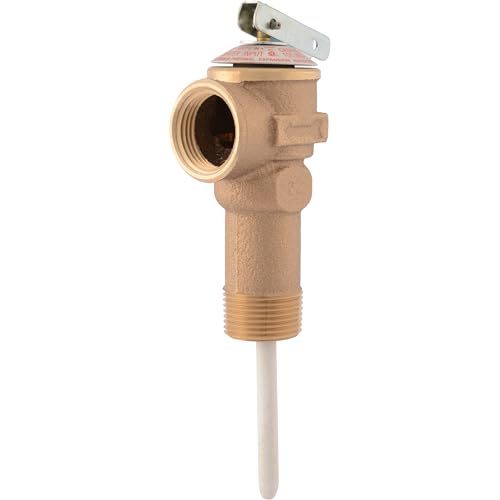
Cash Acme NCLX-5L 3/4 in T&P Valve
$25.98A standard replacement T&P valve, worth having on hand once a pressure diagnosis points to a failed valve rather than a pressure problem.
Best for: A direct replacement on most residential tanks
Check price on AmazonFrequently asked questions
- How do I check my home water pressure?
- Thread a simple screw-on pressure gauge onto an outdoor hose bibb, confirm every other fixture, valve, and appliance in the house is closed and not running, then read the gauge. This is static pressure, the baseline number used for diagnosing relief valve drips, fixture wear, and expansion tank sizing.
- What is normal water pressure for a house?
- Normal residential static water pressure runs approximately 40 to 60 psi, measured at a hose bibb with no fixtures running. Pressure above roughly 80 psi exceeds most residential plumbing code maximums and the pressure rating of many fixtures and appliances.
- What is a pressure-reducing valve and do I need one?
- A pressure-reducing valve, or PRV, is a mechanical valve installed on the main supply line that reduces incoming pressure to a set output regardless of source pressure. If static pressure measured at a hose bibb runs above about 80 psi, a PRV fitted by a licensed plumber is the standard fix.
- Can high water pressure cause my water heater relief valve to drip?
- Yes. If static supply pressure is already close to the T&P valve rated setting, commonly around 150 psi, before the heater even fires, there is very little margin left once thermal expansion adds to it during a heating cycle. An expansion tank alone cannot fully solve pressure that is already too high at the source.
- Does installing a pressure-reducing valve mean I need an expansion tank too?
- Often, yes. A PRV includes a check mechanism that prevents backflow toward the main, which closes the system even if it was open before. A newly closed system needs an expansion tank to absorb thermal expansion, so the two upgrades are commonly installed together.
- Why does my water pressure seem fine but my relief valve still drips?
- Static pressure being normal does not rule out thermal expansion. If the system is closed by a check valve or PRV upstream and there is no correctly pre-charged expansion tank, expansion during heating can still push pressure past the valve threshold even from a normal static baseline.
Measure static pressure before buying any part. A gauge and a hose bibb tell you within minutes whether the fix is an expansion tank, a pressure-reducing valve, or both, and guessing wrong wastes a part and leaves the underlying pressure problem exactly where it was.