Tankless
Indoor vs Outdoor Tankless Water Heater
Researched from the DOE test procedures, NFPA 54 and NEC code tables, and manufacturer specifications. Updated .
Quick answer
Every gas tankless water heater needs a place to exhaust combustion gas and a place to draw combustion air, and where the unit is mounted changes how that gets solved. An indoor unit sits inside a conditioned or semi-conditioned space and vents out through a wall or roof in PVC, CPVC or stainless, depending on whether it condenses. An outdoor unit sits directly on an exterior wall and exhausts right where it stands, with no vent run at all.
The mounting decision is really a climate and space decision more than a preference, and it changes what the unit needs from the location around it just as much as the atmospheric-versus-power-vent choice does for a storage tank.
What does mounting location actually change on a tankless unit?
The core heating technology, condensing or non-condensing, is independent of indoor versus outdoor mounting, both combinations exist. What changes with location is venting need and weather exposure.
| Trait | Indoor tankless | Outdoor tankless |
|---|---|---|
| Venting required | Yes, PVC, CPVC or stainless run to outside | None, exhausts directly at the unit |
| Freeze exposure | Protected inside the building envelope | Directly exposed to outdoor temperatures |
| Sold for which climates | Any climate | Climates that do not freeze hard, per manufacturer guidance |
| Interior space used | A mechanical closet, garage wall or basement | None, mounted on an exterior wall |
| Example condensing unit | Rheem RTGH 8.4 GPM Natural Gas Indoor, 157,000 BTU | Takagi T-H3S-OS-N, condensing, mounted outdoor |
| Example non-condensing unit | Rinnai RE140iN, indoor, non-condensing | Rheem RTG 8.4 GPM Natural Gas Outdoor, non-condensing |
Published standard Source: Manufacturer specification sheets for Rheem RTG and RTGH, Rinnai RE140iN and Takagi T-H3S-OS-N; manufacturer climate suitability guidance for outdoor mounted units.. BTU input and condensing status are manufacturer published specifications. Climate suitability for outdoor units is manufacturer guidance, confirm it against the specific model and installation location.
When is an indoor tankless unit the right call?
An indoor unit is the right call anywhere winters get cold enough to freeze exposed plumbing, since it sits protected inside the building rather than directly exposed to outdoor temperatures. It is also the natural choice where there is already a mechanical closet, garage wall or basement space built for it, and a vent path to the outside is not a hard problem to run.
It is a weaker choice where running that vent path is genuinely difficult, through multiple floors, around framing, or a long horizontal run beyond what the manufacturer allows for the model in question, since that venting work adds real cost and complexity that an outdoor unit skips entirely.
When is an outdoor tankless unit the right call?
An outdoor unit is the right call in a climate with mild winters, where the manufacturer's freeze exposure guidance for that model is met, and where there is a suitable exterior wall to mount it on. Removing the vent run entirely is the biggest single simplification available on a tankless retrofit, which is why outdoor mounting is common in warm climate regions even on otherwise identical equipment lines.
It is the wrong call anywhere winters get genuinely cold, since these units are sold specifically for climates that do not freeze hard, and it is also the wrong call where no exterior wall location meets the clearances the manufacturer requires around the unit for combustion air and exhaust.
What does each mounting choice cost you later?
An outdoor unit's later cost is tied to weather exposure over years: sun, rain and temperature swings act directly on a component that an indoor unit never sees. Any freeze protection features built into the unit are a factor of its own reliability, not a substitute for staying within the climate the manufacturer actually sells it for.
An indoor unit's later cost is mostly about the vent itself: the termination point and its required clearances to windows, doors and other openings need to stay as installed, and anyone remodeling near that termination needs to know it is there. Neither mounting location changes how often the unit needs to be descaled, which is a water hardness question covered by our descaling interval calculator, not a location one.
One pair from each side
A non-condensing and a condensing option for outdoor mounting, plus their indoor equivalents for a cold-climate retrofit.
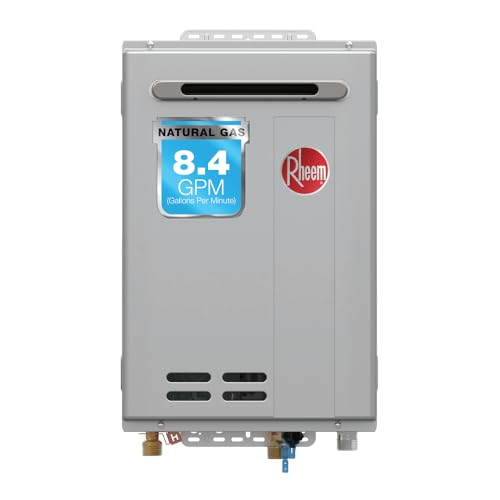
Rheem RTG 8.4 GPM Natural Gas Outdoor
$964.10An 8.4 GPM outdoor unit reviewed in full at the <a href="/reviews/rheem-rtg-84-outdoor-review">Rheem RTG 8.4 outdoor review</a>, no flue to run at all.
Best for: Warm climate retrofits where running a vent is the problem
Check price on Amazon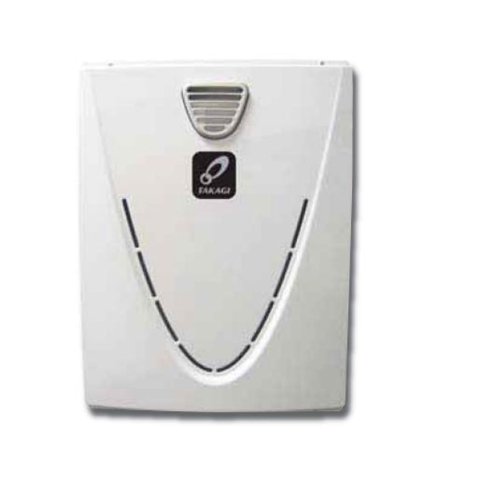
Takagi T-H3S-OS-N Condensing Outdoor
$1,355.95A less common pairing, a condensing unit built for outdoor mounting, reviewed at the <a href="/reviews/takagi-th3s-review">Takagi T-H3S review</a>.
Best for: Warm climates that still want a high efficiency unit
Check price on Amazon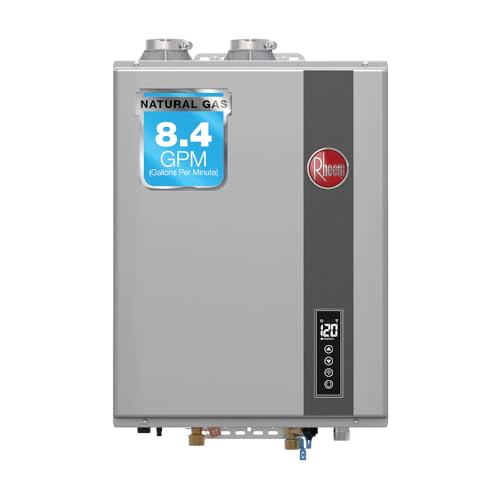
Rheem RTGH 8.4 GPM Natural Gas Indoor
$1,168.99The indoor condensing equivalent at 157,000 BTU, the common size for a two to three bathroom house.
Best for: The common two to three bathroom whole house replacement
Check price on Amazon
Rinnai RE140iN Natural Gas
$795.69A non-condensing indoor unit for a house replacing an existing tankless with the same category III venting already in place.
Best for: Replacing an existing non-condensing tankless
Check price on AmazonFrequently asked questions
- Can an outdoor tankless water heater be installed in a cold climate?
- Not as a general practice. Outdoor tankless units, including models like the Rheem RTG 8.4 GPM Natural Gas Outdoor, are sold by their manufacturers for climates that do not freeze hard, since the unit sits fully exposed to outdoor temperatures with no building envelope protecting it. A cold climate installation should use an indoor unit, protected inside a conditioned or semi-conditioned space instead.
- Does an outdoor tankless unit need any venting at all?
- No, that is the main advantage of outdoor mounting. The unit exhausts combustion gas directly where it stands on the exterior wall, with no PVC, CPVC or stainless vent run required to get exhaust to the outside, since the outside is already right there. This is what makes outdoor mounting the largest single installation simplification available on a tankless retrofit.
- Is a condensing tankless water heater always mounted indoors?
- No, condensing and mounting location are independent choices. The Takagi T-H3S-OS-N is a condensing unit built specifically for outdoor mounting, combining condensing efficiency with no vent run required. Most condensing units on the market are sold as indoor models, like the Rheem RTGH series, but condensing outdoor units exist for climates where that combination makes sense.
- What happens if an outdoor tankless unit freezes?
- A tankless unit that freezes with water still in its heat exchanger can crack internal components, which is why manufacturers limit outdoor models to climates that do not freeze hard rather than relying solely on built in freeze protection features. Anyone in a marginal climate should read the specific manufacturer's freeze protection guidance for their model before choosing outdoor mounting over an indoor unit.
- Why would someone choose an indoor tankless unit if outdoor is cheaper to install?
- Climate is the deciding factor, not preference. Outdoor units are only sold for climates that do not freeze hard, so anywhere winters get cold enough to threaten exposed plumbing, an indoor unit like the Rheem RTGH 8.4 GPM Natural Gas Indoor is the only sound choice regardless of the installation savings an outdoor unit would otherwise offer.
- Do indoor and outdoor tankless units need descaling on the same schedule?
- Descaling frequency depends on water hardness and usage, not on whether the unit is mounted indoors or outdoors, since scale forms inside the heat exchanger from mineral content in the water passing through it either way. Both mounting types benefit from the same annual descale most tankless manufacturers recommend, which our <a href="/calculators/descaling-interval-calculator">descaling interval calculator</a> can help schedule.
Gas line sizing and any vent work on an indoor unit belong to a licensed plumber or gas fitter. Backdrafting and carbon monoxide risk apply to any gas appliance vent, tankless included, and they are invisible while they happen. Confirm gas line capacity with our gas line size calculator before assuming an existing line can feed a larger unit, and never treat vent termination clearances as optional.