Tankless
Tankless GPM by Temperature Rise Chart
Researched from the DOE test procedures, NFPA 54 and NEC code tables, and manufacturer specifications. Updated .
Quick answer
Every tankless water heater's flow rate is a function of two things multiplied together: how much heat it can put into the water, and how far that water needs to rise in temperature. A unit rated for 8 GPM in a warm climate can fall to a third of that number in a cold climate, using the identical hardware, because the temperature rise more than doubles. This is the single most misunderstood number in tankless shopping.
The tables below work out gallons per minute for common gas and electric tankless input ratings across a realistic range of temperature rises. The tankless sizing calculator and temperature rise calculator run this same math for a specific groundwater temperature and target output.
Why does a tankless GPM rating change with temperature rise?
A tankless unit has a fixed maximum heat output, whether measured in BTU per hour for gas or kilowatts for electric. Delivering more gallons per minute at that fixed output means spreading the same heat across more water, which raises each gallon a smaller number of degrees. The relation is BTU per hour equals 500 times GPM times the temperature rise in Fahrenheit degrees, where 500 is a standard combined constant for water's weight and minutes per hour, so for a fixed BTU output, GPM and temperature rise move in opposite directions.
What GPM does a gas tankless unit deliver at each rise?
| Gas input | 35 F rise | 45 F rise | 55 F rise | 65 F rise | 75 F rise | 85 F rise |
|---|---|---|---|---|---|---|
| 120,000 BTU | 4.80 GPM | 3.73 GPM | 3.05 GPM | 2.58 GPM | 2.24 GPM | 1.98 GPM |
| 150,000 BTU | 6.00 GPM | 4.67 GPM | 3.82 GPM | 3.23 GPM | 2.80 GPM | 2.47 GPM |
| 180,000 BTU | 7.20 GPM | 5.60 GPM | 4.58 GPM | 3.88 GPM | 3.36 GPM | 2.96 GPM |
| 199,000 BTU | 7.96 GPM | 6.19 GPM | 5.07 GPM | 4.29 GPM | 3.71 GPM | 3.28 GPM |
Convention Source: Calculated from GPM = (BTU/hr x 70 percent) / (500 x rise). The 70 percent factor is an assumed usable-output planning convention combining thermal efficiency and continuous-duty derating; a manufacturer's published GPM-at-rise curve for a specific model governs.. A unit's actual flow can differ from this estimate because of internal turndown limits and minimum flow activation thresholds not captured by this formula alone.
What GPM does an electric tankless unit deliver at each rise?
| Electric input | 35 F rise | 45 F rise | 55 F rise | 65 F rise | 75 F rise | 85 F rise |
|---|---|---|---|---|---|---|
| 11 kW | 2.14 GPM | 1.67 GPM | 1.36 GPM | 1.15 GPM | 1.00 GPM | 0.88 GPM |
| 18 kW | 3.51 GPM | 2.73 GPM | 2.23 GPM | 1.89 GPM | 1.64 GPM | 1.45 GPM |
| 24 kW | 4.68 GPM | 3.64 GPM | 2.98 GPM | 2.52 GPM | 2.18 GPM | 1.93 GPM |
| 27 kW | 5.26 GPM | 4.09 GPM | 3.35 GPM | 2.83 GPM | 2.46 GPM | 2.17 GPM |
Published standard Source: Calculated from GPM = (kW x 3,412) / (500 x rise). Electric resistance heating converts at close to 100 percent efficiency, so no derating factor is applied.. Most single-unit electric tankless models top out around 27 to 36 kW on a 240 volt residential service; higher whole-house flow needs either a gas unit or multiple electric units staged together.
What temperature rise should I actually plan around?
| Scenario | Typical inlet temperature | Target output | Resulting rise |
|---|---|---|---|
| Warm climate, groundwater fed | 70 F | 105 F | 35 F |
| Moderate climate, average winter | 50 F | 105 F | 55 F |
| Cold climate, winter well or municipal supply | 40 F | 105 F | 65 F |
| Very cold climate or shallow well, higher target | 35 F | 120 F | 85 F |
Convention Source: Illustrative inlet temperature ranges commonly cited for regional groundwater and municipal supply temperatures; an actual site's incoming water temperature should be measured directly.. A single house can see its own inlet temperature swing 20 to 30 F between summer and winter, which alone can cut a tankless unit's usable GPM by a third or more without any change in hardware.
Why do listing titles almost never state the rise?
A headline GPM figure without a stated rise is not dishonest so much as incomplete, since manufacturers typically publish a full GPM-at-rise curve somewhere in the specification sheet, but marketing copy and search listings tend to lead with whichever single number looks most impressive. That number is almost always the flow rate at the smallest realistic rise the unit is rated for, commonly around 35 F, which is also the rise least representative of a cold-climate winter. Checking the full curve, not the headline number, is the only way to know what a unit actually delivers where you live.
How do I size a tankless unit against this chart?
Start from your household's actual peak simultaneous flow demand, in GPM, and your actual incoming water temperature at its coldest point of the year, then find the row in the tables above that clears that flow rate at that rise. The tankless sizing calculator automates this lookup for a specific set of fixtures rather than requiring a manual table read, and it accounts for the fact that showers, dishwashers and clothes washers rarely all specify the same target temperature.
Representative gas and electric units at these ratings
These match the input ratings used in the tables below; confirm a specific model's manufacturer GPM-at-rise chart before buying, since real-world derating varies by unit.
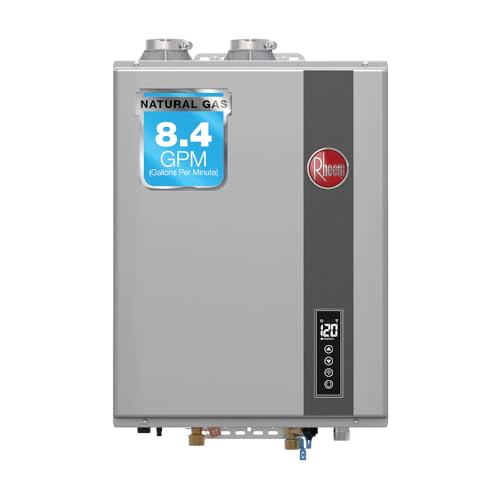
Rheem RTGH 8.4 GPM Natural Gas Indoor
$1,168.99A higher-output natural gas tankless unit representative of the 180,000 to 199,000 BTU rows in the table below.
Best for: The common two to three bathroom whole house replacement
Check price on Amazon
Rinnai RX160iN Condensing
$1,442.70A high-capacity indoor gas tankless unit built for the larger temperature rises a cold climate demands.
Best for: Three bathroom houses in a cold inlet region
Check price on Amazon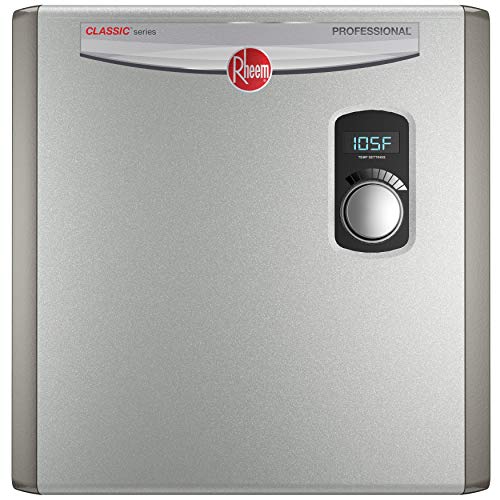
Rheem RTEX-24 24kW
$549.00A 24 kW electric tankless unit representative of the higher electric rows in the table below.
Best for: Houses with service capacity already proven
Check price on Amazon
Stiebel Eltron Tempra 24 Trend 24kW
$521.69Another 24 kW electric tankless model, illustrating the same flow-versus-rise tradeoff on a different platform.
Best for: Cooler inlet climates with service capacity
Check price on AmazonFrequently asked questions
- Why does my tankless water heater deliver less flow in winter?
- Incoming groundwater runs colder in winter, which increases the temperature rise the unit has to achieve for the same target output temperature. Since a tankless unit's maximum GPM falls as temperature rise increases for a fixed BTU or kilowatt input, the identical unit can deliver noticeably less flow on a cold winter day than it does in summer with no hardware change at all.
- What GPM does a 199,000 BTU tankless water heater actually deliver?
- It depends entirely on the temperature rise. At a mild 35 F rise, a 199,000 BTU unit delivers roughly 8.0 GPM using an assumed 70 percent usable-output factor; at a cold-climate 85 F rise, that same unit delivers only about 3.3 GPM. A GPM figure without a stated rise describes neither number specifically.
- Is a higher GPM rating always better for a tankless water heater?
- Only relative to your actual temperature rise and simultaneous fixture demand. A unit oversized for a warm climate's low rise costs more without adding usable capacity, while a unit sized only for that low rise will fall short in winter. Matching GPM to the rise you actually need, using the tankless sizing calculator, matters more than chasing the highest headline number.
- Why do gas tankless units generally out-flow electric tankless units?
- A large gas tankless unit can carry a BTU input rating many times higher than a residential electrical service can support in kilowatts, since natural gas delivers far more raw energy per unit of infrastructure than a household electrical panel typically has spare capacity for. A 199,000 BTU gas unit and a 27 kW electric unit are not comparable in raw heat output, which shows up directly in the GPM tables above.
- What is the formula behind a tankless GPM-at-rise chart?
- The underlying relation is BTU per hour equals 500 times GPM times the temperature rise in Fahrenheit degrees, where 500 combines water's weight of 8.33 pounds per gallon with 60 minutes per hour. Rearranged for GPM, that becomes GPM equals BTU per hour divided by 500 times the rise, adjusted by a usable-output factor for gas units or a near-100-percent factor for electric units.
- Can I trust the single GPM number printed on a tankless water heater's box?
- Treat it as one point on a curve, not the whole specification. Manufacturers publish a full GPM-at-rise table in the installation manual or spec sheet, and the single number on packaging or a listing title is almost always the flow rate at the smallest, most favorable rise the unit supports, not the figure relevant to a cold-climate installation.
Never compare two tankless units by GPM alone. Ask what temperature rise each figure assumes, then compare both units at the rise your own incoming water actually requires at its coldest point of the year, not at whichever rise made the marketing number look best.