Tankless
Best Tankless Water Heaters for Cold Climates
Researched from the DOE test procedures, NFPA 54 and NEC code tables, and manufacturer specifications. Updated .
Quick answer
A tankless water heater has a fixed maximum heat input, measured in BTU/h, and the flow rate it can sustain at any given moment is a direct function of that input divided by how much the incoming water needs to be raised. This is not a marketing detail, it follows from the same relation that governs any heating problem: Q = m x c x dT, energy input equals the mass flow rate times the specific heat of water times the temperature change required.
The practical consequence for cold-climate buyers: the same tankless unit delivers roughly half its rated flow at double the temperature rise. A unit that looks generously sized against a mild-climate 40 F rise can be genuinely undersized against a cold-climate 80 F winter rise, at exactly the season demand is highest. This page exists because the headline GPM number on a listing is measured at a rise the listing usually does not state, and in a cold climate that gap is the difference between a unit that works and one that runs out of hot water on a family's coldest morning.
Run your specific groundwater temperature and target setpoint through the temperature rise calculator before choosing a model by GPM alone.
Why does the same unit deliver less hot water in winter?
Because temperature rise, the difference between incoming water temperature and the target setpoint, is the other half of the equation determining flow. A fixed BTU/h input has to be divided across a bigger temperature gap in winter, when groundwater might enter at 35 to 45 F, than in summer, when it might already be near 65 to 75 F. Doubling the required rise roughly halves the flow the same unit can sustain, a direct consequence of Q = m x c x dT rather than a flaw in any particular model.
| Rise | Flow relative to the unit's rated maximum | When this rise typically occurs |
|---|---|---|
| 35 to 40 F | Near the rated maximum | Warm climate, most of the year |
| 55 to 65 F | Roughly two thirds of the maximum | Moderate climate winter, or warm climate targeting a higher setpoint |
| 75 to 90 F | Roughly half the maximum, or less | Cold climate winter groundwater to a 120 F or higher setpoint |
Published standard Source: The general inverse relation between flow and temperature rise for a fixed heat input follows from Q = m x c x dT; specific flow figures at a given rise come from each manufacturer's published performance curve.. This shows the shape of the relationship, not any specific model's numbers. Always check the manufacturer's own flow-versus-rise curve for the unit you are considering.
What should I actually buy on, if not the GPM number?
Buy on the unit's maximum BTU/h input, then check that input against the manufacturer's published flow-versus-rise curve at your specific winter groundwater temperature and target setpoint. A listing's headline GPM figure with no stated rise is not enough information to size a cold-climate purchase; two units can advertise the same GPM number while one has meaningfully more input capacity in reserve for a large winter rise. The input rating, not the flow rating, is the number that actually predicts cold-climate performance.
How we chose these picks
These picks were compiled from manufacturer published specifications, installation manuals and the consensus of verified owner reviews, ranked here specifically by published BTU/h input rather than by headline advertised GPM. We did not install, test or run any of these units ourselves, and we have not measured any unit's real-world winter flow.
Buying tips for a cold-climate tankless purchase
- Find your coldest groundwater temperature (often available from your regional water utility or a rough climate estimate) and run it through the temperature rise calculator before comparing models.
- Buy input capacity with headroom above your calculated worst-case need, not exactly to it, since simultaneous fixture use compounds the demand.
- If considering an outdoor unit in a cold climate, also read the outdoor tankless page for the freeze-risk tradeoff specifically.
- Recirculation helps perceived wait time at distant fixtures but does not change the unit's maximum flow at a given rise; those are separate problems.
When comparing two units, compare published BTU/h input first, headline GPM second. A larger input reserve is what protects a cold-climate household on the coldest morning of the year, not a bigger number on the front of the box.
The picks, by tier
Every pick below is ranked with cold-climate BTU/h input as the deciding factor, not the headline flow rate on the listing.

Rheem RTG 7.0 GPM Natural Gas Indoor
$653.77A reasonable entry point for a single bathroom or small house in a cold climate, understanding it will deliver noticeably less than its headline GPM at a large winter rise.
Best for: A one or two bathroom house in a warm inlet climate
Check price on Amazon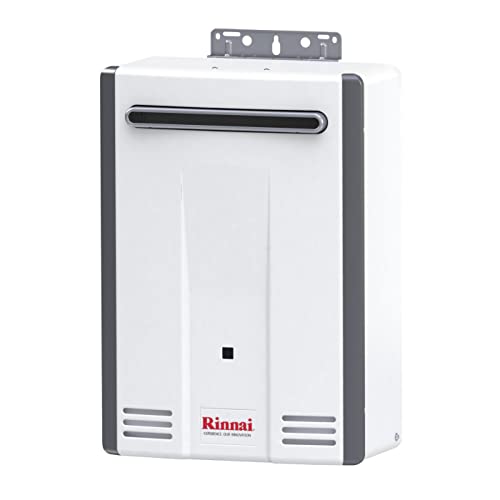
Rinnai V53DeN Natural Gas
$589.00A non-condensing unit with solid published input for its size, a workable starting point for a smaller cold-climate household.
Best for: A single bathroom house or a dedicated fixture group
Check price on Amazon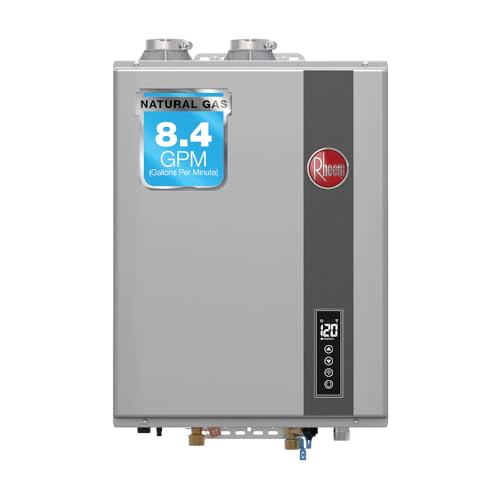
Rheem RTGH 8.4 GPM Natural Gas Indoor
$1,168.99The buy-once pick for most cold-climate homes, with enough input headroom to cover a large winter rise across two fixtures at once.
Best for: The common two to three bathroom whole house replacement
Check price on Amazon
Rinnai RX130iN Condensing
$1,264.20Strong published input plus recirculation readiness, useful where cold-climate distant fixtures also suffer from slow hot water delivery.
Best for: Households that run short, repeated draws
Check price on Amazon
Rheem RTGH 9.0 GPM Natural Gas Indoor
$1,219.99The highest input in the Rheem gas lineup here, sized to hold up under a large winter rise across multiple simultaneous fixtures.
Best for: Cold groundwater regions where the rise eats the flow
Check price on Amazon
Rinnai RX160iN Condensing
$1,442.70The highest published input in this entire lineup, the strongest cold-climate pick for a large household or short-term rental running several bathrooms at once.
Best for: Three bathroom houses in a cold inlet region
Check price on AmazonFrequently asked questions
- Why does my tankless water heater struggle in winter but work fine in summer?
- Because the temperature rise required is much larger in winter, when incoming groundwater might be 35 to 45 F, than in summer, when it might already be 65 to 75 F. A fixed heat input has to cover a bigger gap, which reduces the flow the unit can sustain. This follows from Q = m x c x dT and affects every tankless unit, not a specific defective one.
- What BTU input do I need for a tankless water heater in a cold climate?
- Enough that the manufacturer's published flow-versus-rise curve covers your worst-case winter groundwater temperature at your target setpoint and simultaneous fixture count. There is no single number that fits every household; run your specific groundwater temperature through the temperature rise calculator and compare that requirement against each model's published input rating rather than its headline GPM.
- Should I buy a tankless water heater based on its GPM rating for a cold climate?
- No, not by itself. The GPM figure on most listings does not state the temperature rise it assumes, and that rise is usually a mild one that does not reflect winter groundwater. Buy on the unit's maximum BTU/h input and check it against the manufacturer's flow-versus-rise curve at your actual winter conditions instead.
- How much less flow does a tankless water heater deliver at a high temperature rise?
- As a general relation, doubling the required temperature rise roughly halves the flow a fixed heat input can sustain. A unit performing near its rated maximum GPM at a mild 40 F rise might deliver roughly half that at an 80 F winter rise. Exact figures come from each manufacturer's published performance curve, not this general relation alone.
- Is an outdoor tankless water heater a bad idea in a cold climate?
- Not automatically, but it carries real freeze risk that an indoor unit does not, since freeze-protection heating elements need continuous power to function. In a cold climate with a reliable power grid, outdoor can still work; in a climate with frequent winter outages, indoor mounting removes that specific risk. See the outdoor tankless page for the full tradeoff.
- Do I need a bigger tankless water heater for a cold climate than a warm one?
- Generally yes, for the same household size and fixture count, because the larger winter temperature rise reduces sustainable flow from any given unit. A household in a cold climate needing 6 to 8 gallons per minute at peak simultaneous demand typically needs a higher-input model than the same household would need in a warm climate with a smaller rise.
Buy the input rating, not the box's GPM number. In a cold climate the gap between a mild-rise headline figure and your actual winter performance is the whole ballgame, and the manufacturer's own flow curve is the only honest way to close it.