Tankless
Tankless Water Heater Venting, Explained
Researched from the DOE test procedures, NFPA 54 and NEC code tables, and manufacturer specifications. Updated .
Quick answer
A tankless water heater burns fuel continuously while it runs, at a higher instantaneous input than most storage tank units, and every bit of that combustion exhaust has to leave the building through a venting system engineered specifically for the unit connected to it. Venting is not a generic exhaust pipe. It is a listed system, meaning the vent components are tested and certified together with the specific appliance model they serve, and the manufacturer's installation manual specifies the exact materials, maximum lengths and termination clearances that keep that listing valid.
Getting venting wrong is not a performance problem the way an undersized gas line is. It is a life safety problem, because improperly vented combustion exhaust puts carbon monoxide into a home, and carbon monoxide is colorless, odorless and can be fatal well before anyone notices anything is wrong. This page explains the mechanism behind venting choices so the reasoning is clear; installation and any modification of an existing vent system belongs to a licensed plumber or gas fitter, not to this page.
Why do condensing and non-condensing units need such different vent materials?
A non-condensing tankless unit exhausts flue gas while it is still hot, well above the temperature at which water vapor in the exhaust condenses back into liquid. That flue gas is hot enough, and corrosive enough over time, that only Category III stainless steel vent pipe is rated to handle it safely at the positive pressure these units push it through. Plastic pipe simply is not rated for that combination of heat and pressure, and using it on a non-condensing unit is a certified path to vent failure and combustion gas leaking where it should not.
A condensing unit works differently: a secondary heat exchanger extracts additional heat from the flue gas before it exits, cooling it enough that water vapor in the exhaust does condense, which is also where the unit gets its extra efficiency. Because the exhaust leaving a condensing unit is cool enough, PVC, CPVC or polypropylene vent pipe is rated for it, materials that would fail immediately on a non-condensing unit's hotter exhaust. That condensate itself is mildly acidic and has to be collected and neutralized before it reaches a drain, which is why condensing installations include a condensate neutralizer as standard equipment rather than an accessory.
What is the difference between concentric and two-pipe venting?
Both approaches are sealed combustion, meaning the unit draws its combustion air from outside the building rather than from the room it sits in, which is safer and more efficient than an atmospheric unit pulling combustion air from indoor space. Concentric venting achieves this with a single pipe-within-a-pipe assembly through one wall or roof penetration: exhaust travels out through the inner pipe while fresh combustion air is drawn in through the outer annular space around it, in the same physical opening. Two-pipe venting instead uses two entirely separate pipes, one dedicated to exhaust and one to intake, which can terminate at different points if the installation calls for it.
Concentric venting is generally simpler to install where a single clean penetration is available and the termination location works for both intake and exhaust together. Two-pipe venting offers more routing flexibility when the intake and exhaust need to terminate in different locations, at the cost of two penetrations instead of one. Which is appropriate for a given installation depends on the unit's certification and the specific building layout, decisions that belong to the installing gas fitter.
What actually limits how far a vent run can go?
Every unit's installation manual publishes a maximum equivalent vent length, expressed in feet, that the total vent run cannot exceed while still moving exhaust and, on sealed combustion units, intake air reliably. Straight pipe counts against that budget at something close to its actual length, but every elbow in the run counts for meaningfully more than its physical length, because a bend adds resistance to flow that a straight run of the same length does not. A run with several elbows to route around framing or clear an obstruction can hit its maximum equivalent length with far less physical distance covered than a straight run would.
This is why counting elbows matters just as much as measuring feet of straight pipe when a vent run is being planned, and it is also why substituting more elbows for a straight path someone thought was cleaner can silently push a run past its rated maximum even though the physical footprint looks shorter. Exceeding the manufacturer's maximum equivalent length is not a minor inefficiency; it can prevent the unit from venting reliably at all.
A vent system is listed together with its specific appliance; a generic pipe that happens to fit is not a substitute for a listed vent system. Improper venting, including exceeding the maximum equivalent length or substituting unlisted materials, can put carbon monoxide into the building. Vent installation and modification belong to a licensed plumber or gas fitter.
How do the two vent categories actually compare on paper?
| Factor | Non-condensing (Category III) | Condensing (Category IV) |
|---|---|---|
| Required vent material | Stainless steel, listed Category III vent pipe | PVC, CPVC or polypropylene, per the unit's listing |
| Flue gas condition | Exits hot, above the condensation point | Cooled by a secondary heat exchanger, below the condensation point |
| Condensate handling | Not applicable | Requires collection and neutralization before draining |
| Venting configuration options | Concentric or two-pipe, per unit listing | Concentric or two-pipe, per unit listing |
Published standard Source: ANSI Z21.10.3 appliance venting category definitions (Category III and Category IV) as applied in manufacturer installation manuals for residential tankless gas water heaters.. Always follow the specific unit's own installation manual for exact material listing, maximum equivalent length and termination clearances; this table describes the general category distinction, not a substitute for that manual.
What clearances actually govern where a vent can terminate?
A vent termination cannot simply exit the nearest exterior wall wherever is convenient. Manufacturer installation manuals, working from requirements in the International Fuel Gas Code and similar plumbing and mechanical codes, specify minimum clearances from a vent termination to windows and doors that open, since combustion exhaust exiting near an operable opening can be drawn back indoors. Similar clearances apply to soffits and other openings into the building envelope, to adjacent property lines, to the ground or a walking surface to avoid exposure at head or hand height, and to other vent terminations or air intakes on the same or an adjacent building.
These clearances vary by unit and by local code amendment, which is exactly why they belong in the installation manual and to the professional doing the installation rather than to a general guide. A vent that technically reaches outside is not the same thing as a vent that terminates in a location the manufacturer's listing and local code actually permit.
Vent components, matched to the unit
Vent parts must be listed for the specific unit. These are common accessory pieces referenced by installation manuals; verify compatibility against your unit's own manual before buying.

Rheem RTG20320 Adjustable Concentric Vent Kit
$95.83A concentric vent termination kit for sealed-combustion venting through a single wall or roof penetration, matched to compatible Rheem tankless models.
Best for: A sealed combustion install through a wall
Check price on Amazon
Rheem RTG20270D 36 in Concentric Vent Pipe
$62.53Straight vent pipe sections for extending a run within the maximum equivalent length specified by the unit's installation manual.
Best for: Extending an existing concentric run
Check price on Amazon
Rheem RTG20321 45 Degree Elbow Vent Kit
$48.10A vent elbow for routing around framing, each one consuming a portion of the total equivalent vent length budget.
Best for: Routing a vent past an obstruction
Check price on Amazon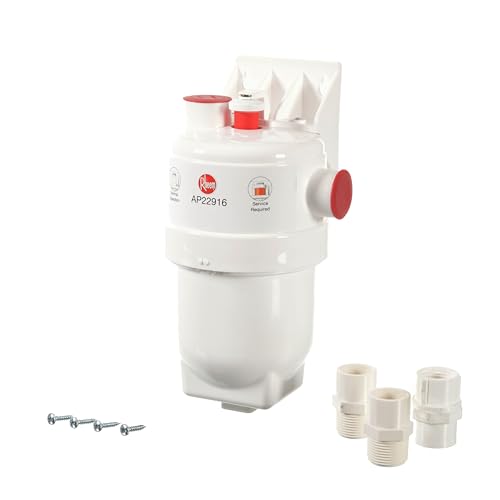
Rheem Axiom External Neutralizer RTG20329AR
$149.85A condensate neutralizer for a condensing unit, treating the mildly acidic condensate produced by PVC-vented systems before it reaches a drain.
Best for: A Rheem condensing tankless that must pass inspection
Check price on AmazonFrequently asked questions
- Can I use PVC pipe to vent a non-condensing tankless water heater?
- No. A non-condensing unit exhausts flue gas while it is still hot, above the temperature PVC is rated for, and only Category III stainless steel vent pipe is listed for that combination of heat and positive pressure. Using PVC on a non-condensing unit is not a listed configuration and risks vent failure and combustion gas escaping where it should not.
- What is the difference between concentric and two-pipe tankless venting?
- Concentric venting uses a single pipe-within-a-pipe assembly through one wall or roof penetration, with exhaust exiting through the inner pipe and intake air drawn in around it. Two-pipe venting uses two entirely separate pipes for intake and exhaust, offering more routing flexibility at the cost of two penetrations instead of one. Both are sealed combustion configurations.
- Why does an elbow in a vent run matter more than its physical length?
- Every elbow adds resistance to flow that a straight run of the same physical length does not, so manufacturers count each elbow against the total maximum equivalent vent length at more than its actual measured length. A run with several elbows can hit its maximum equivalent length with far less physical distance covered than a straight run would.
- What happens if a tankless vent run exceeds the maximum equivalent length?
- Exceeding the manufacturer's specified maximum equivalent length can prevent the unit from venting exhaust and drawing intake air reliably, which is a safety issue rather than a minor inefficiency. It can also void the unit's warranty, since the vent system is only rated as listed up to that specific length.
- Does a condensing tankless unit need anything my non-condensing unit does not?
- Yes, a condensate neutralizer. A condensing unit cools flue gas enough that water vapor in it condenses, and that condensate is mildly acidic, so it has to be collected and neutralized before draining. A non-condensing unit produces no such condensate and has no equivalent requirement.
- Can I install my own tankless vent system?
- Vent installation and any modification of an existing system should be done by a licensed plumber or gas fitter. Vent components are listed together with the specific appliance model, a generic pipe that happens to fit is not a substitute for that listed system, and improper venting can allow carbon monoxide into the building.
A vent system is only safe when every component in it is listed for the specific appliance, in the exact configuration and length the installation manual specifies. Vent installation, modification and any question about an existing run belong to a licensed plumber or gas fitter, never to a generic pipe that happens to fit.