Efficiency
How to Set Water Heater Temperature
Researched from the DOE test procedures, NFPA 54 and NEC code tables, and manufacturer specifications. Updated .
Quick answer
A water heater's temperature setting is really two separate numbers that only sometimes agree with each other: whatever a dial or thermostat is turned to, and what actually comes out of a tap once heat loss through the tank and the pipes has had its say. Confusing the two is common, since the dial is the only part of the system most owners ever touch, but the dial on both electric and gas tanks is a control input, not a display of the water's actual temperature.
There is also a genuine tradeoff behind whatever number gets chosen, between scald risk at the tap and the growth of Legionella bacteria inside a tank that runs too cool for too long. This guide covers how to set the temperature on both fuel types, how to actually measure the result, and lays out that tradeoff honestly rather than picking a single number and presenting it as the only correct answer.
How do I set the temperature on an electric water heater?
An electric tank has two thermostats, one behind the upper access panel and one behind the lower, each controlling the element nearest to it. Both need to be set to the same temperature. A mismatch, most commonly the lower thermostat left at a different setting than the upper, causes uneven heating: one element runs far more than the other, or the tank never satisfies the higher of the two settings efficiently.
- Turn off power to the water heater at the breaker before removing any panels.
- Remove the upper access panel, insulation, and plastic safety guard to expose the upper thermostat.
- Using a flathead screwdriver, set the upper thermostat dial to the target temperature.
- Remove the lower access panel, insulation, and guard, and set the lower thermostat to the same target temperature as the upper one.
- Replace both guards, insulation, and access panels.
- Restore power at the breaker.
- Allow a full heating cycle, which can take an hour or more, before measuring the actual result at a tap.
How do I set the temperature on a gas water heater?
A gas water heater's temperature control is a single dial on the gas control valve, typically at the bottom front of the tank. Many gas control valves mark this dial with vague labels rather than actual degrees, such as low, A, B, C, and hot, which makes the dial even less of a measurement than an electric thermostat's numbered setting. Turning the dial to a new position and waiting for a heating cycle, then measuring the result at a tap, is the only reliable way to know what a given dial position actually produces on a specific unit.
- Locate the gas control valve dial at the base of the tank.
- Turn the dial toward hot to raise temperature or toward low to reduce it, in small increments.
- Allow a full heating cycle to pass.
- Measure the result at a nearby tap with a probe thermometer.
- Repeat in small increments, checking after each adjustment, until the measured temperature matches the target.
Why does the dial number not match what comes out of the tap?
A thermostat dial, on either fuel type, sets a target for the water inside the tank, not a guaranteed delivery temperature at a specific tap. Heat is lost as water travels from the tank through however much pipe separates it from a given fixture, more on a long run or an uninsulated line in an unconditioned space, less on a short run close to the tank. A dial reading exactly matches nothing at the tap unless it happens to have been calibrated against a specific fixture, which manufacturers do not do.
The only way to know an actual delivered temperature is to measure it directly, with a probe or dial thermometer held in the stream at the tap after running the water long enough for it to stabilize, not by trusting the number a dial or thermostat is turned to.
120 F or hotter: what is the honest tradeoff?
120 F is the setpoint most commonly recommended for scald safety, and the reasoning is specific: published scald-time research, widely cited by burn treatment centers, puts a serious burn at around five seconds of contact with 140 F water, while 120 F water takes several minutes to cause the same injury, which is enough time for a person, especially a child or an older adult with slower reflexes, to react and pull away.
Legionella bacteria complicate that recommendation. Legionella survives and can multiply in water that sits for extended periods in the roughly 68 F to 122 F range, and a tank that runs consistently near the low end of that range, especially one with low turnover, gives the bacteria more opportunity than a tank that runs hotter. The common answer to both concerns at once is to store water hotter, commonly 140 F, where Legionella growth is suppressed, and then use a thermostatic mixing valve at the tank outlet to blend the hot water back down to a safer delivery temperature, such as 120 F, before it reaches any tap. This is not a case where one number is simply correct and the other wrong; it is a genuine tradeoff between two different risks, and a household with no one especially vulnerable to Legionella, on a tank with reasonable turnover, may reasonably choose to run cooler and skip the mixing valve, while a household with a compromised immune system in it, or a tank that sits mostly idle, may reasonably choose the other way.
140 F water can cause a serious burn in seconds; a Legionella-conscious household storing hotter than that should pair it with a thermostatic mixing valve at the tank outlet, not deliver 140 F straight to a tap. Neither number is universally correct; the right choice depends on who uses the water.
What tools actually measure the real result?
A dial or digital probe thermometer, held directly in the stream of water at a tap after running it long enough to stabilize, is the only way to confirm an actual delivered temperature rather than trust a dial setting. This matters most immediately after any adjustment, and it is worth rechecking occasionally afterward, since thermostat accuracy can drift with age.
What to measure with, and how to blend down safely
A probe thermometer is the only way to know what a dial setting actually produced. A mixing valve is what makes storing hotter safe to deliver.
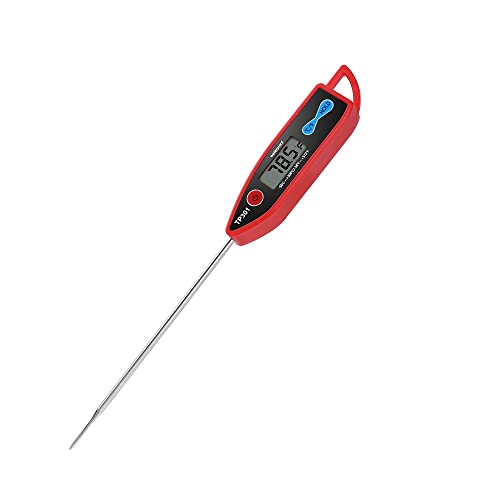
Digital Water Thermometer, Long Probe
$9.88A probe thermometer sized to measure an actual tap temperature directly, the only reliable way to confirm a dial or thermostat setting.
Best for: Checking the actual delivered temperature
Check price on Amazon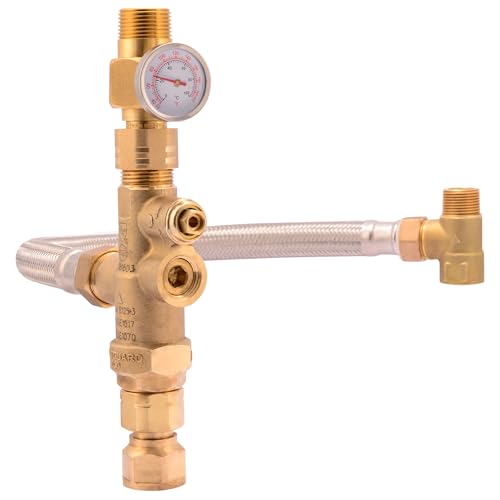
Cash Acme 3/4 in Tank Booster with TMV
$145.00A thermostatic mixing valve for a household storing water hotter for Legionella control, blending it back down to a safer delivered temperature.
Best for: Getting more usable hot water without a bigger tank
Check price on Amazon
Watts Under Sink Guardian USG-B-M2
$97.18An ASSE listed mixing valve alternative worth comparing on flow capacity for a household with higher simultaneous hot water demand.
Best for: One basin used by a child or an older adult
Check price on AmazonFrequently asked questions
- What temperature should I set my water heater to?
- There is a genuine tradeoff rather than one correct number. 120 F is the common recommendation for scald safety, since published research puts a serious burn at around five seconds of contact with 140 F water versus several minutes at 120 F. Households concerned about Legionella bacteria sometimes store water hotter, around 140 F, and add a thermostatic mixing valve to deliver a safer temperature at the tap.
- Why do both thermostats on my electric water heater need to be set the same?
- Each thermostat controls the element nearest it, and a mismatch causes uneven heating: one element runs far more than the other, or the tank fails to satisfy the higher setting efficiently. Setting both the upper and lower thermostat to the same target temperature is the standard approach on any electric tank with two elements.
- Is the dial on my gas water heater accurate?
- Not reliably as a measurement. Many gas control valve dials use vague labels like low, A, B, C, and hot rather than actual degrees, and even a numbered dial only sets a target inside the tank, not a guaranteed temperature at a specific tap. Measuring the actual result with a probe thermometer after a full heating cycle is the only way to know what a dial position really produces.
- What temperature kills Legionella bacteria in a water heater?
- Legionella survives and can multiply in water sitting for extended periods in roughly the 68 F to 122 F range, and growth is suppressed at higher storage temperatures such as 140 F. Some households store water at 140 F for this reason and add a thermostatic mixing valve at the tank outlet to bring the delivered temperature back down to a safer level like 120 F.
- How do I measure my water heater's actual temperature?
- Run a hot tap long enough for the temperature to stabilize, then hold a probe or dial thermometer directly in the stream. This is the only reliable way to know a delivered temperature, since a thermostat or gas valve dial sets a target inside the tank rather than displaying what actually reaches a given fixture after heat loss through the pipe run.
- Do I need a thermostatic mixing valve if I set my water heater hotter than 120 F?
- A mixing valve is strongly recommended, not optional in practice, if a tank is deliberately stored at a higher temperature such as 140 F for Legionella control. Without one, that hotter water reaches taps directly, and 140 F water can cause a serious burn in about five seconds of contact.
Measure at the tap with a probe thermometer, never trust the dial alone. If a tank is deliberately stored hotter than 120 F for Legionella control, pair that with a thermostatic mixing valve rather than sending that hotter water straight to a tap.