Safety & Efficiency
Water Heater Temperature Chart
Researched from the DOE test procedures, NFPA 54 and NEC code tables, and manufacturer specifications. Updated .
Quick answer
A water heater's setpoint sits between two real risks that pull in opposite directions. Scalding is fastest at the highest temperatures, so a lower setpoint reduces burn risk at a faucet or shower. Legionella bacteria, which cause a severe form of pneumonia when inhaled in a fine mist such as a shower, grow most readily in a specific warm-but-not-hot range, so a higher storage temperature suppresses that growth. Neither risk disappears at any single setpoint; each setpoint simply trades one risk for the other to some degree.
This page is not medical advice and does not recommend a specific temperature for any individual household. It lays out the published figures behind both risks so the tradeoff can be weighed for a specific household's own occupants, alongside a licensed plumber's guidance and a specific water heater's own manual.
How fast does hot water actually cause a scald burn?
These figures come from commonly published burn-time tables used in scald-prevention literature. Individual results vary by skin thickness, age, exposure area and length of contact, so treat these as illustrative, not a guarantee for any specific person.
| Water temperature | Approximate time to serious burn |
|---|---|
| 155 F | About 1 second |
| 148 F | About 2 seconds |
| 140 F | About 5 seconds |
| 133 F | About 15 seconds |
| 127 F | About 1 minute |
| 120 F | About 5 minutes |
| 100 F | Not expected to scald under normal exposure |
Convention Source: Commonly published burn-time figures from scald-prevention and burn-injury literature. These are illustrative averages, not a measurement of any individual person's skin or a specific exposure.. Children, older adults and anyone with reduced sensation or reduced ability to move away from hot water can be injured faster than these general figures suggest.
What temperature range lets Legionella bacteria multiply?
| Temperature range | Legionella growth |
|---|---|
| Below 77 F | Minimal growth, largely dormant |
| 77 F to 113 F | Active growth range, where Legionella multiplies most readily |
| Above 113 F | Growth suppressed; further heating toward the range commonly cited for water heater storage increases disinfection |
Published standard Source: Consensus growth range cited in public health and plumbing guidance on Legionella risk in building water systems, including ASHRAE 188 hot water system guidance.. This is general public health research on Legionella behavior, not a water-heater-specific test procedure, and it does not account for a specific building's plumbing layout or water age in dead legs.
What does each common setpoint give you, and what does it cost you?
| Setpoint | Approximate time to serious scald | Legionella zone | What it means |
|---|---|---|---|
| 120 F | About 5 minutes | Within or just above the growth range | A common default; lower scald risk, more reliance on other Legionella controls if a system is prone to it |
| 130 F | Roughly 20 to 60 seconds, interpolated between published points | Above the growth range | A middle setpoint; still a real scald risk to a child or an older adult, more heat margin against Legionella growth |
| 140 F | About 5 seconds | Well above the growth range | The fastest scald risk of the three; commonly paired with a thermostatic mixing valve so delivered water is cooled at the fixture |
Convention Source: Cross-referenced from the scald-time and Legionella-range tables above. The 130 F scald figure is interpolated between the 127 F and 133 F published data points rather than a direct source figure.. No setpoint in this table eliminates both risks at once; each one shifts the balance between them.
How much more does a higher setpoint cost to run?
A larger temperature rise costs proportionally more, using the same method as the operating cost chart on this site. Assuming a 50 F incoming water temperature, an electric resistance tank at $0.16 per kWh and 55 gallons a day, held as conventions:
| Setpoint | Resulting rise | Estimated annual cost | Compared to 120 F |
|---|---|---|---|
| 120 F | 70 F rise | $597 | Baseline |
| 130 F | 80 F rise | $682 | About 14 percent more |
| 140 F | 90 F rise | $767 | About 29 percent more |
Convention Source: Calculated as (55 gal x 8.33 x rise x 365) / 0.92 UEF, converted at 3,412 BTU per kWh and multiplied by $0.16 per kWh. 50 F incoming water, 55 gallons a day and the 0.92 UEF are held as conventions.. Cost scales directly with rise for a fixed usage and UEF, so this same percentage increase applies regardless of fuel type or price, only the dollar amounts change.
What is a thermostatic mixing valve, and why does the plumbing trade use one?
A thermostatic mixing valve sits between the tank's hot outlet and the household's fixtures, blending in cold water to bring the delivered temperature down to a setting independent of the tank's own thermostat. This lets a tank store water at a higher temperature, where Legionella growth is suppressed, while the water that actually reaches a shower or faucet runs at a cooler, separately controlled temperature. It does not remove the underlying tradeoff between scald risk and Legionella risk; it relocates where that tradeoff gets managed, from a single dial on the tank to a valve that can be set and, in some models, locked to a specific delivery temperature.
Who should weigh this tension differently?
Young children, older adults, and anyone with reduced sensation or reduced mobility to move away from hot water are generally more vulnerable to a fast scald injury, which argues for more caution on the lower end of the temperature range or for a mixing valve set conservatively. Anyone immunocompromised is generally more vulnerable to a Legionella infection, which argues for more caution on the higher end of the storage temperature range. A household with people in both groups at once is exactly the situation a thermostatic mixing valve is built to address, since it allows a hotter storage temperature and a cooler delivered temperature at the same time.
This page does not give medical advice and does not recommend a setpoint for any individual household. A household with young children, older adults, or an immunocompromised occupant should weigh this tradeoff with guidance appropriate to that occupant's specific medical situation, alongside a licensed plumber and the water heater's own manual.
The plumbing trade's resolution: store hot, deliver cool
A thermostatic mixing valve lets a tank store water hot enough to suppress Legionella growth while blending in cold water at the valve so the water actually delivered to a fixture runs cooler and safer against scalding. This does not resolve the tradeoff by itself; it moves where the tradeoff is managed, from the tank's single setpoint to a valve set independently at the point of use.
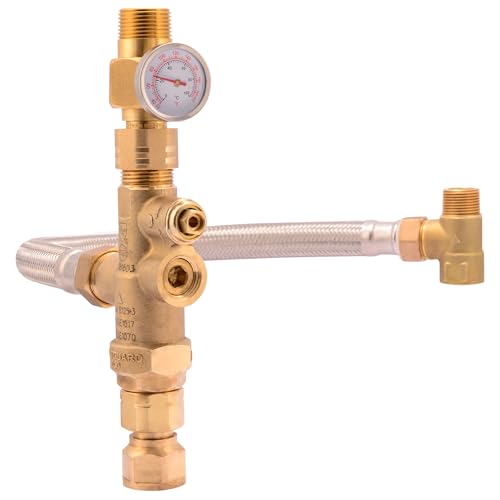
Cash Acme 3/4 in Tank Booster with TMV
$145.00A thermostatic mixing valve that blends tank-hot water down to a separately set delivery temperature at the point of use.
Best for: Getting more usable hot water without a bigger tank
Check price on Amazon
Watts Under Sink Guardian USG-B-M2
$97.18Another thermostatic mixing valve option for the store-hot, deliver-cool approach described above.
Best for: One basin used by a child or an older adult
Check price on Amazon
BOMATA Digital Water Thermometer, IPX7
$9.99A thermometer for checking the actual delivered temperature at a fixture, since a tank's dial setting and the water that actually arrives at a faucet are not always the same number.
Best for: Checking tap temperature at several fixtures
Check price on AmazonFrequently asked questions
- What temperature should I set my water heater to?
- This page does not recommend a specific number, because the honest answer depends on a household's own occupants and system. 120 F is a commonly cited default that reduces scald risk, while storing hotter and using a thermostatic mixing valve to deliver cooler water at the fixture is the approach the plumbing trade uses to manage Legionella risk without increasing scald risk at the tap.
- How long does it take to get a scalding burn at 140 F?
- Commonly published burn-time tables put a serious scald at around 5 seconds of contact with 140 F water, compared with roughly 5 minutes at 120 F. These are illustrative averages from burn-injury literature, not a guarantee for any individual, since skin thickness, age and length of exposure all change how quickly an actual burn occurs.
- What temperature suppresses Legionella bacteria growth?
- Legionella grows most actively in roughly the 77 F to 113 F range; growth is suppressed above that range, and further heating toward the temperatures commonly used for water heater storage increases disinfection. This is general public health guidance on Legionella behavior in building water systems, not a specific instruction for any one household's plumbing.
- Is 120 F or 140 F a safer water heater setpoint?
- Neither is safer in every respect; each trades one risk for the other. 120 F meaningfully lowers scald risk at the tap but sits closer to the range where Legionella grows well, while 140 F suppresses Legionella growth more but scalds far faster on contact, which is why the plumbing trade commonly pairs a higher storage temperature with a thermostatic mixing valve rather than picking one setpoint alone.
- What is a thermostatic mixing valve and how does it help with this tradeoff?
- It is a valve installed after the tank's hot outlet that blends in cold water to deliver a set, cooler temperature to fixtures, independent of how hot the tank itself is storing water. This lets a household store water hot enough to suppress Legionella growth while still delivering cooler, less scald-prone water at the shower or faucet, without changing the tank's own thermostat.
- Who is at higher risk from scalding versus from Legionella?
- Young children, older adults, and anyone with reduced sensation or limited mobility face a higher scald risk, since they may not react to or move away from hot water quickly enough. Anyone immunocompromised faces a higher risk from Legionella, since a healthy immune system typically fights off exposure that could cause serious illness in someone whose immune system is compromised.
This page will not pick a number for you, and it is not medical advice. Weigh the scald and Legionella tables above against a specific household's own occupants, consider a thermostatic mixing valve if storing hotter is the right call for Legionella control, and check a specific water heater's own manual and a licensed plumber before changing a setpoint.