Safety
Legionella and Water Heater Temperature
Researched from the DOE test procedures, NFPA 54 and NEC code tables, and manufacturer specifications. Updated .
Quick answer
Legionella is a bacteria naturally present in many water sources, responsible for Legionnaires' disease when inhaled in a fine mist, most often from a shower, a cooling tower or a similar aerosol-producing fixture. It does not grow at every temperature equally; like most bacteria, it has a range in which it thrives and temperatures above and below that range where it survives poorly or not at all. Water heater temperature sits directly inside this picture, because a storage tank held at a low setpoint for scald safety can also sit squarely inside the temperature range where Legionella grows best, while a tank held hot enough to suppress it delivers water hot enough to cause a serious burn if it reaches a tap unmixed.
This page lays out that tension as it actually exists, without picking a single number and presenting it as universally correct. The right balance depends on who uses the water, and that is a judgment for a household and, where the concern is medical, a physician, not something a calculator or a guide can safely settle in general terms.
What temperature range does Legionella actually grow in?
Public health guidance commonly cites roughly 77 to 113 F as the range where Legionella survives and can multiply, with growth generally poorest at the cold end of typical water heater storage temperatures and increasingly suppressed as storage temperature climbs above that range. A tank that runs consistently near the lower end of common setpoints, especially one with low turnover where water sits for extended periods rather than being drawn and replaced frequently, gives the bacteria more opportunity than a tank that runs hotter or turns over its water more often.
This is a general microbiological fact about the bacteria's temperature tolerance, not a claim about any specific household's risk. Actual Legionella exposure risk depends on far more than tank setpoint alone, including plumbing design, how long water sits in dead legs of pipe, and how the water is ultimately used, particularly whether it is aerosolized. None of that is something this page, or any water heater calculator, can assess for a specific home.
Why does the scald side push in the opposite direction?
Scald risk is a function of both temperature and contact time, and the two trade off sharply in the range that matters here. Widely cited burn research puts a serious scald at around five seconds of contact with 140 F water, while the same injury from 120 F water takes several minutes of contact, long enough that a person, especially one with normal reflexes and sensation, generally has time to react and pull away before serious injury occurs. That difference in reaction time is the entire argument for a lower delivered temperature, and it is why 120 F is the setpoint most commonly recommended for scald safety at a tap.
Reaction time is not equal for everyone. Young children, older adults, and anyone with reduced sensation or slower mobility, whether from a medical condition, a medication, or simply age, have less ability to react to unexpectedly hot water before an injury occurs, which is part of why scald guidance leans conservative rather than treating five seconds as an acceptable margin for a whole household.
140 F water can cause a serious burn in about five seconds of contact; 120 F water takes several minutes. That gap, not a preference for one number over another, is the entire basis for scald-safety guidance, and it matters most for young children, older adults and anyone with reduced sensation.
How does a thermostatic mixing valve actually resolve both concerns at once?
A thermostatic mixing valve installed at the tank outlet blends hot water leaving the tank with a small amount of cold water before it ever reaches the household's plumbing, holding the blended output at a set, stable temperature regardless of what the tank itself is storing. This is what allows the tank to be kept near 140 F, suppressing Legionella growth inside the storage volume itself, while the water that actually reaches a shower or a sink arrives at a safer delivered temperature such as 120 F.
The valve does the temperature reduction at one point, right after the tank, rather than relying on every fixture in the house to be adjusted individually, and a properly sized valve responds quickly enough to hold its output steady even as tank temperature or incoming cold water pressure fluctuates. This is the standard plumbing trade answer to the tradeoff on this page: not choosing one temperature and accepting the other risk, but separating storage temperature from delivery temperature entirely.
Who sits on which side of this tradeoff?
| Concern | Group with elevated risk | What that argues for |
|---|---|---|
| Scald injury | Young children, older adults, and anyone with reduced sensation or slower reflexes | A lower delivered temperature at the tap, such as 120 F, or a mixing valve set to that output |
| Legionella exposure | Anyone who is immunocompromised, separately from the scald-risk groups above | A higher storage temperature to suppress bacterial growth, delivered through a mixing valve rather than directly |
Published standard Source: General public health and plumbing code guidance on scald risk (burn research widely cited by burn treatment centers) and Legionella growth temperature ranges (CDC and ASHRAE Legionella control guidance).. This table describes which groups carry more of each risk in general; it is not medical advice and does not tell any specific household which setpoint to choose. A household with someone in both groups at once faces the sharpest version of the tradeoff and may want to discuss it with a physician alongside a plumber.
What does this page intentionally not tell you?
It does not tell you what temperature is safe for your household. That depends on who lives there, how the plumbing is laid out, how long water sits between draws, and factors specific enough to a single home that no general guide can responsibly answer them. It also does not offer medical advice about Legionella exposure risk for anyone immunocompromised living in or visiting the home; that is a conversation for a physician, not a water heater setting.
What this page can responsibly do is lay out the mechanism on both sides, honestly and without picking a winner: Legionella's temperature tolerance argues for storing hotter, scald physics argues for delivering cooler, and a thermostatic mixing valve is the standard way the plumbing trade resolves that specific tension rather than forcing a household to choose only one side of it.
What actually resolves the tradeoff
A thermostatic mixing valve is what lets a tank run hot for Legionella control without sending that same hot water straight to a tap. A probe thermometer is how the delivered result is actually confirmed rather than assumed.
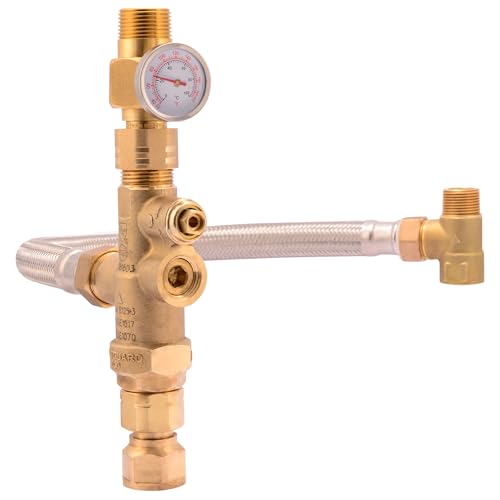
Cash Acme 3/4 in Tank Booster with TMV
$145.00A thermostatic mixing valve built for exactly this application, blending a hotter-stored tank down to a safer delivered temperature at the point it leaves the tank.
Best for: Getting more usable hot water without a bigger tank
Check price on Amazon
Watts Under Sink Guardian USG-B-M2
$97.18An ASSE listed mixing valve alternative with higher flow capacity, worth comparing for a household with more simultaneous hot water demand.
Best for: One basin used by a child or an older adult
Check price on Amazon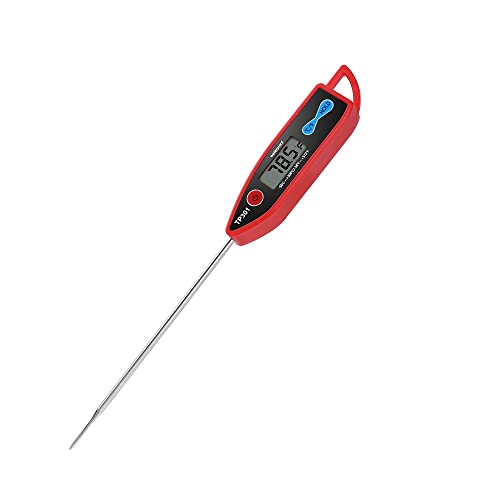
Digital Water Thermometer, Long Probe
$9.88A probe thermometer for confirming the actual temperature delivered at a tap, since neither a tank thermostat dial nor a mixing valve's own setting is a substitute for measuring the real result.
Best for: Checking the actual delivered temperature
Check price on AmazonFrequently asked questions
- What temperature does Legionella bacteria grow at in a water heater?
- Public health guidance commonly cites roughly 77 to 113 F as the range where Legionella survives and can multiply, with growth increasingly suppressed above that range. A tank running near the low end of common setpoints, especially with low water turnover, sits closer to that growth range than a tank stored hotter.
- Is 120 F or 140 F the correct water heater temperature?
- There is a genuine tradeoff rather than one universally correct answer. 120 F is the common recommendation for scald safety, since 140 F water can cause a serious burn in about five seconds versus several minutes at 120 F. Some households store water at 140 F to suppress Legionella and add a thermostatic mixing valve to deliver it cooler at the tap.
- How does a thermostatic mixing valve solve the Legionella and scald tradeoff?
- It blends hot water leaving the tank with cold water at a single point, right at the tank outlet, holding a stable delivered temperature regardless of what the tank itself stores. This lets a tank run hot enough to suppress Legionella growth inside it while the water reaching a shower or sink arrives at a lower, safer delivered temperature.
- Who is most at risk from scalding at higher water heater temperatures?
- Young children, older adults, and anyone with reduced sensation or slower reflexes, whether from a medical condition, a medication, or age, have less ability to react to unexpectedly hot water before a burn occurs. This is separate from Legionella risk and is why scald guidance leans toward lower delivered temperatures for a general household.
- Who is most at risk from Legionella exposure specifically?
- Anyone who is immunocompromised carries elevated risk from Legionella exposure, separately from the groups more vulnerable to scalding. This page does not offer medical guidance for that risk; a household with an immunocompromised member should raise water storage temperature and plumbing design with a physician alongside a plumber.
- Does this guide recommend a specific water heater temperature?
- No. The mechanism on each side is described honestly, but the right setpoint depends on who uses the water and factors specific to a single household, which no general guide can responsibly determine. A thermostatic mixing valve is presented as the trade's common way to address both concerns rather than as a specific temperature recommendation.
This page describes a tradeoff, not a recommendation. Where a household includes someone especially vulnerable to scalding, someone immunocompromised, or both, that is a conversation worth having with a physician and a plumber together, not a single number picked from a guide.