Efficiency
Water Heater Standby Loss, Explained
Researched from the DOE test procedures, NFPA 54 and NEC code tables, and manufacturer specifications. Updated .
Quick answer
Every storage tank water heater keeps a large volume of water hot around the clock, whether or not anyone is using it, and heat always moves from a hotter object toward a cooler surrounding one. Standby loss is the name for that constant, background leak: heat moving out through the tank's insulation, through the metal fittings that penetrate it, and into the first stretch of pipe still connected to the hot water it just delivered. None of it is a malfunction. It is the same physics that cools a cup of coffee left on a counter, applied to a tank that is trying to stay hot for potentially weeks between full draws.
Standby loss matters because it runs whether or not the household uses any hot water that day, unlike the energy spent actually heating cold water to a setpoint. A tank that is oversized for the household, or poorly insulated, or connected with bare metal fittings that conduct heat straight out of the tank, pays this cost every single day it sits idle.
Where exactly does the heat actually go?
Standby loss happens through three separate paths at once. Heat conducts outward through the tank's foam insulation and jacket, the largest single path on most tanks and the one the insulation thickness on the nameplate is meant to slow. Heat also escapes through the metal fittings, most notably the cold inlet and hot outlet nipples that penetrate the insulation directly, since metal conducts heat far better than the surrounding foam does and gives it a shortcut out. Finally, heat is lost into the first stretch of pipe connected to the tank, since that pipe stays hot even when no water is moving through it, and an uninsulated run bleeds heat into the surrounding air the same way the tank itself does.
The metal fitting path deserves particular attention because it does not just conduct heat, it also allows a convective loop: hot water in the tank rises into the vertical pipe above the outlet, cools slightly, and sinks back down, continuously cycling heat out of the tank even with no fixture open anywhere in the house. A heat trap nipple, which contains a small check ball or a deliberate bend in the fitting, blocks that specific loop without blocking the flow that happens when a tap is actually opened.
Why does the Uniform Energy Factor capture standby loss and thermal efficiency does not?
Thermal efficiency is a narrow measurement: the percentage of fuel energy that actually transfers into the water while the burner or element is firing. It says nothing about what happens between firings, when the tank is simply sitting there, full and hot, losing heat to its surroundings. Two units can have an identical thermal efficiency and still cost meaningfully different amounts to run if one holds heat far better than the other during all the hours neither is actively heating water.
The Uniform Energy Factor, the standardized rating on the yellow EnergyGuide label, is different because the DOE test procedure behind it simulates a full day of use, drawing water on a schedule, then measuring total energy consumed against total hot water delivered over that whole simulated day, standby hours included. That is why UEF is the number that actually reflects standby loss and thermal efficiency is not, and it is also why comparing two tanks on UEF is a fairer efficiency comparison than comparing them on thermal efficiency alone. The guide on how to read a water heater label covers where to find both figures and what else the label reports.
UEF, not thermal efficiency, is the number that reflects what a tank actually costs to keep hot. Compare units on UEF, or run both through the operating cost calculator, rather than on thermal efficiency alone.
Why does a bigger tank cost more to run even at the same UEF?
Surface area is the reason. A larger tank holds more hot water, but it also has proportionally more surface area exposed to the surrounding air, and more surface area gives standby heat more square footage to escape through even at the same insulation thickness and the same UEF rating class.
| Tank size | Relative surface area to lose heat through | What this means in practice |
|---|---|---|
| 40 gallon | Baseline | Lowest standby cost of the three, appropriate where recovery and first hour rating still meet demand |
| 50 gallon | Moderately more than a 40 gallon tank | A small, ongoing standby cost added for extra capacity that may or may not be used daily |
| 80 gallon | Substantially more than a 40 gallon tank | The largest ongoing standby cost of the three; sized correctly, this is the cost of a genuinely larger household's capacity, not waste |
Published standard Source: Direct consequence of tank geometry: surface area available to lose heat scales with a tank's dimensions, the same relation underlying the DOE UEF test's size-based rating classes.. This is an argument for sizing a tank correctly, not for buying undersized. Use the water heater size calculator to match capacity to actual household demand rather than assuming smaller always saves more than it costs in recovery.
What actually reduces standby loss, beyond buying a better-rated tank?
Three low-cost changes address the three loss paths directly. Heat trap nipples on the cold inlet and hot outlet block the convective loop that otherwise cycles heat out through the fittings around the clock, and they are a one-time part swap rather than an ongoing cost. Insulating the first six feet or so of pipe leaving the tank, on both the hot and cold sides, addresses the pipe-loss path, since that stretch of pipe stays hot longest and loses the most heat per foot of any section of the run. An insulating jacket or wrap on the tank itself is worth adding to an older unit whose factory insulation has thinned with age, or to any tank installed in an unconditioned space such as a garage, where the temperature difference driving heat loss is largest for most of the year.
None of these changes affect recovery rate, first hour rating or how hot the water gets. They only address the heat that leaks out while nobody is drawing any water at all, which is exactly the part of a water heater's running cost that a thermal efficiency number never captured in the first place.
What actually cuts standby loss
Heat trap nipples and insulated first-pipe runs are inexpensive, one-time additions that keep working for the life of the tank, unlike a setpoint change that has other tradeoffs attached to it.

Eastman Dielectric Heat Trap Nipples, Pair
$11.64A pair of heat trap nipples that replace the tank's standard inlet and outlet fittings, blocking the convective loop that otherwise carries heat straight up an uninsulated pipe.
Best for: Every tank replacement with copper pipe
Check price on Amazon
A.O. Smith Heat Trap Nipples, 3/4 x 3 in
$13.98An alternative heat trap nipple pair worth comparing on thread size and dielectric fitting against the Eastman set.
Best for: An A.O. Smith or Reliance tank
Check price on Amazon
SmartJacket SJ-80 Blanket, 20 to 80 Gallon
$43.95An insulating jacket for the tank itself, worth adding on an older unit whose factory insulation has thinned or on a tank kept in an unconditioned garage.
Best for: Anyone who does not want fibreglass in a closet
Check price on Amazon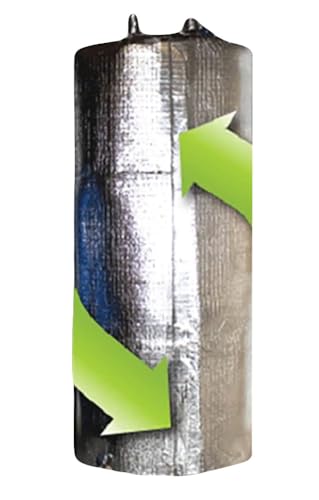
Trade Winds R12 Foam Blanket, 40 to 80 Gallon
$52.88Pipe insulation rated for hot water lines, sized to cover the first several feet of pipe leaving the tank where standby loss into the pipe itself is highest.
Best for: The coldest garages and basements
Check price on AmazonFrequently asked questions
- What is standby loss on a water heater?
- Standby loss is the heat a full storage tank loses through its insulation, its metal inlet and outlet fittings, and the connected pipe while nobody is drawing hot water. It runs continuously, day and night, independent of how much hot water the household actually uses, since it is simply heat moving from the hot tank toward the cooler surrounding air.
- Why does the UEF rating matter more than thermal efficiency when comparing water heaters?
- Thermal efficiency only measures how well fuel energy converts to heat while the unit is actively firing, and says nothing about heat lost during standby hours. Uniform Energy Factor is measured over a full simulated day of use, standby hours included, so it reflects the total cost of running the unit rather than only its performance mid-cycle.
- Does a bigger water heater tank cost more to run just sitting there?
- Yes. A larger tank has more surface area exposed to the surrounding air, and more surface area gives standby heat more area to escape through even at an identical insulation thickness and UEF rating class. This is an argument for sizing a tank to actual demand, not for buying undersized, since undersizing trades a small standby saving for a real shortfall in hot water.
- What are heat trap nipples and do they actually help?
- Heat trap nipples replace a tank's standard inlet and outlet fittings with ones containing a check ball or deliberate bend that blocks a convective loop, hot water rising into the pipe above the tank and sinking back down, that otherwise cycles heat out of the tank continuously. They are a one-time, inexpensive fitting swap that keeps working for the life of the tank.
- Does insulating the pipes near my water heater actually save energy?
- Yes, particularly the first several feet of pipe leaving the tank on both the hot and cold sides, since that stretch stays hottest longest and loses the most heat per foot of any section of the run. It is a low-cost addition that addresses a real, separate loss path from the tank's own insulation.
- Can I reduce standby loss without replacing my water heater?
- Yes. Heat trap nipples on the inlet and outlet, insulation on the first several feet of connected pipe, and an insulating jacket on an older tank with thinned factory insulation all reduce standby loss on a unit already installed, without affecting recovery rate or first hour rating.
Standby loss runs every hour of every day, whether or not any hot water is used. Heat trap nipples and insulation on the first stretch of pipe are the cheapest, most durable fixes, and they address a cost a thermal efficiency rating never showed in the first place.