Tankless
Best Condensing Tankless Water Heaters
Researched from the DOE test procedures, NFPA 54 and NEC code tables, and manufacturer specifications. Updated .
Quick answer
Condensing and non-condensing describe how a gas tankless unit handles its exhaust. A non-condensing unit vents hot exhaust gas out through stainless steel pipe, the way a traditional water heater flue has always worked. A condensing unit runs the exhaust through a second heat exchanger first, pulling additional heat out of it before it leaves the building, which is where the higher efficiency numbers come from.
That second heat exchanger cools the exhaust enough that water vapor in it condenses into liquid, mildly acidic condensate that has to drain somewhere, and cool enough that the vent pipe itself can be ordinary PVC or CPVC rather than stainless steel. Those two facts, the vent material and the condensate drain, are the entire decision. Everything else about the two heater types is similar.
See how the two categories compare directly on condensing vs non-condensing tankless before choosing a specific model here.
What is the actual difference between condensing and non-condensing?
A non-condensing tankless unit has a single heat exchanger and vents exhaust that is still hot enough that condensation inside the vent is not a design factor; that lets it use stainless steel venting rated for the higher temperature. A condensing unit adds a secondary heat exchanger that recovers more heat from the same exhaust, cooling it enough that water vapor condenses out as liquid before the gas leaves the vent. That condensate is mildly acidic and must be drained, typically through a neutralizer if it is going to a metal drain or septic system, or directly to a suitable drain per local plumbing code.
The efficiency gain from condensing is real and comes from a physical relation, not marketing: capturing latent heat from water vapor that a non-condensing unit simply vents outside. The tradeoff is plumbing a condensate path into the install, which a non-condensing unit does not need.
PVC or stainless: what does each vent material actually cost you?
Condensing units vent in PVC or CPVC because the exhaust is cool enough by the time it exits the secondary heat exchanger. That is typically cheaper material and easier to run through tight spaces than rigid stainless. Non-condensing units need stainless steel vent pipe rated for the higher exhaust temperature, which costs more per linear foot and is less forgiving to bend around obstacles.
The flip side: a condensing unit needs a condensate drain path from the unit to a suitable drain, often through a plastic media neutralizer that raises the condensate's pH before it reaches copper pipe or a septic system. A non-condensing unit skips that plumbing entirely. Neither cost is fabricated or fictional; each is real installed cost that shows up on one side or the other.
| Factor | Condensing | Non-condensing |
|---|---|---|
| Vent material | PVC or CPVC | Stainless steel |
| Condensate drain needed | Yes, often through a neutralizer | No |
| Typical efficiency | Higher (recovers latent heat from exhaust) | Lower |
| Common retrofit fit | Good where a drain is nearby | Good where an existing stainless flue chase exists |
Published standard Source: Manufacturer installation manuals and published unit specifications for condensing versus non-condensing tankless designs.. Local plumbing code governs where condensate may drain and whether a neutralizer is required; check your jurisdiction before finalizing an install plan.
How we chose these picks
These picks were compiled from manufacturer published specifications, installation manuals and the consensus of verified owner reviews. We did not install, test or run any of these units ourselves. Efficiency and flow figures cited here are the manufacturer's own published numbers, not a measurement we performed.
Buying tips for a condensing unit
- Confirm a drain is genuinely accessible near the planned mounting location before committing to condensing; retrofitting a drain path after the fact is real added cost.
- Budget for a neutralizer if the condensate will reach copper pipe or a septic system; check accessory pages and your local code for requirements.
- PVC venting is often easier through finished walls than stainless, which can matter more than the efficiency gain in a tight retrofit.
- Water quality affects scale on the heat exchanger either way; treatment options are covered at homewatercalc.com, not here.
Condensate is mildly acidic. Check local plumbing code on whether it can drain directly or must pass through a neutralizer first; this varies by jurisdiction.
The picks, by tier
All picks below are condensing units. A neutralizer or condensate pump is worth budgeting alongside any of them if the install site has no gravity drain nearby.

Rheem RTGH 6.8 GPM Natural Gas Indoor
$1,001.00A smaller condensing unit for a two to three bedroom house, at the low end of the condensing lineup's cost.
Best for: A smaller house that still wants PVC venting
Check price on Amazon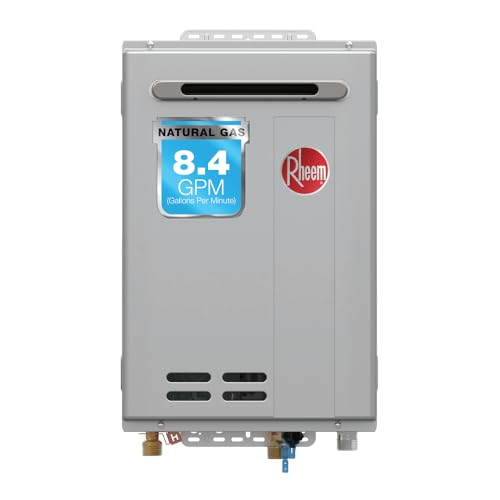
Rheem RTG 8.4 GPM Natural Gas Outdoor
$964.10An outdoor condensing unit that avoids interior venting questions entirely for a simpler first install.
Best for: Warm climate retrofits where running a vent is the problem
Check price on Amazon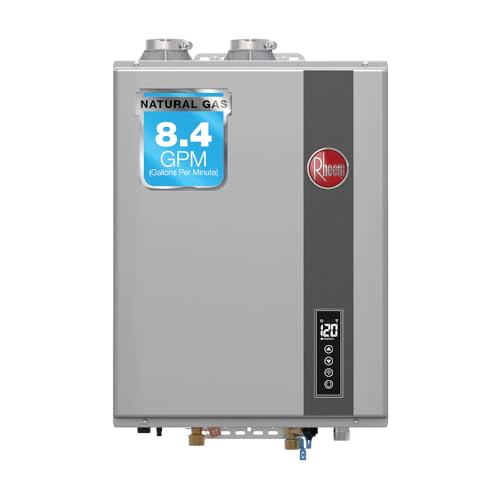
Rheem RTGH 8.4 GPM Natural Gas Indoor
$1,168.99The buy-once whole-house pick: enough published flow for two to three fixtures at the mid tier of the condensing lineup.
Best for: The common two to three bathroom whole house replacement
Check price on Amazon
Rinnai RX130iN Condensing
$1,264.20Condensing and recirculation-ready, useful where faster hot water delivery to distant fixtures matters as much as raw capacity.
Best for: Households that run short, repeated draws
Check price on Amazon
Rheem RTGH 9.0 GPM Natural Gas Indoor
$1,219.99The top of this condensing lineup for large houses or high simultaneous demand, with a proportionally larger condensate volume to plan for.
Best for: Cold groundwater regions where the rise eats the flow
Check price on Amazon
Rinnai RX160iN Condensing
$1,442.70The highest published flow condensing unit in this lineup, aimed at large houses running multiple bathrooms at once.
Best for: Three bathroom houses in a cold inlet region
Check price on Amazon
A.O. Smith ATI-540P-N 199K BTU
$1,449.99A high-capacity condensing alternative to the largest Rheem and Rinnai models, worth cross-shopping at this tier.
Best for: Large houses, and only after the gas line has been sized
Check price on AmazonFrequently asked questions
- What is the main difference between a condensing and non-condensing tankless water heater?
- A condensing unit adds a second heat exchanger that recovers additional heat from the exhaust, raising efficiency, and can vent through PVC instead of stainless steel. That efficiency requires a condensate drain path since water vapor condenses out of the cooled exhaust. A non-condensing unit skips both the second heat exchanger and the condensate plumbing but needs stainless steel venting.
- Does a condensing tankless water heater need a drain?
- Yes. Condensing units produce liquid condensate as a byproduct of extracting extra heat from the exhaust, and that condensate is mildly acidic. It typically needs to pass through a neutralizer before reaching copper pipe or a septic system, and local plumbing code governs exactly how it may be routed, so check your jurisdiction before installing.
- Can I vent a condensing tankless water heater in PVC?
- Yes, that is one of the main advantages of a condensing design. Because the secondary heat exchanger cools the exhaust before it exits, condensing units are approved for PVC or CPVC venting per their installation manuals, which is typically less expensive and easier to route than the stainless steel venting a non-condensing unit requires.
- Is a condensing tankless water heater worth the extra cost?
- It depends on whether a condensate drain is easy to plumb at your install location. The efficiency gain is real, but if there is no accessible drain nearby, adding one can offset much of the savings on vent material. Where a drain already exists close to the mounting spot, condensing is usually the better value.
- Do condensing tankless water heaters need a neutralizer?
- Often yes, particularly if the condensate will reach copper piping or a septic system, since the condensate is mildly acidic. A neutralizer, typically a small cartridge filled with calcite media, raises the pH before the condensate reaches the drain. Check local plumbing code, since requirements vary by jurisdiction.
- How much more efficient is a condensing tankless unit than non-condensing?
- Manufacturers publish Uniform Energy Factor ratings for each model, and condensing units generally rate higher than non-condensing units in the same lineup because they recover heat that would otherwise leave through the exhaust. Check the specific published UEF for the models you are comparing rather than assuming a fixed percentage difference across the category.
Check for an accessible drain before choosing condensing. The efficiency case is real, but a condensate path plumbed in after the fact costs more than planning for it up front.