Accessories
Best Thermal Expansion Tanks for Water Heaters
Researched from the DOE test procedures, NFPA 54 and NEC code tables, and manufacturer specifications. Updated .
Quick answer
A water heater is a closed system the moment something on the supply side stops backflow: a check valve at the meter, a pressure-reducing valve, a backflow preventer, or a municipal requirement that installs one anyway. Heated water expands. With nowhere to push that expansion back into the street main, the pressure inside the tank rises until the temperature and pressure relief valve opens to bleed it off, or repeat cycling wears a valve out early. An expansion tank gives that expanding water somewhere to go: a sealed air-charged bladder that absorbs volume as the tank heats and gives it back as the tank cools.
The picks below are grouped by tank size and application, from a basic bladder tank for a rental unit up to a diaphragm tank sized for a large household or a commercial-adjacent setup. Every one of them is a potable-rated tank rated for use on a domestic water supply. That distinction is worth its own section before the picks, because it is the single most common way people buy the wrong part in this category.
What is a thermal expansion tank and when is one required?
A thermal expansion tank is a small pressure vessel with a rubber diaphragm or bladder inside, pre-charged with air on one side. It threads into the cold supply line near the water heater. As stored water heats and expands by roughly 2 percent between a cold fill and a 140 F setpoint, that extra volume pushes into the tank and compresses the air charge instead of raising pressure in the plumbing.
An expansion tank is required, as a matter of physics rather than code alone, whenever the supply side is a closed system: a check valve at the water meter, a pressure-reducing valve (PRV) on the incoming main, a backflow preventer, or any device that lets water in but not back out. Many municipal water utilities install a check valve at the meter as standard practice, which makes a huge number of ordinary homes a closed system without the homeowner ever being told. If a system is open, meaning expanding water can push back out toward the street main with no check valve in the way, an expansion tank does no harm but is not doing the same job.
How do I know if my expansion tank is potable rated?
This is the single costliest mistake in this category and it is worth stating without hedging: a hydronic expansion tank is not the same product as a potable water expansion tank, and the two show up side by side in the same online search results.
Hydronic tanks, including the Watts ETX line and the Amtrol Extrol line, are built for closed-loop heating and radiant systems that circulate the same water indefinitely. Their internal materials, liner, and certifications are not rated for domestic drinking water that gets drawn out, refilled, and consumed. A potable-rated tank uses a liner and bladder material rated for domestic hot water and typically carries a certification such as NSF/ANSI 61 for contact with drinking water. Before buying, confirm the listing states the tank is rated for potable or domestic water use, not "expansion tank" alone. If a listing does not say potable, treat that as a reason to look elsewhere rather than an oversight to ignore.
A second, unrelated mistake worth ruling out at the same time: a hammer arrestor is not an expansion tank. A hammer arrestor is a small shock-absorbing fitting that quiets the bang of a fast-closing solenoid valve on a washing machine or dishwasher. It does not have the air-charged volume to absorb the thermal expansion of an entire tank of water, and installing one in place of an expansion tank leaves the closed-system pressure problem completely unsolved.
Only buy a tank explicitly labeled potable or domestic water rated. A hydronic tank and a hammer arrestor both look similar in a listing photo and neither belongs on a domestic hot water supply.
Why does the pre-charge pressure matter before installation?
Every expansion tank ships with a factory air pre-charge, commonly 40 psi, set through a Schrader valve on the tank identical to a tire valve. That factory number is a starting point, not the number to install at. Before the tank is plumbed in, the air pre-charge has to be checked with a standard tire gauge and adjusted with a bicycle pump or compressor to match the static water pressure of the home, meaning the pressure measured at a hose bib with no water running and no fixture open.
If the pre-charge sits well below static supply pressure, incoming water pressure overcomes the air cushion almost immediately and compresses the bladder to its limit, so the tank accepts almost no additional expansion volume and behaves as if it were not there at all. This is the most common reason an expansion tank is present and correctly sized on paper, yet the T&P valve still drips. Check and set the pre-charge every time, including on a brand new tank straight out of the box, and re-check it if static supply pressure changes for any reason, such as a new pressure-reducing valve.
What size expansion tank does my water heater need?
| Water heater size | Static supply pressure | Typical tank size | Basis |
|---|---|---|---|
| 40 gallon | Up to 60 psi | 2 gallon (2.1 gal actual) | Manufacturer sizing chart |
| 50 gallon | Up to 60 psi | 2 gallon (2.1 gal actual) | Manufacturer sizing chart |
| 50 gallon | 60 to 80 psi | 4.5 gallon | Manufacturer sizing chart |
| 65 to 75 gallon | Up to 60 psi | 4.5 gallon | Manufacturer sizing chart |
| 80 to 100 gallon | Up to 80 psi | 12 gallon | Manufacturer sizing chart |
Convention Source: Compiled from manufacturer expansion tank sizing charts (Amtrol, Watts) that cross-reference heater volume and setpoint against static supply pressure.. These are planning figures, not a code table. Run your own numbers with the expansion tank size calculator, since setpoint temperature and exact static pressure shift the result.
How we chose
We did not install or pressure test any of these tanks ourselves. These picks are compiled from manufacturer published specifications, including rated volume, connection size, and stated potable certification, cross-referenced against the consensus of verified owner reviews for fit and factory pre-charge accuracy. Where a listing did not clearly state potable rating, we excluded it rather than assume.
Buying tips
Match the connection thread to your existing plumbing, almost always 3/4 inch NPT, before ordering. Confirm clearance above the tank location, since bladder tanks mount vertically off a tee fitting and need several inches of headroom. If you are replacing a failed tank, a waterlogged bladder (no longer compressible, heavy for its size) is the usual failure mode and is a sign to check pre-charge on the replacement immediately rather than trust the factory setting.
The Beginner tier covers a standard 40 to 50 gallon tank on typical municipal pressure and nothing more. Do not size up to the Expert 12 gallon tank unless your water heater is 75 gallons or larger, your static pressure genuinely exceeds 60 psi, or you have measured a PRV output well above normal. An oversized tank is not dangerous, just an unnecessary spend and a bigger fitting to find space for.
The picks, by tier
Tank size should follow the water heater it protects and the static supply pressure, not the other way around. Use the expansion tank size calculator to match a tank to your heater volume and setpoint before choosing from the list below.

Eastman 2 Gallon Thermal Expansion Tank
$34.98A basic 2 gallon potable tank at the lowest entry cost, correctly sized for a typical 40 to 50 gallon residential tank and adequate for a rental or a first replacement.
Best for: The standard 40 or 50 gallon tank on a closed system
Check price on Amazon
GE 2.1 Gallon Expansion Tank
$42.99A compact 2.1 gallon tank with a standard 3/4 inch NPT connection, an easy swap where an old tank failed and the fitting is already there.
Best for: A supply near 40 psi, or anyone with a gauge and a bike pump
Check price on Amazon
EFIELD 2.1 Gallon Expansion Tank
$39.98Another budget-tier 2.1 gallon tank for the same footprint as the Eastman and GE, useful when stock or price pushes the choice.
Best for: A budget replacement of a failed tank
Check price on Amazon
TTFLEX 2.1 Gallon Expansion Tank
$39.99A 2.1 gallon tank built for tight utility closets, with a slightly narrower diameter than the standard bladder tanks in this size class.
Best for: A straightforward 2.1 gallon replacement
Check price on Amazon
Amtrol ST-5 2 Gallon
$77.99The buy-once pick for a standard 40 to 50 gallon household tank, from a manufacturer with a long track record specifically in potable expansion tanks.
Best for: Anyone who wants the name plumbers recognise
Check price on Amazon
Watts PLT-5 2.1 Gallon Potable
$87.76A comparable potable-rated alternative to the Amtrol ST-5 at the same size class, worth comparing on availability and connection thread.
Best for: A standard tank where the brand is specified
Check price on Amazon
Amtrol Therm-X-Span T-5A
$54.28A small-diameter version of the same Amtrol build for installations where a standard ST-5 will not clear the joists or the platform.
Best for: Replacing an older Amtrol T-5
Check price on Amazon
Amtrol THERM-X-TROL ST-1
$50.43A smaller-volume Amtrol tank suited to a compact electric tank or a point-of-use heater rather than a full 50 gallon system.
Best for: A 30 gallon tank at low supply pressure
Check price on Amazon
Amtrol ST-12 Thermal Expansion Tank
$127.03A larger-capacity tank for a 75 to 100 gallon tank, a high static pressure supply, or a setup already running a booster pump, where a 2 gallon tank would be undersized and cycle the relief valve anyway.
Best for: An 75 to 80 gallon tank, or a high pressure supply
Check price on Amazon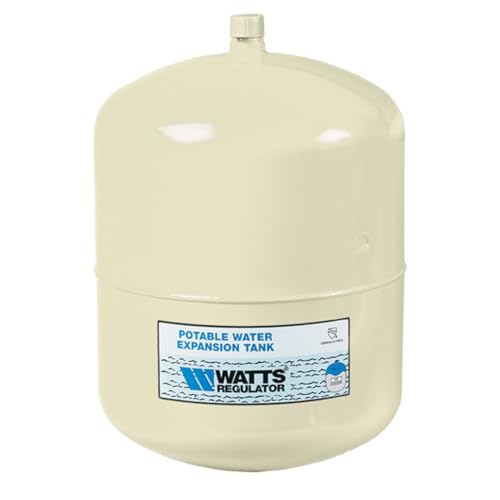
Watts PLT-12 4.5 Gallon Potable
$159.50A large-volume alternative to the Amtrol ST-12 for the same oversized-tank and high-pressure scenarios.
Best for: An 80 gallon tank or a supply above 70 psi
Check price on Amazon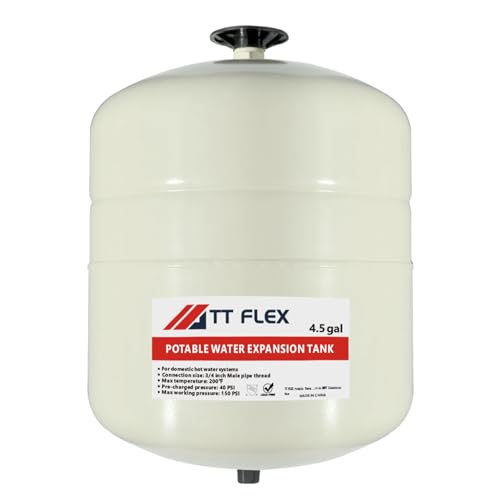
TTFLEX 4.5 Gallon Expansion Tank
$63.64A mid-size 4.5 gallon option that sits between the standard 2 gallon and the large 12 gallon tanks, useful for a 65 to 75 gallon tank on moderate supply pressure.
Best for: A larger tank on a budget
Check price on AmazonFrequently asked questions
- Can I use a hydronic expansion tank on my water heater?
- No. Hydronic tanks such as the Watts ETX and Amtrol Extrol lines are built for closed-loop heating systems and are not rated for contact with potable drinking water. Use only a tank the listing explicitly states is potable or domestic water rated, since the two product types look similar but use different internal liner materials.
- Is a hammer arrestor the same as an expansion tank?
- No. A hammer arrestor is a small fitting that absorbs the shock of a fast-closing valve, such as on a washing machine, and has nowhere near the air-charged volume needed to absorb the thermal expansion of a full water heater tank. It does not solve closed-system pressure buildup and should never be installed as a substitute.
- What pre-charge pressure should my expansion tank be set to?
- Set the tank pre-charge to match your home static water pressure, measured at a hose bib with no fixtures running, using a standard tire gauge at the tank Schrader valve. Factory pre-charge is typically 40 psi and is a starting point only. A tank left at factory pre-charge below actual static pressure accepts almost no expansion volume.
- What size expansion tank do I need for a 50 gallon water heater?
- Most 50 gallon residential water heaters on typical municipal pressure up to about 60 psi use a 2 gallon (commonly sold as 2.1 gallon) potable-rated tank. On higher static pressure above 60 psi, sizing charts commonly call for a 4.5 gallon tank instead. Use the expansion tank size calculator to confirm against your own pressure and setpoint.
- Do I need an expansion tank if I do not have a check valve?
- If your supply has no check valve, pressure-reducing valve, or backflow preventer, the system is open and expanding water can push back toward the street main, so an expansion tank is not doing the same job it does on a closed system. Many municipalities install a check valve at the meter without notice, so verify rather than assume your system is open.
- Why is my T&P valve still dripping after I installed an expansion tank?
- The most common cause is a pre-charge that was never checked or set to match static supply pressure before installation. If the air charge is lower than incoming water pressure, the tank bladder compresses immediately and accepts almost no expansion volume, so the relief valve keeps opening exactly as if no tank were installed.
Buy potable rated, and set the pre-charge before you plumb it in. Those two steps, done correctly, are what separate an expansion tank that actually protects a T&P valve from one that only looks like it does.