Maintenance
How to Replace an Anode Rod
Researched from the DOE test procedures, NFPA 54 and NEC code tables, and manufacturer specifications. Updated .
Quick answer
An anode rod is the sacrificial part of a water heater, a steel core wire wrapped in a more reactive metal, usually magnesium or an aluminum-zinc alloy, that corrodes in place of the steel tank itself. As long as the rod has enough reactive metal left, it, not the tank wall, is what dissolves into the water over years of service. Once the rod is consumed down to bare core wire, that protection is gone and the tank itself becomes the next thing corrosion attacks.
Replacing a spent rod is one of the few maintenance jobs on a water heater that meaningfully extends the life of the tank itself, and it is a job most owners can do with hand tools, provided the ceiling clearance above the tank allows the old rod to come out in one piece, or a flexible rod is used where it does not.
What tools does replacing an anode rod actually take?
The anode rod's hex head, where a socket grips it, is usually 1-1/16 inch on a standard residential water heater. A rod that has never been removed since the tank was installed is very often seized by mineral deposits and years of thread sealant, so a breaker bar for leverage, or an impact wrench where one is available, makes far more difference here than on almost any other water heater job. A basic socket and a short ratchet are frequently not enough to break a stuck rod loose without rounding the hex.
Beyond the socket and breaker bar or impact wrench, have new thread sealant rated for potable water on hand for the replacement rod, and a garden hose for the small amount of draining this job needs.
How do I replace a water heater anode rod, step by step?
- Turn off power to an electric tank at the breaker, or set a gas tank's control valve to pilot, and close the cold water supply valve.
- Open a hot water tap briefly to relieve pressure in the tank.
- Connect a hose to the tank's drain valve and drain 3 to 5 gallons, enough to drop the water level below the anode port at the top of the tank.
- Locate the anode rod's hex head, either exposed at the top of the tank or, on some models, hidden under a plastic cap or combined with the hot water outlet fitting.
- Fit a 1-1/16 inch socket onto the hex head and break it loose counterclockwise using a breaker bar or an impact wrench, since a corroded rod can require significant force to start turning.
- Once loose, continue unthreading by hand and withdraw the rod. If the ceiling or joists overhead do not allow a full-length rod to clear, use a flexible or segmented replacement rod instead, which folds or hinges as it comes out.
- Inspect the old rod: if more than about six inches of bare steel core wire is exposed, or the reactive metal coating is mostly gone, replace it.
- Wrap the new rod's threads with pipe thread sealant rated for potable water, thread it in by hand, then snug it with the socket and breaker bar.
- Close the drain valve, open the cold water supply valve fully, and open a hot tap until the stream runs steady with no air.
- Restore power or return the gas control valve to its normal setting.
How do I know when an anode rod actually needs replacing?
The clearest sign is visual: once more than about six inches of the rod's bare steel core wire shows through what should be a coating of reactive metal, the rod has done most of what it can do and is close to offering no further protection. A rod that has shrunk to a thin wire along most of its length, rather than one with a consistent coating remaining, is past due even if six inches has not been reached everywhere along it.
A rotten egg smell in hot water only, not cold, is a separate but related signal, often caused by a magnesium rod reacting with sulfate-reducing bacteria in the water rather than the rod being worn out. Switching to an aluminum-zinc rod frequently resolves that smell without giving up sacrificial protection.
What if there is no headroom to pull a full-length rod?
A water heater installed in a low crawlspace, a shallow attic, or with ductwork directly overhead often does not have the vertical clearance a standard 3 to 4 foot rod needs to come straight out. Flexible rods, made of short segments linked so the rod bends as it withdraws, and segmented rods that separate into pieces, both exist specifically for this situation and thread into the same port as a standard rod.
Measure the actual clearance above the anode port before ordering a replacement, since a flexible rod bought unnecessarily costs more than a standard one for no benefit, while a standard rod bought where there is no room for it cannot be installed without first creating clearance another way.
Magnesium or aluminum-zinc, and how long does an anode rod actually last?
| Material | Typical service life | Best suited to |
|---|---|---|
| Magnesium | Roughly 3 to 5 years on typical municipal water | Most standard municipal supplies; the default OEM choice |
| Aluminum-zinc alloy | Roughly 4 to 6 years | Well water or water with a sulfur, rotten egg odor |
| Powered, impressed current | Not consumed; runs as long as the unit has power | Softened water, where sacrificial rods deplete unusually fast |
Convention Source: Compiled from manufacturer service life estimates and the consensus of verified owner reviews on typical municipal and well water conditions.. Actual life depends heavily on local water chemistry and whether the household runs a water softener, which accelerates sacrificial rod consumption. Run your own estimate with the anode rod life calculator.
What to buy for this job
Match the material to the water, not just the tank. A magnesium rod is the default; an aluminum-zinc rod is the fix for a sulfur smell.

Eastman 42 in Flexible Magnesium Anode
$35.25A standard magnesium rod at the size and thread most residential tanks use, the default replacement on ordinary municipal water.
Best for: A tank with a low ceiling above it
Check price on Amazon
Ozek 44 in Segmented Aluminum Zinc Anode
$36.45An aluminum-zinc rod worth choosing over magnesium when hot water carries a sulfur smell, without giving up sacrificial protection.
Best for: A tank with a sulphur smell
Check price on Amazon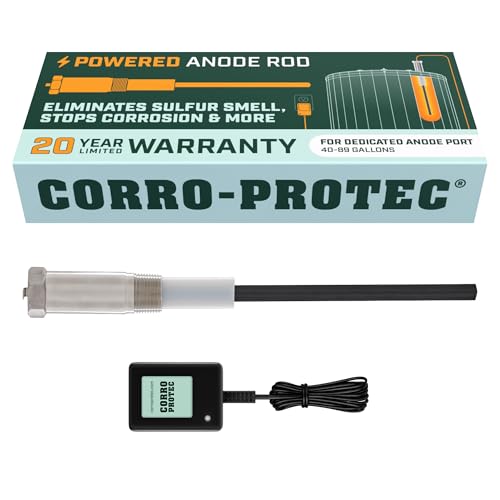
Corro-Protec Powered Anode Rod
$179.95A powered anode that runs on household current instead of being consumed, removing the recurring replacement job entirely at a higher upfront cost.
Best for: Hard water, or a tank you intend to keep
Check price on Amazon
Element Socket Set, 27 mm and 38 mm
$15.99A socket set covering the 1-1/16 inch anode hex and other common water heater fastener sizes in one box.
Best for: Not knowing which size the tank takes
Check price on AmazonFrequently asked questions
- What size socket do I need to remove a water heater anode rod?
- Most residential anode rods use a 1-1/16 inch hex head. This is a different size than the 1-1/2 inch socket a heating element takes, and search results for water heater sockets often mix the two up, so confirm which part you are actually removing before ordering a socket.
- How do I know if my anode rod needs to be replaced?
- Pull the rod and look at it: once more than about six inches of the bare steel core wire is exposed, with little or no reactive metal coating left around it, the rod is past due for replacement. A rod still showing a consistent coating along most of its length can usually be reinstalled and checked again later.
- Why will my anode rod not come loose?
- A rod that has never been removed is commonly seized by mineral buildup and years of thread sealant. A basic ratchet often is not enough force; a breaker bar for extra leverage, or an impact wrench where available, is usually what actually breaks a stuck rod free without rounding the hex head.
- Can I replace an anode rod if there is no room above my water heater?
- Yes. A flexible or segmented anode rod, built from linked short sections, threads into the same port as a standard rod but bends or separates as it comes out, so it works in a low crawlspace, attic, or under ductwork where a standard 3 to 4 foot rod has nowhere to go.
- Does an aluminum anode rod fix rotten egg smelling hot water?
- Often, yes. A sulfur or rotten egg smell limited to hot water is frequently caused by a magnesium anode rod reacting with sulfate-reducing bacteria in the water. Switching to an aluminum-zinc rod commonly resolves the smell while still providing sacrificial corrosion protection for the tank.
- How often should I check or replace my water heater anode rod?
- Checking every one to two years is a reasonable starting point, tightening to yearly on water softened by a whole-house softener, since softened water is known to accelerate sacrificial rod consumption. Replace once more than about six inches of bare core wire is exposed, rather than on a fixed schedule alone.
Shut off power to an electric tank before draining any water for this job, and never force a rod's hex head with anything but a properly sized socket. A rounded hex on a seized rod turns a straightforward annual check into a much harder repair.