Tankless Electric
EcoSmart ECOS 27 Review: 140.6 Amps of Design Load
Researched from the DOE test procedures, NFPA 54 and NEC code tables, and manufacturer specifications. Updated .
Quick answer
Twenty seven kilowatts is the largest rating in this whole-house electric tankless lineup, and it is worth saying plainly: almost no residential panel should take this unit without a service upgrade already planned for. The reason to read this review is to decide whether that describes your house, not to shop the price first.
The EcoSmart ECOS 27's own product listing states 112.5 A, which matches exactly what the 27 kW, 240 V nameplate rating calculates to. That agreement is worth noting, because most listings in this category state kilowatts and volts and leave the amperage for the buyer to work out.
What do the ECOS 27's specifications actually say?
| Specification | Value |
|---|---|
| Nameplate rating (published) | 27 kW at 240 V |
| Current draw (published on the listing, matches P = I / V) | 112.5 A |
| NEC 422.13 continuous-load factor | 125 percent of nameplate draw |
| Design load for circuit and breaker sizing | 140.6 A |
| Number of circuits | Specified in EcoSmart's installation manual, not stated further in this listing. Units this large are commonly split across three circuits. |
Published standard Source: Nameplate kW, V and the 112.5 A figure from the product listing; design load calculated from that amperage using NEC 422.13's 125 percent continuous-load rule.. 140.6 A of design load is 70 percent of a 200 A panel's total rating, before any other circuit in the house is added to the calculation.
How much flow does the ECOS 27 deliver, and what does temperature rise cost you?
| Temperature rise | Calculated flow (GPM) |
|---|---|
| 35°F | 5.16 |
| 45°F | 4.01 |
| 55°F | 3.28 |
| 65°F | 2.78 |
| 75°F | 2.41 |
Published standard Source: Calculated from the published 27 kW nameplate rating using GPM = kW x 3412 x 0.98 / (rise x 8.33 x 60). Not a manufacturer flow curve.. Even at this rating, a 75°F rise, common with cold groundwater, still calculates to under 2.5 GPM, roughly one shower.
Who does the ECOS 27 suit?
This unit suits a house that already has a 400 A service, or a 200 A service with genuinely nothing else on it, both confirmed by a licensed electrician's load calculation before purchase. It suits a cold-inlet climate where the extra kilowatts over an 18 or 24 kW unit meaningfully change the calculated flow, for example 3.28 GPM at a 55°F rise versus 2.92 GPM on a 24 kW unit at the same rise.
Who should not buy the ECOS 27?
A typical 200 A residential panel with a range, dryer, and central air already installed should not take this unit; 140.6 A of design load simply does not fit alongside those loads on that size of service. Anyone who has not already budgeted for a probable service upgrade should not shop this unit on the sticker price, since the electrical work is very likely to cost more than the heater itself. And anyone in a mild climate should look at the 18 or 24 kW units in this category first, since the extra flow this size buys mostly shows up in a cold-inlet rise.
What does installing the ECOS 27 actually involve?
A licensed electrician's load calculation comes first, and for most homes it returns a recommendation to upgrade the service before this unit goes in at all. EcoSmart's installation manual specifies how the unit's circuits split, commonly across three breakers at this size, with conductor and breaker sized to NEC Table 310.16 for each run. The cost of a service upgrade or new subpanel is scoped and quoted by the electrician; houseprojectcalc.com covers that question, which is out of scope here.
A unit drawing over 100 A continuously has multiple energized circuits. Turn off every breaker feeding it and verify each with a meter before opening the box; checking only one is not enough.
How we researched this
We did not test this heater in person. This review is built from EcoSmart's published nameplate rating of 27 kW, 240 V, and 112.5 A stated directly on the product listing, with the NEC 422.13 design load and the flow-by-rise table both calculated from those published figures. We read verified owner reviews for install feedback at this size, and we state plainly that a UEF rating and an exact circuit count are not published for this model rather than estimate them.
Recommended gear

EcoSmart ECOS 18 18kW
$411.73At 18 kW and 75 A drawn, this is EcoSmart's option for a panel that cannot absorb 140.6 A of design load.
Best for: A whole house electric install on a proven service
Check price on Amazon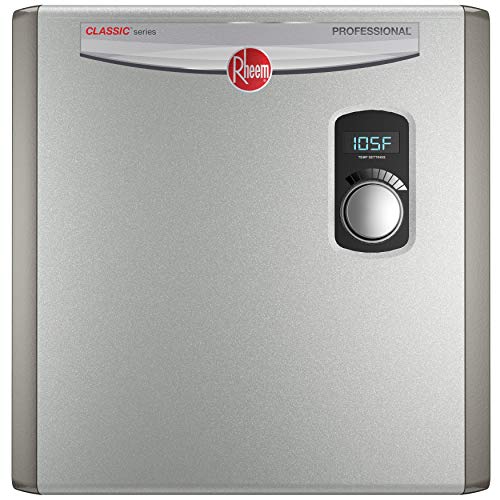
Rheem RTEX-24 24kW
$549.0024 kW draws 100 A and needs 125 A of design load, a meaningfully smaller ask than the ECOS 27's 140.6 A for households in a milder climate.
Best for: Houses with service capacity already proven
Check price on Amazon
Aquanta WiFi Water Heater Controller
$189.00A unit drawing this much continuous power benefits from remote leak and temperature alerts, given how much is riding on that one circuit path.
Best for: Measuring before spending on a new heater
Check price on AmazonFrequently asked questions
- How many amps does the EcoSmart ECOS 27 draw?
- EcoSmart states 112.5 A directly on the product listing for the ECOS 27, which matches the figure calculated from its 27 kW, 240 V nameplate rating using P = I x V. Under NEC 422.13's continuous-load rule, the circuit and breaker are sized to 125 percent of that draw, which comes to about 140.6 A of design load.
- Can a 200 amp panel run the EcoSmart ECOS 27?
- Rarely without a service upgrade. A design load of 140.6 A consumes about 70 percent of a 200 A panel's total rating before any other circuit in the house, including lighting, appliances, and HVAC, is counted. A licensed electrician's load calculation on the specific panel is required, and for most existing 200 A services it returns a recommendation to upgrade first.
- How much flow does the ECOS 27 deliver at a 55 degree rise?
- Calculated from its published 27 kW rating, the ECOS 27 works out to about 3.28 GPM at a 55°F rise. That is the highest calculated flow of the electric tankless units covered in this series at that rise, though it still falls to about 2.41 GPM at a 75°F rise common with cold groundwater.
- Does the EcoSmart ECOS 27 need a service upgrade?
- Most homes on a standard 200 A residential panel will need one, since 140.6 A of NEC design load leaves very little spare capacity once other household circuits are counted. A 400 A service, or a 200 A service with unusually little else on it, is the more realistic starting point, confirmed by an electrician's load calculation rather than assumed.
- How is the ECOS 27 different from the ECOS 18?
- The ECOS 27 is rated 27 kW against the ECOS 18's 18 kW, which raises the published current draw from 75 A to 112.5 A and the NEC design load from 93.75 A to about 140.6 A. In exchange, calculated flow at a 55°F rise rises from 2.19 GPM to 3.28 GPM, a meaningful jump for a cold-inlet household.
- Does the ECOS 27 publish a UEF rating?
- No. The product listing does not state a Uniform Energy Factor figure for the ECOS 27. It does publish current draw directly, at 112.5 A, which is unusual transparency in this category, but a UEF number is not among the published specifications and should not be assumed.
Get the load calculation before the heater, not after. A 140.6 A design load is a service-upgrade question for most homes. Turn off every breaker feeding the unit and verify each with a meter before opening it, and never energize an element that is not fully submerged.