Tankless
Electric vs Gas Tankless Water Heater
Researched from the DOE test procedures, NFPA 54 and NEC code tables, and manufacturer specifications. Updated .
Quick answer
Gas versus electric sounds like a preference question, but at whole-house flow rates it is closer to an infrastructure question. One path needs a gas line and venting large enough to feed a burner working at nearly 200,000 BTU per hour. The other needs an electrical service large enough to carry a load that can approach a home's entire existing panel capacity on its own. Neither path is free to add if the house does not already have it.
How much energy does it actually take to heat water on demand?
| Energy path | Raw heat required | What a whole-house unit is typically rated for | What that means for your house |
|---|---|---|---|
| Gas (combustion) | About 140,000 BTU/hr, from the standard Q = 500 x GPM x degrees F formula for heating water | Commonly rated up to roughly 199,000 to 205,000 BTU/hr input, since combustion is not 100 percent efficient | Needs a gas line and meter capacity sized for that draw, plus dedicated venting |
| Electric (resistance) | The same 140,000 BTU/hr converts to about 41 kW at close to 100 percent conversion efficiency | Whole-house electric tankless units built for this duty commonly carry nameplate ratings around 54 to 58 kW | At 240 volts that is close to 240 amps of continuous current, typically split across several dedicated double-pole breakers |
Convention Source: Q = 500 x GPM x degrees F rise, the standard constant for heating water; manufacturer nameplate specifications for whole-house gas and electric tankless water heaters; amperage calculated as watts divided by volts.. A single fixture or a smaller temperature rise needs proportionally less of both. These figures describe a full whole-house duty point, not one sink.
Why does gas tankless need less electrical work than the raw numbers suggest?
A gas tankless unit still uses electricity, for its ignition control board and, on power-vent models, a small blower motor, but that draw is a fraction of an amp on a standard household circuit rather than a dedicated high-amperage service. The heavy lifting is done by combustion, so the electrical side of a gas installation stays close to what a typical outlet already provides.
Why does whole-house electric tankless run into panel limits?
Every unit in this catalog's electric tankless lineup tops out well below the 54 to 58 kW a full whole-house, high-rise duty point calls for, because a residential electrical service rarely has that much unused capacity to dedicate to one appliance. Electric tankless units in the 12 to 24 kW range, which is what is commonly available, cover a more modest flow rate or a smaller temperature rise, such as a warmer climate or a single high-use fixture, rather than a whole house in a cold-inlet-water climate. Sizing an electric tankless unit against actual flow and rise needs, not against a marketing claim of whole-house coverage, is what the tankless sizing calculator is for.
When is gas tankless the right call?
A house that already has a gas line and adequate meter capacity, needs to cover multiple simultaneous fixtures, or sits in a cold-climate region where incoming water starts well below a warm-climate baseline is the clearest case for gas. The infrastructure already exists or is a straightforward extension, and one unit can be sized for genuinely whole-house duty.
When is electric tankless the right call?
A house with no gas service at all, a remodel where running a new gas line is impractical, a warmer climate with a smaller temperature rise to cover, or a target that is really one fixture or a small zone rather than the whole house are all scenarios where electric tankless fits without the panel upgrade a full whole-house electric duty point would otherwise force. Confirming a specific unit's breaker and wire requirements against the panel's available capacity, using the breaker size calculator, is the step that keeps this option realistic rather than aspirational.
What does each choice cost you later?
A gas unit needs periodic professional attention to its burner, venting and combustion components, work that belongs to a licensed gas fitter or plumber rather than a homeowner. An electric unit has no combustion system to service, but both gas and electric tankless units still accumulate mineral scale on their heat exchangers and need the same descaling schedule regardless of energy source. Ongoing energy cost depends on local gas and electric rates and each unit's efficiency rating; the operating cost calculator compares them for specific local rates rather than giving a generic answer.
Gas line sizing, connection and venting work is a job for a licensed gas fitter or plumber. An undersized gas line starves the unit and can affect other appliances on the same line, and improperly vented combustion appliances can backdraft carbon monoxide into the house, a hazard that gives no warning without a detector.
Representative units on each side
These illustrate the flow and capacity ranges discussed above; match a specific model's rated BTU or kW input against your actual gas line or electrical service before buying.
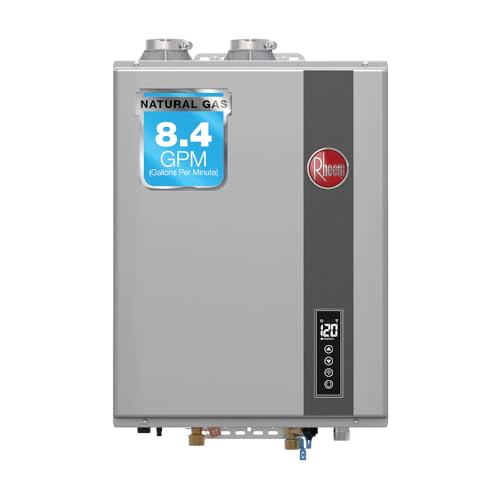
Rheem RTGH 8.4 GPM Natural Gas Indoor
$1,168.99A higher-capacity natural gas tankless unit representative of whole-house duty rated near the top of the residential range.
Best for: The common two to three bathroom whole house replacement
Check price on Amazon
Rinnai RX130iN Condensing
$1,264.20A high-capacity indoor gas tankless unit built for whole-house flow rates in colder climates.
Best for: Households that run short, repeated draws
Check price on Amazon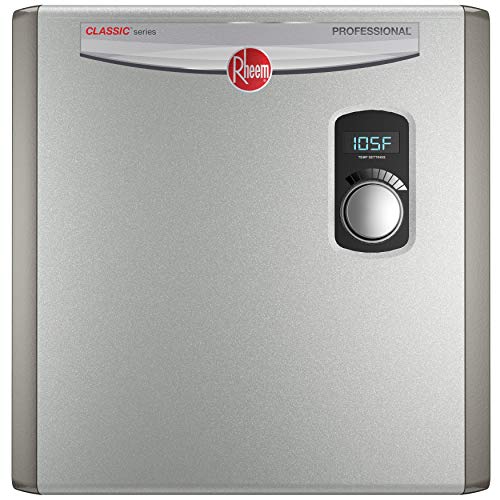
Rheem RTEX-24 24kW
$549.00One of the higher-capacity electric tankless units in this catalog, illustrating where electric residential ratings top out.
Best for: Houses with service capacity already proven
Check price on Amazon
Stiebel Eltron Tempra 24 Trend 24kW
$521.69A 24 kW electric tankless model suited to a smaller flow rate or warmer-climate rise rather than full whole-house cold-climate duty.
Best for: Cooler inlet climates with service capacity
Check price on AmazonFrequently asked questions
- How much gas does a whole-house tankless water heater actually need?
- Delivering 4 gallons per minute through a 70 F temperature rise takes about 140,000 BTU per hour of raw heat, and a whole-house gas tankless unit built for that duty commonly carries a published input rating up to roughly 199,000 to 205,000 BTU per hour, since combustion is not perfectly efficient. The gas line size calculator translates that into a required pipe diameter.
- Can a typical home electrical panel run a whole-house electric tankless water heater?
- Not comfortably in most cases. A whole-house electric tankless unit sized for a 4 GPM, 70 F rise duty point commonly needs 54 to 58 kW, which is close to 240 amps of continuous current at 240 volts, often more than half of an entire standard 200 amp panel's total capacity dedicated to one appliance.
- Why are electric tankless water heaters in stores usually rated much lower than 58 kW?
- Most residential electric tankless units are built for a smaller flow rate, a warmer climate with a lower temperature rise, or a single fixture rather than true whole-house duty in a cold climate, because that is what a normal electrical service can actually support. Units in the 12 to 24 kW range are common for those narrower jobs.
- Does a gas tankless water heater need electricity to run?
- Yes, but only a small amount. The ignition control board and, on power-vent models, a small blower motor draw a fraction of an amp on a standard household circuit, nothing close to the heavy electrical service a fully electric whole-house unit would need, since combustion rather than electric resistance does the actual heating.
- Is electric tankless cheaper to operate than gas tankless?
- It depends on local utility rates for gas and electricity and each specific unit's efficiency rating, not on the energy source alone. The water heater operating cost calculator compares a specific gas and electric model against local rates rather than giving one universal answer, since rate structures vary widely by location.
- Do both gas and electric tankless water heaters need descaling?
- Yes. Mineral scale builds up on the heat exchanger of any tankless unit regardless of whether it is heated by combustion or electric resistance, so both gas and electric models need the same periodic descaling schedule; the energy source has no bearing on how fast scale accumulates from the water passing through.
Check the infrastructure before the unit. A gas line and meter capacity check, or an electrical panel load calculation, tells you which side of this comparison your house can actually support before you spend money sizing a specific model.