Running cost
What Does a Electric resistance tank Cost to Run at $0.16 per kWh?
Researched from the DOE test procedures, NFPA 54 and NEC code tables, and manufacturer specifications. Updated .
Quick answer
Water heating is usually the second largest energy use in a house after space conditioning, and almost all of the variation between households comes from two numbers: how much hot water they use and what their fuel costs.
This page holds the usage at 55 gallons a day through a 70 F rise and the efficiency at a 0.92 UEF, then reads the cost at $0.16 per kWh: about $597 a year.
Where the figure comes from
| Step | Figure |
|---|---|
| Hot water per day | 55 gal |
| Temperature rise | 70 F |
| Heat delivered per day | 32,071 BTU |
| UEF | 0.92 |
| Energy input per year | 12,723,622 BTU |
| kWhs per year | 3,729 |
| Price per unit | $0.16 |
| Cost per year | $597 |
Published standard Source: DOE Uniform Energy Factor as the divisor on delivered energy, with published energy content per fuel unit. UEF is measured over a standard daily draw pattern and already includes standby loss, which is why it is always lower than a burner thermal efficiency.
How electric resistance tank compares at this price
Every heater type at its typical UEF, on the same 55 gallons a day and the same 70 F rise. Fuel prices differ between these, so this is a comparison of efficiency rather than of bills.
| Heater type | Typical UEF | Energy per year | Unit |
|---|---|---|---|
| Electric resistance tank | 0.92 | 3,729 | kWh |
| Heat pump water heater | 3.5 | 980 | kWh |
| Atmospheric gas tank | 0.6 | 195 | therm |
| Condensing gas tank | 0.8 | 146 | therm |
| Condensing gas tankless | 0.93 | 126 | therm |
| Propane tank | 0.6 | 213 | gallon of propane |
Published standard Source: DOE UEF figures typical of each category, applied to the same delivered energy. Multiply the energy column by your own fuel price to get a comparable bill. A heat pump UEF above 1 is not an error: it moves heat rather than making it.
The same heater across the price range
| Price per kWh | Cost per year | Cost per day |
|---|---|---|
| $0.12 | $447 | $1.23 |
| $0.16 | $597 | $1.63 |
| $0.22 | $820 | $2.25 |
| $0.30 | $1,119 | $3.06 |
Published standard Source: The same energy calculation at each price point. Fuel prices vary regionally by more than efficiency does between units in the same category, which is why a general answer about the cheapest fuel is not worth much.
The input to change first
Gallons per day, every time. This page assumes 55, which is a planning convention rather than a measurement of your house, and household hot water use varies more than any other input here. A two person household using 30 gallons a day pays close to half this figure for the same heater at the same price.
Put your own numbers into the operating cost calculator, and if you are weighing an upgrade, the payback calculator compares two UEFs directly.
Units in this category, and the cheapest efficiency upgrade there is
Foam sleeve on the first six feet of hot outlet pipe is the best value item on this entire site. It costs less than ten dollars, needs nothing switched on, and cuts the fastest standing heat loss on the system.

Rheem PROE50 M2 50 Gallon
$945.99The professional line 50 gallon electric, which is the single most common residential water heater size in the country.
Best for: A straight 50 gallon electric replacement
Check price on Amazon
GE 40 Gallon Lowboy
$522.00A lowboy is short and wide, which is the answer when the tank has to fit under a stair or in a crawlspace and the tall version physically will not go in.
Best for: Height restricted closets and crawlspaces
Check price on Amazon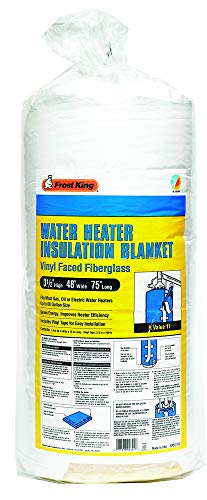
Frost King SP57 R10 Blanket, 48 x 75 in
$32.54R10 stated on the package, which is the only number worth comparing between blankets. Many listings publish none.
Best for: An older tank that is warm to the touch
Check price on AmazonFrequently asked questions
- What does a electric resistance tank cost to run per year?
- About $597 at $0.16 per kWh, heating 55 gallons a day through a 70 F rise at a 0.92 UEF. Your own figure moves most with daily hot water use, which varies far more between households than efficiency does between units in the same category.
- What is UEF and where do I find it?
- UEF is the DOE Uniform Energy Factor, the ratio of hot water energy delivered to energy consumed, measured over a standard daily draw pattern. It is printed on the yellow EnergyGuide label and in the specification sheet. Because the test runs a whole day it already includes standby loss through the tank walls.
- Why is the UEF lower than the burner efficiency?
- Because the UEF test runs a whole day and includes standby loss, while thermal efficiency measures only what the burner puts into the water while it is running. A burner at 80 percent thermal efficiency on a tank that loses heat through its walls all night shows a UEF well below that.
- Does a bigger tank cost more to run?
- A little, through standby loss, but far less than people expect on a modern foam insulated tank. The energy to heat the water you actually use dominates the bill, and that is the same whatever size the tank is. Standby loss is a reason not to buy a much larger tank than you need, not a large number on its own.
- What is the cheapest way to reduce this bill?
- In order: use less hot water, insulate the first stretch of hot outlet pipe, lower the setpoint if the scald and Legionella tradeoff allows it, and only then consider a more efficient heater. The first two cost almost nothing and work immediately, while the last one has a payback measured in years.
Researched guidance, not professional advice. These figures come from published test procedures, code tables and manufacturer specifications, and they are planning numbers rather than a sizing done for your house. Where a manufacturer publishes a figure for the unit in front of you, that figure governs over anything computed here.