Installation Requirements
Water Heater in a Garage: Clearance Rules
Researched from the DOE test procedures, NFPA 54 and NEC code tables, and manufacturer specifications. Updated .
Quick answer
A garage is a plausible install location for a water heater almost everywhere, and it is also a room that regularly holds a running or recently running vehicle, stored gasoline, solvents and propane tanks, and enough open floor space for a car to physically strike the appliance. Code requirements for a water heater in a garage exist to address those specific hazards, and they are more detailed than the requirements for a water heater in a dedicated mechanical closet.
This page lays out what those rules cover in plain terms. The specific adopted code in your jurisdiction, and any amendments to it, is the document that actually governs an installation, and a licensed plumber or gas fitter pulling the permit is the one who confirms it.
Why does a gas water heater in a garage need to be elevated?
Gasoline vapor and many other flammable vapors are heavier than air and settle near the floor rather than dispersing upward, so a spill or a leaking container in a garage can create a pool of flammable vapor at low level well before anyone smells it strongly enough to notice. A gas water heater's burner, pilot or ignition source sitting at floor level sits directly inside that danger zone. Elevating the ignition source above where that vapor typically pools was the traditional code response, historically expressed as raising the source of ignition to at least 18 inches above the garage floor.
Does every gas water heater in a garage still need the 18 inch elevation?
Not necessarily. Since 2003, residential gas storage water heaters manufactured for the domestic market have been required to meet ANSI Z21.10.1, a flammable vapor ignition resistant (FVIR) standard that keeps the appliance from igniting flammable vapors at its own surface even without physical elevation. Most model codes, including common versions of the International Residential Code and the International Fuel Gas Code, carry an exception allowing an FVIR-listed unit to sit directly on the garage floor without the 18 inch platform. That exception is not universal, and some jurisdictions still apply the elevation requirement regardless of FVIR listing, so checking both the specific unit's listing and the locally adopted code, not just one or the other, is the only reliable way to know what a given installation needs.
What does code require to protect a water heater from vehicle impact?
| Requirement | What it addresses | Typical form it takes |
|---|---|---|
| Ignition source elevation | Flammable vapors pooling near the floor | Historically 18 inches above the floor; many current codes exempt FVIR-listed units, subject to local adoption |
| Vehicle impact protection | A parked or moving vehicle striking the appliance | Bollards, a raised platform out of the drive path, or wall-mounted installation, depending on local code and garage layout |
| Combustion air | Enough fresh air for safe, complete combustion | Sized louvered vents or openings, calculated against the appliance's BTU input rating |
| Seismic strapping | The tank tipping or shifting during an earthquake and shearing gas or water connections | Two straps, one in the upper third and one in the lower third of the tank, required in many seismic design categories |
Published standard Source: Common provisions of the International Residential Code and International Fuel Gas Code as adopted with local amendments; ANSI Z21.10.1 flammable vapor ignition resistant listing standard.. Local amendments vary meaningfully by jurisdiction. Confirm the exact requirements with the permitting authority and the installing gas fitter or plumber before installation, not after.
Why does combustion air matter for a garage installation specifically?
A garage is often a more sealed, tightly built space than an older mechanical closet with louvered doors, and a gas burner without enough fresh combustion air can produce incomplete combustion, generating carbon monoxide, or can starve the appliance of the air it needs to burn cleanly and vent properly. Combustion air openings are sized against the specific appliance's BTU input rating, not left to a rule of thumb, which is a calculation a licensed gas fitter performs as part of a code-compliant installation.
When is seismic strapping required, and what does it actually do?
Jurisdictions in higher seismic design categories commonly require a water heater, gas or electric, to be secured with two straps, positioned in the upper third and lower third of the tank, anchored to wall framing rather than to drywall alone. The goal is preventing the tank from tipping or sliding during an earthquake strongly enough to shear off its gas connection, water lines or flue connector, any of which can turn a survivable earthquake into a fire or flood on top of it. The specific strapping method and hardware are covered in the earthquake strapping guide.
What should I confirm before installing a water heater in my garage?
Confirm the specific unit's FVIR listing status and whether the locally adopted code still requires elevation regardless of that listing, confirm the planned location is out of a vehicle's realistic path of travel or protected by a physical barrier, and confirm combustion air provisions are adequate for the appliance's BTU input. All of this is scope for the licensed plumber or gas fitter pulling the permit, not a homeowner working from a general guide, since a garage installation touches vehicle safety, combustion and structural anchoring all at once.
Gas line connections and flue or vent work in a garage installation belong to a licensed plumber or gas fitter, without exception. Carbon monoxide from improperly vented combustion gives no warning smell of its own, and backdrafting on an appliance sharing a garage with vehicle exhaust and stored fuel is a hazard that a permit, an inspection and a qualified installer exist specifically to catch before anyone moves in.
Parts a garage installation actually needs
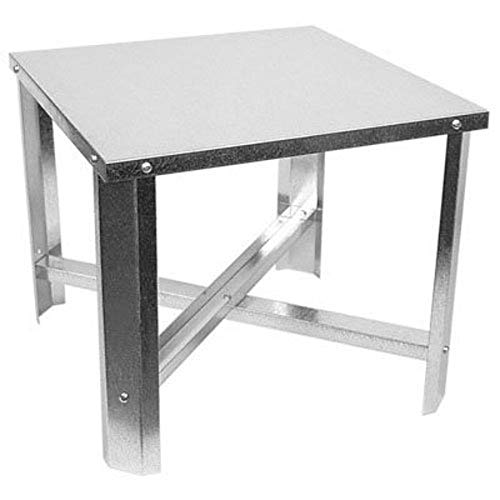
Camco 11231 Gas Water Heater Stand
$61.99Raises the ignition source off the garage floor, which is the clearance rule this page is about.
Best for: Any gas heater in a garage
Check price on Amazon
Everflow GWHS21 Galvanized Stand 21 in
$50.99A galvanized 18 inch platform sized for a standard 40 to 50 gallon footprint.
Best for: A 40 or 50 gallon gas tank
Check price on Amazon
Eastman 86299 Seismic Strap, 132 in
$21.67Two straps rather than one, which is what a seismic requirement actually asks for.
Best for: A standard tank in a seismic zone
Check price on Amazon
Oatey 34084 26 in Aluminum Pan
$32.95An aluminium pan, which is the right material under a gas tank near a draft hood.
Best for: A gas tank, or any pan that might see heat
Check price on AmazonFrequently asked questions
- Does a gas water heater in a garage have to be raised 18 inches off the floor?
- Traditionally, yes, to keep the ignition source above where heavier flammable vapors pool near the floor. Many current model codes exempt water heaters listed as flammable vapor ignition resistant under ANSI Z21.10.1, a standard required on domestic residential gas water heaters since 2003, but some jurisdictions still require the elevation regardless of that listing, so checking the locally adopted code is necessary.
- What is a flammable vapor ignition resistant (FVIR) water heater?
- It is a gas water heater built to a design standard, ANSI Z21.10.1, that prevents flammable vapors from being ignited at the appliance's own surface even without elevation above the floor. Residential gas storage water heaters manufactured for the domestic market have been required to meet this standard since 2003, which is why many current garage installations no longer need the historical 18 inch platform.
- Why does a garage water heater need vehicle impact protection?
- A garage regularly holds a parked or moving vehicle, and a water heater struck by a car can shear its gas or water connections, creating a fire or flood hazard on top of the collision itself. Bollards, a protected corner location, or a raised platform out of the vehicle's realistic path of travel are common ways code requirements for impact protection are met.
- Is seismic strapping required for a water heater in every garage?
- Only in jurisdictions within higher seismic design categories, where code commonly requires two straps, one in the upper third of the tank and one in the lower third, anchored to structural framing. Requirements vary by location, so confirming with the local permitting authority is necessary rather than assuming strapping is or is not required.
- Can I install a gas water heater in my garage myself?
- The tank itself is sometimes a homeowner task depending on local rules, but the gas line connection and any flue or venting work should be done by a licensed plumber or gas fitter, since improperly connected gas lines and improperly vented combustion appliances create carbon monoxide and fire hazards that give no warning on their own.
- Does an electric water heater in a garage need the same clearance rules as a gas one?
- No. The 18 inch ignition source elevation rule and combustion air requirements apply specifically to gas appliances with a flame or spark source. An electric water heater has no open flame or spark-producing ignition, so it is not subject to the same elevation requirement, though vehicle impact protection and seismic strapping requirements, where applicable, still apply to both fuel types.
Pull the permit and let a licensed gas fitter or plumber confirm the specifics. Elevation, impact protection, combustion air and seismic strapping requirements all vary by locally adopted code, and a permitted, inspected installation is what actually confirms a garage water heater meets the rules that apply in that specific location.