Gas piping
What Size Gas Line for a 120,000 BTU Water Heater Over 20 Feet?
Researched from the DOE test procedures, NFPA 54 and NEC code tables, and manufacturer specifications. Updated .
Quick answer
Gas pipe is sized on the volume of gas it must carry, not on the appliance connection size. A 120,000 BTU appliance needs about 117 cubic feet per hour of natural gas at a typical 1,030 BTU per cubic foot heating value.
Over 20 feet that calls for 1 inch Schedule 40 pipe, which the table rates at 466 cubic feet per hour, leaving 349.5 cubic feet per hour of headroom. Gas line upsizing is routinely the largest single line in a tankless quote and the one most often missed.
Capacity by pipe size at 20 feet
Straight from the NFPA 54 low pressure table, for Schedule 40 metallic pipe carrying natural gas at 0.60 specific gravity with a half inch water column drop.
| Pipe size | Capacity | Carries this load |
|---|---|---|
| 1 in | 466 CFH | Yes |
| 2 in | 2,760 CFH | Yes |
| 1/2 in | 118 CFH | Yes |
| 3/4 in | 247 CFH | Yes |
| 1-1/4 in | 957 CFH | Yes |
| 1-1/2 in | 1,430 CFH | Yes |
Published standard Source: NFPA 54 and IFGC pipe capacity table, Schedule 40 metallic pipe, natural gas at 0.60 specific gravity, less than 2 psi inlet, 0.5 in water column drop. Code sizing uses the longest run from the meter to any outlet, and every elbow, tee and valve adds equivalent length that this table does not include. Treat this as the minimum.
The same load at other run lengths
| Run length | Minimum pipe size |
|---|---|
| 10 ft | 1 in |
| 20 ft | 1 in |
| 30 ft | 1 in |
| 40 ft | 1 in |
| 50 ft | 1 in |
| 60 ft | 1 in |
| 70 ft | 1 in |
| 80 ft | 1 in |
| 90 ft | 1 in |
| 100 ft | 1 in |
Published standard Source: NFPA 54 and IFGC pipe capacity table. Capacity falls with length because the pressure drop is what is being held constant. Doubling the run roughly cuts capacity by a third.
Why this calculator will not do propane
NFPA 54 publishes a separate capacity table for undiluted propane at 11 inches water column, and this site does not reproduce it. Sizing propane pipe from the natural gas table understates what the run needs, which on a gas appliance is not an acceptable kind of wrong.
If the property is on propane, use the propane table or have the gas fitter size it. That is a genuine limitation of this page rather than an oversight, and the honest answer is better than a confident number that is too small.
An undersized gas line starves a burner, and a starved burner produces carbon monoxide. Gas piping, flue and vent work belongs to a licensed plumber or gas fitter. This page is for planning a conversation and checking a quote, not for doing the work. A working carbon monoxide alarm belongs on every floor of a house with a gas appliance.
What people miss when planning a tankless retrofit
The existing line. A 40,000 BTU tank and a 199,000 BTU tankless unit differ by a factor of five in gas demand, so a line that was generously sized for the tank can be badly undersized for the tankless. Check the input on both data plates before assuming the pipe is reusable.
The other thing is that the whole house shares the meter. A furnace, a range and a dryer on the same system all draw from it, so the water heater is sized within a total load rather than on its own. See the gas pipe size chart and the gas line size calculator.
Gas connectors and units at this input
A restricted flexible connector throttles the input the whole sizing calculation assumed, so a full port connector matters on a high input appliance.

Eastman Steel-Flex 18 in Water Connector
$14.89Braided stainless with a swivel nut, which lets the tank be set down and then connected rather than threaded into place.
Best for: A standard tank replacement
Check price on Amazon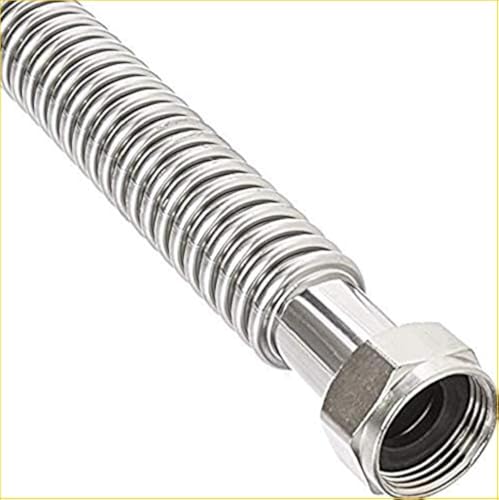
EZ-Fluid 18 in Corrugated Water Connector
$9.95Corrugated stainless rather than braided, which bends tighter and suits a tank pushed close to a wall.
Best for: A tight tank closet
Check price on Amazon
Rheem RTG 7.0 GPM Natural Gas Indoor
$653.77A 160,000 BTU non-condensing indoor unit, which is the cheapest way into a real brand-name gas tankless with a dealer parts channel behind it.
Best for: A one or two bathroom house in a warm inlet climate
Check price on AmazonFrequently asked questions
- What size gas line does a 120,000 BTU water heater need?
- Over a 20 foot run, 1 inch Schedule 40 pipe, because the appliance draws about 117 cubic feet per hour and the NFPA 54 table rates that size at 466 cubic feet per hour at that length. Fittings add equivalent length, so treat that as the minimum rather than the answer.
- Does the length include fittings?
- No, and that is why this is a minimum. Every elbow, tee and valve adds equivalent length to the run, and code sizing accounts for it. A run with many turns can size up a pipe diameter on the fittings alone, which is one of several reasons the sizing belongs to the person who signs the permit.
- Can I use this table for propane?
- No. NFPA 54 publishes a separate capacity table for undiluted propane at 11 inches water column, and sizing propane pipe from the natural gas table understates what the run needs. This site does not reproduce the propane table, so the honest answer is to use the propane table or have the gas fitter size it.
- Why is capacity lower on a longer run?
- Because the pressure drop is what is being held constant. The table is built around a half inch water column drop across the whole run, so a longer pipe has to be fatter to lose the same pressure while carrying the same volume. Doubling the run length roughly cuts the capacity of a given size by a third.
- Do other gas appliances affect the sizing?
- Yes, because they share the meter and often share the piping. A furnace, a range and a dryer all draw from the same system, so the water heater is sized within a total connected load rather than on its own. A gas fitter sizes the whole system, which is why a quote that only mentions the heater run is incomplete.
Gas and flue work belongs to a licensed plumber or gas fitter. An undersized gas line starves a burner, and a starved burner produces carbon monoxide. Backdrafting on an atmospheric vent is real, it is invisible, and it kills. Nothing on this page is a substitute for the sizing done by the person who signs the permit, and a working carbon monoxide alarm belongs on every floor of a house with a gas appliance.