Fuel Type
Gas vs Electric Water Heater
Researched from the DOE test procedures, NFPA 54 and NEC code tables, and manufacturer specifications. Updated .
Quick answer
Gas and electric storage tanks both keep a reservoir of hot water at setpoint; what differs is how fast each one can refill that reservoir after a draw, and what a unit of that recovery energy costs where the household lives. This page compares the two on recovery rate, which is a fixed physical relationship, and on running cost, which depends entirely on local fuel prices and is not fixed at all.
Actual dollar operating costs are specific to a household's usage and local rates; the operating cost calculator runs those numbers rather than a generic claim about which fuel is cheaper.
What actually decides the running cost, gas or electric?
Recovery rate is the gallons per hour a heater can reheat after a draw, and it comes straight from physics: the energy input in BTU per hour, divided by the temperature rise, tells you the gallons per hour. Running cost is a separate calculation entirely: it is the energy input needed, multiplied by the local price of that energy, whether that is dollars per therm of gas or dollars per kilowatt-hour of electricity. A fuel can win decisively on recovery rate and still lose on running cost, or the reverse, depending entirely on what the household pays for each fuel locally.
Recovery rate, gas vs electric, head to head
The table below applies the standard heat relationship, energy equals mass times specific heat times temperature rise, to a common burner input and a common element wattage at a 90°F rise.
| Heat source | Useful heat delivered | Recovery at a 90°F rise |
|---|---|---|
| 36,000 BTU gas burner, roughly 75 percent combustion efficiency | About 27,000 BTU per hour | About 36 gallons per hour |
| 4,500 watt electric element, near 100 percent resistance efficiency | About 15,354 BTU per hour | About 20 gallons per hour |
Published standard Source: Q = m x c x delta-T (water at 8.33 lb per gallon); manufacturer burner and element input ratings. A specific model's own published input rating and the site's recovery rate calculator give the exact figure for that unit rather than this generic 36,000 BTU and 4,500 watt example.
When is electric the right call?
Electric is the right call for a house with no gas line at all, since running one is a separate, often costly project outside this comparison's scope. It also removes combustion and venting from the picture entirely: an electric tank produces no exhaust gas and carries no backdrafting or carbon monoxide risk, because there is no flame. For one or two person households that never stress a tank's recovery rate, and for circuits already sized to NEC requirements, electric is a straightforward, low-complexity choice.
When is gas the right call?
Gas wins where recovery speed actually matters: larger households, back-to-back showers, or a laundry cycle running at the same time as a shower. Where natural gas is available and priced favorably against electricity per unit of delivered heat, gas often runs cheaper too, but that comparison has to be run on local rates rather than assumed; the operating cost calculator does that math for a specific household.
What does each one cost you later?
An electric tank's running cost is a direct, one-to-one line against the price of a kilowatt-hour, with no combustion byproducts to manage and no vent to inspect; its circuit, per NEC 422.13, is sized at 125 percent of nameplate load since a storage water heater of 120 gallons or less is treated as a continuous load. A gas tank's running cost tracks the local price per therm, and it carries an ongoing venting and burner assembly to keep clear and inspected, which an electric tank simply does not have.
Is the combustion difference actually a safety difference?
Yes, and it is worth stating plainly rather than glossing over. A gas water heater burns fuel and produces exhaust gas that must be vented correctly; an atmospheric vent that backdrafts pushes carbon monoxide into the house, and that failure is invisible without a detector. An electric tank has no combustion at all, so it carries none of that risk. That does not make gas unsafe when vented correctly, but it is a real category difference between the two fuels, not a marketing point.
Install a carbon monoxide detector near any gas water heater and have its vent inspected periodically by a licensed technician. Backdrafting on an atmospheric vent produces no smell and no visible sign on its own.
A gas and an electric pick for each side
Two picks per fuel type, spanning the tiers most households actually choose between.
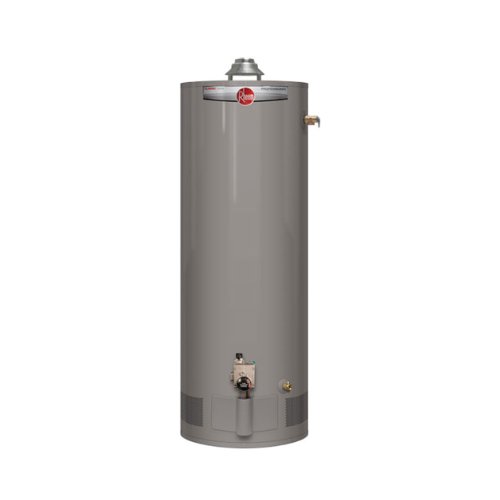
Rheem PROG50-36P 50 Gallon Propane
$1,207.00A 36,000 BTU propane atmospheric tank, the input figure that sets the recovery rate used throughout this comparison.
Best for: Propane properties replacing an atmospheric tank
Check price on Amazon
GE RealMAX Choice 40 Gallon Natural Gas
$1,051.49An atmospheric natural gas tank that vents on buoyancy through an existing flue, the cheapest gas tank to install as a like-for-like swap.
Best for: A like-for-like swap into an existing masonry or B-vent flue
Check price on Amazon
Rheem PROE50 M2 50 Gallon
$945.99A straight 50 gallon electric replacement, the most common residential tank size and the simplest all-electric swap.
Best for: A straight 50 gallon electric replacement
Check price on Amazon
GE Smart 40 Gallon Short, 12 Year
$675.00A 12 year warranty version of a 40 gallon electric tank, worth the difference in hard water areas where the anode does real work.
Best for: Hard water areas where the anode does real work
Check price on AmazonFrequently asked questions
- Is a gas water heater always cheaper to run than an electric one?
- No. Gas usually recovers faster, but running cost depends entirely on the local price of a therm of gas against a kilowatt-hour of electricity, and that ratio varies by region and by season. The operating cost calculator on this site compares the actual numbers for a specific household rather than assuming gas wins on cost everywhere it wins on speed.
- How much faster does a gas water heater recover than an electric one?
- At the same 90 degree temperature rise, a common 36,000 BTU gas burner recovers roughly 36 gallons per hour, while a single 4,500 watt electric element recovers roughly 20 gallons per hour, using the standard Q equals mass times specific heat times temperature rise relationship. That is roughly twice the recovery rate for the gas burner in this example.
- Can an electric water heater use a smaller circuit than the tank needs?
- No, and doing so trips the breaker or overheats the wiring. NEC 422.13 treats a storage water heater of 120 gallons or less as a continuous load, requiring the circuit be sized at 125 percent of the tank's nameplate rating. The water heater breaker size calculator applies that rule to a specific tank's wattage.
- Does an electric water heater need any venting at all?
- No. An electric resistance tank produces no combustion byproducts, so it needs no flue, no vent pipe, and carries no carbon monoxide risk. That is one of electric's clearest advantages over gas, independent of running cost, and it is why an interior closet with no path to an exterior wall often defaults to electric.
- Why do some gas water heaters recover faster than others at the same tank size?
- Recovery rate tracks the burner's BTU input rating, not the tank's gallon capacity. Two 50 gallon gas tanks with different input ratings, such as 36,000 BTU against 40,000 BTU, will recover at different rates even though they store the same volume, so the input rating on the label matters more than the gallon number.
- Is it worth switching an all-gas home to electric, or the reverse, just to save on operating cost?
- Rarely on operating cost alone, since adding a gas line where none exists or upgrading an electrical panel to support a larger element both carry their own costs that a fuel switch has to earn back. Run the operating cost calculator on current local rates before treating a fuel switch as the fix for a high water heating bill.
Always turn off the breaker before touching an electric element, and never energize an element that is not fully submerged. On a gas unit, leave burner, gas line and venting work to a licensed plumber or gas fitter; carbon monoxide from a backdrafting vent is invisible.