Tank Size
50 vs 75 Gallon Water Heater
Researched from the DOE test procedures, NFPA 54 and NEC code tables, and manufacturer specifications. Updated .
Quick answer
Going from 50 to 75 or 80 gallons buys mostly stored volume, not recovery speed, unless the burner input or element wattage also increases with it. That distinction matters because more stored volume that never gets drawn down is pure standby loss with no benefit attached, while more stored volume that regularly does get drawn down is exactly what a larger household needs.
This page also covers the physical side of going bigger: weight, height and doorway clearance, which become real constraints once a tank crosses into the 75 to 80 gallon class.
How much more hot water does 75 gallons actually deliver over 50?
Mostly more stored volume, which is why the gain matters for storage-driven demand, such as a large soaking tub fill, more than it matters for recovery-driven demand, such as back-to-back showers. Unless the larger tank also has a higher burner input or a bigger element, its recovery rate stays roughly the same as a 50 gallon tank of the same construction, so the two tanks behave almost identically once the initial larger reservoir has been drawn down.
What 25 to 30 extra gallons of storage actually weighs and costs, standing
| Factor | 50 gallon tank | 75 to 80 gallon tank |
|---|---|---|
| Water weight alone, at 8.34 lb per gallon | About 417 lb | About 625 to 667 lb |
| Standby loss | Lower; less tank surface area holding heat | Higher; more surface area holds heat around the clock whether or not it is used |
| Typical household fit | 3 to 4 people on a normal schedule | 5 or more people, or a household that regularly fills a large soaking tub |
| Drain pan sizing | Fits a standard 26 inch residential pan | Needs a larger pan, such as a 30 inch model, to clear the tank's wider base |
Published standard Source: Water density at 8.34 lb per gallon; manufacturer drain pan fitment guidance. Exact height, diameter and shipping weight vary by manufacturer and model; check the specific unit's dimension sheet against the doorway, stairwell and ceiling height before ordering.
When is going up to 75 or 80 gallons genuinely worth it?
Households of five or more people on a normal daily schedule, homes with a large soaking tub that gets filled regularly, and households consolidating two smaller water heaters into one larger unit are the clearest cases for going bigger. It is also common on heat pump water heaters specifically, since a larger tank gives a slower compressor-only recovery more stored buffer to work with before the backup elements have to engage.
When is 75 gallons just buying standby loss you will never use?
Most three to four person households on a normal schedule already get everything they need out of a 50 gallon tank's first hour rating, and adding 25 more gallons of storage they never draw down simply adds standby loss with no offsetting benefit. If the household's peak hour demand is not close to a 50 gallon tank's ceiling, the larger tank is paying for capacity that sits unused, heated, around the clock.
What does each one cost you later?
A larger tank pays standby loss every day for the life of the unit, regardless of whether the extra capacity ever gets used, and its greater weight and height make a future replacement more of a logistics problem, since the same doorway and stairwell constraints apply again at swap time. A 50 gallon tank has no new costs beyond making sure it was sized correctly to begin with, using the peak hour demand calculator against the household's actual fixtures and schedule.
Will a 75 to 80 gallon tank even fit through the door?
Not always, and it is worth checking before ordering rather than after delivery. A tank in that class is taller and meaningfully heavier full of water than a 50 gallon tank, and its height alone can be a problem in a low-ceiling closet or a stairwell with a tight turn. Installation logistics and moving a tank this size safely are worth planning with an installer; houseprojectcalc.com covers what that installation runs.
Measure the doorway, stairwell turns and ceiling height against the specific model's dimension sheet before ordering a 75 to 80 gallon tank. A tank that will not clear a stairwell turn has to be returned or replaced with a smaller unit after the fact.
A 50 gallon pick in each fuel, and the large-capacity class
No standard 75 gallon resistance or gas tank appears in this catalog; the closest large-capacity example here is an 80 gallon heat pump tank, paired with the drain pan sized for that class.

Rheem PROE50 M2 50 Gallon
$945.99A straight 50 gallon electric replacement, the size that already covers most three to four person households.
Best for: A straight 50 gallon electric replacement
Check price on Amazon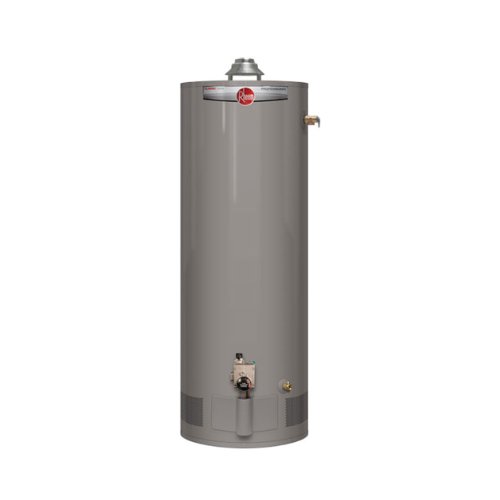
Rheem PROG50-36P 50 Gallon Propane
$1,207.00A 36,000 BTU propane atmospheric tank at 50 gallons, for households sizing on the gas side.
Best for: Propane properties replacing an atmospheric tank
Check price on Amazon
Rinnai REHP80 80 Gallon
$2,299.00An 80 gallon heat pump tank, the large-capacity example in this catalog closest to the 75 gallon question this page asks.
Best for: Large households with the room and the air volume
Check price on Amazon
Everflow AWHP30 30 in Aluminum Pan
$59.99A 30 inch drain pan sized specifically for a 75 to 80 gallon tank or a heat pump water heater, wider than the pan a 50 gallon tank needs.
Best for: Heat pump water heaters and 75 to 80 gallon tanks
Check price on AmazonFrequently asked questions
- Is a 75 gallon water heater always better than a 50 gallon one?
- No. For a typical three to four person household, a 75 gallon tank often just adds standby loss on capacity that never gets drawn down, since the household's peak hour demand already fits comfortably within a 50 gallon tank's first hour rating. Bigger only helps when a household actually draws down the extra stored volume regularly.
- How much heavier is a 75 to 80 gallon tank than a 50 gallon tank?
- Water alone weighs about 8.34 pounds per gallon, so a 75 to 80 gallon tank holds roughly 625 to 667 pounds of water compared to about 417 pounds in a 50 gallon tank, before adding the weight of the tank itself. That difference matters for both the floor structure underneath it and for moving it during installation or replacement.
- Does a 75 to 80 gallon tank need a bigger drain pan?
- Usually yes. A standard 26 inch pan is sized for a 50 gallon tank's base, while a 75 to 80 gallon tank or a heat pump water heater typically needs a wider pan, such as a 30 inch model, to actually clear the tank's larger diameter and catch a leak properly.
- Why do heat pump water heaters often come in larger tank sizes?
- A heat pump water heater's compressor recovers more slowly than a gas burner or a full-power electric element, so a larger tank gives it more stored buffer to draw from before the backup resistance elements have to engage. Sizing up the tank is a common way to compensate for that slower compressor-only recovery.
- Will a 75 to 80 gallon water heater fit through a standard doorway?
- Not always, and it should be checked against the specific model's dimension sheet before ordering, since these tanks are taller and heavier than a 50 gallon unit. A tight stairwell turn or a low ceiling in the installation space can also be a real obstacle that a doorway measurement alone will not catch.
- Is standby loss really that different between a 50 and a 75 gallon tank?
- A larger tank has more surface area holding heated water at setpoint around the clock, so it does lose somewhat more heat per hour than a smaller tank of similar construction, even when neither is being drawn down. That difference accumulates daily over the tank's life, which is why sizing correctly rather than sizing up as a safety margin actually matters.
A full 75 to 80 gallon tank is heavy enough that moving it should never be a one-person job, even empty. Confirm a working T&P valve is installed on any tank this size before it goes into service; a relief valve that drips needs replacing, never capping.