Tank Size
40 vs 50 Gallon Water Heater
Researched from the DOE test procedures, NFPA 54 and NEC code tables, and manufacturer specifications. Updated .
Quick answer
First hour rating is the gallons of hot water a heater delivers in one hour starting from a full tank at setpoint. It combines two things: how much usable hot water is already stored, and how fast the burner or elements can add more while that stored water is being drawn down. Two tanks with different gallon capacities can post very different first hour ratings depending on how fast each one recovers, which is why gallon capacity alone is an unreliable way to size a replacement.
This page walks through that arithmetic using a 40 gallon gas tank against a 50 gallon electric tank, then looks at when each size is actually the right call.
What is first hour rating, and why does it matter more than tank size?
First hour rating is the gallons of hot water a heater delivers in one hour starting from a full tank at setpoint, and it is the figure the DOE test procedure certifies on a unit's EnergyGuide label. It matters more than the raw gallon count because it already accounts for recovery speed: a tank with a fast-recovering burner or a large element adds meaningfully to the water available during that first hour, while a tank with slow recovery is really only offering its stored volume.
Illustrative first hour arithmetic, 40 gallon gas vs 50 gallon electric
The table below applies the standard 70 percent usable-storage planning convention plus the recovery physics from Q = m x c x delta-T to a 40 gallon gas tank and a 50 gallon electric tank at a 90°F rise.
| Tank | Usable storage (70% convention) | Recovery in the first hour | Illustrative first hour total |
|---|---|---|---|
| 40 gallon, 36,000 BTU gas burner | About 28 gallons | About 36 gallons at a 90°F rise | About 64 gallons |
| 50 gallon, single 4,500 watt element | About 35 gallons | About 20 gallons at a 90°F rise | About 55 gallons |
Convention Source: The 70 percent usable-storage planning convention; recovery from Q = m x c x delta-T using each unit's published input rating. This is illustrative arithmetic, not a certified rating. The actual first hour rating for a specific model is on its DOE EnergyGuide label and can differ from this estimate.
When is 40 gallons enough, or even the better choice?
A 40 gallon tank fits where floor space or closet height is tight, and a lowboy version trades height for width in a crawlspace or under-stair closet a tall 50 gallon tank simply will not fit into. As the arithmetic above shows, a 40 gallon gas tank can post a higher first hour rating than a 50 gallon electric tank with a single element, since gas recovery adds more during that first hour than a slower electric element does. A smaller tank also carries somewhat lower standby loss, day after day, than a larger one.
When do you actually need 50 gallons?
Fifty gallons is the right call for an all-electric household of three or four people, where the slower element recovery means additional stored volume is doing more of the work than it would on a fast-recovering gas tank. It is also the safer default when a household's peak hour demand is close to a 40 gallon tank's first hour rating ceiling, since the extra 10 gallons of stored buffer gives more room before a shower runs cold. The peak hour demand calculator checks a specific household's actual demand against either size.
What does each one cost you later?
A 50 gallon tank has more surface area than a 40 gallon tank of the same construction, which means somewhat higher standby loss every single day, whether or not the household ever draws down the extra 10 gallons. A 40 gallon tank has to be sized correctly the first time; running short on hot water with no easy after-the-fact fix beyond a full replacement or adding a second heater is the real cost of undersizing.
Do all 40 or 50 gallon tanks have the same physical footprint?
No. Manufacturers sell both sizes in a standard tall configuration and, for 40 gallon tanks especially, in a short, wide "lowboy" configuration meant for crawlspaces or closets with limited ceiling height. Two tanks rated at the same gallon capacity can have meaningfully different height, diameter and weight, so the specific model's dimension sheet needs to be checked against the space before ordering, not assumed from the gallon number alone.
A 40 and a 50 gallon pick in each fuel
Four picks spanning both sizes and both common fuels, so the size comparison is not tangled up with a fuel comparison.

GE RealMAX Choice 40 Gallon Natural Gas
$1,051.49An atmospheric natural gas tank that vents on buoyancy through an existing flue, the cheapest gas tank to install as a like-for-like swap.
Best for: A like-for-like swap into an existing masonry or B-vent flue
Check price on Amazon
GE 40 Gallon Lowboy
$522.00A short, wide tank for a height-restricted closet or crawlspace, illustrating that "40 gallon" is not one fixed physical footprint.
Best for: Height restricted closets and crawlspaces
Check price on Amazon
Rheem PROE50 M2 50 Gallon
$945.99The single most common residential water heater size in the country, and the electric tank used in this page's first hour arithmetic.
Best for: A straight 50 gallon electric replacement
Check price on Amazon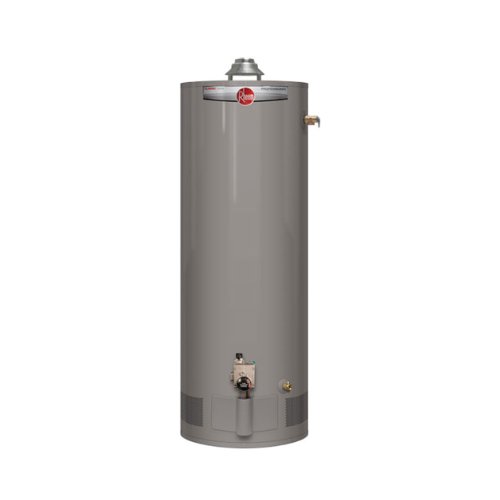
Rheem PROG50-36P 50 Gallon Propane
$1,207.00A 36,000 BTU propane atmospheric tank, the exact burner input figure used in this page's recovery-rate arithmetic.
Best for: Propane properties replacing an atmospheric tank
Check price on AmazonFrequently asked questions
- Can a 40 gallon tank really out-perform a 50 gallon tank in the first hour?
- Yes, when the 40 gallon tank recovers significantly faster. A 40 gallon gas tank with a strong burner input can add more hot water during the draw than a 50 gallon electric tank with a single, slower-recovering element, so its first hour rating can come out higher despite storing less water to begin with.
- What is the 70 percent usable-storage convention, and is it exact?
- It is a planning convention, not a measured standard, that assumes roughly 70 percent of a tank's rated capacity is usable before the outgoing water temperature drops enough to feel cold, due to mixing inside the tank. It is useful for estimating, but a specific model's certified first hour rating on its EnergyGuide label is the number to size against.
- Is a 40 gallon lowboy tank the same capacity as a standard 40 gallon tank?
- Yes, both store 40 gallons, but a lowboy tank is shorter and wider than a standard tall 40 gallon tank of the same brand. The physical footprint differs even though the rated capacity does not, which is why a lowboy exists specifically for spaces where the tall version will not fit.
- Does a 50 gallon tank always cost more to run than a 40 gallon tank?
- It typically has somewhat higher standby loss, since more stored water and more tank surface area both add to daily heat loss at the same setpoint, even when neither is drawn down further than the other. The difference is usually modest compared to the fuel and recovery-rate differences between gas and electric.
- How do I know if 40 gallons is enough for my household?
- Compare the household's peak hour hot water demand, not just headcount, against the specific tank model's certified first hour rating on its EnergyGuide label. The peak hour demand calculator and the first hour rating calculator on this site run that comparison for a specific household's fixtures and schedule rather than a generic per-person rule.
- Does upgrading from 40 to 50 gallons fix a recurring hot water shortage?
- Sometimes, but only if the shortage was a storage problem rather than a recovery problem. If the existing 40 gallon tank has slow recovery, such as a single small element, going to 50 gallons of the same slow-recovering type may help less than switching to a faster-recovering unit at the same or smaller capacity.
Whichever size is chosen, confirm the tank has a working T&P valve before it goes into service. A relief valve that drips is a sign it needs replacing, or that thermal expansion needs an expansion tank; it is never a sign to cap or remove it.