Electrical
What Breaker and Wire Size for a 12 kW Water Heater at 240 V?
Researched from the DOE test procedures, NFPA 54 and NEC code tables, and manufacturer specifications. Updated .
Quick answer
Electric water heater circuits are sized on a rule people often miss: NEC 422.13 classes a storage water heater of 120 gallons or less as a continuous load, meaning it can run for three hours or more at a time. Continuous loads are sized at 125 percent of the nameplate, so the breaker is deliberately larger than the current draw.
At 12 kW and 240 volts that is 50 amps of draw and 62.5 amps of design load.
The sizing, step by step
| Step | Figure | Where it comes from |
|---|---|---|
| Nameplate power | 12 kW | The unit data plate |
| Current draw | 50 A | Watts divided by volts |
| Continuous load factor | 125% | NEC 422.13 |
| Design load | 62.5 A | Draw times 1.25 |
| Circuits | 1 | A single branch circuit |
| Breaker per circuit | 70 A | Next standard size at or above the per circuit design load |
| Copper conductor | 6 AWG | NEC Table 310.16 at 75 C, limited by NEC 240.4(D) |
Published standard Source: NEC 422.13, Table 310.16 at 75 C copper, and 240.4(D) small conductor limits. The circuit count is from the manufacturer installation manual. Sizing a single circuit for the whole load gives a wrong and much more expensive answer.
Where this sits against other ratings
| Power | Draw | Design load | Breaker | Copper |
|---|---|---|---|---|
| 2.5 kW | 10.4 A | 13 A | 15 A | 14 AWG |
| 3.5 kW | 14.6 A | 18.2 A | 20 A | 12 AWG |
| 4.5 kW | 18.8 A | 23.4 A | 25 A | 10 AWG |
| 5.5 kW | 22.9 A | 28.6 A | 30 A | 10 AWG |
| 6.5 kW | 27.1 A | 33.9 A | 35 A | 8 AWG |
| 7.2 kW | 30 A | 37.5 A | 40 A | 8 AWG |
| 9 kW | 37.5 A | 46.9 A | 50 A | 8 AWG |
| 11 kW | 45.8 A | 57.3 A | 60 A | 6 AWG |
| 12 kW | 50 A | 62.5 A | 70 A | 6 AWG |
| 13 kW | 54.2 A | 67.7 A | 70 A | 4 AWG |
Published standard Source: NEC 422.13 continuous load factor with Table 310.16 ampacity at 75 C copper. Ratings above about 13 kW are split across multiple circuits by the manufacturer, so a single circuit row would be misleading and is left out.
Can the existing circuit take this?
A standard electric tank element circuit is 30 amps on 10 AWG, which covers anything up to about 5.5 kW at 240 volts. At 12 kW this exceeds it, so the existing tank circuit would need new conductors and a new breaker.
Check the breaker and the conductor gauge together, because a 30 amp breaker on 12 AWG conductors is a violation that exists in plenty of houses and is worth finding before adding load to it.
Turn the breaker off before touching an element. Both legs of a 240 volt circuit are live, so switching one of them is not enough, and testing with a meter before touching anything is the habit that matters. Never energise an element that is not submerged: dry firing destroys an element in seconds. This page is a planning figure and not a substitute for an electrician.
Electric units and controls at this rating

Rheem RTEX-13 13kW
$278.00Thirteen kilowatts at 240 volts is about 54 amps, which many existing panels can take. In a warm inlet climate it supports roughly one shower at a time.
Best for: A single bathroom in a warm inlet climate
Check price on Amazon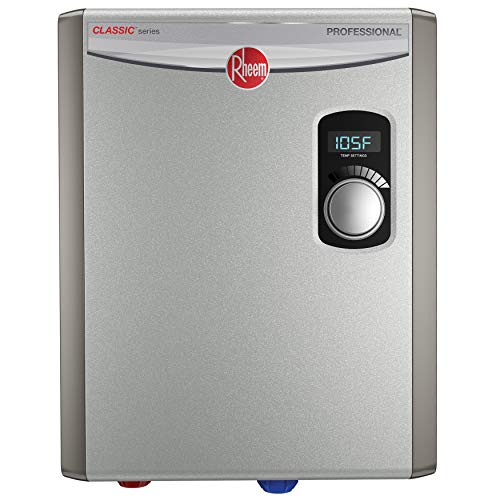
Rheem RTEX-18 18kW
$438.00Eighteen kilowatts draws 75 amps across two circuits. This is the largest electric tankless a typical 200 amp service absorbs without a load calculation fight.
Best for: The realistic ceiling on a 200 amp service
Check price on Amazon
Intermatic WH21 Water Heater Timer
$69.26Built for this appliance rather than adapted to it, rated 208 to 277 volts at 6,250 watts, which covers a standard 4,500 watt element with headroom.
Best for: A 240 volt electric tank on a time of use rate
Check price on AmazonFrequently asked questions
- What breaker does a 12 kW water heater need?
- At 240 volts it draws 50 amps, which becomes 62.5 amps once the NEC continuous load factor is applied. That calls for a 70 amp double pole breaker with 6 AWG copper conductors. The installation manual is the authority for the circuit count.
- Why is the breaker larger than the current draw?
- Because NEC 422.13 classes a storage water heater as a continuous load, meaning it can run for three hours or more at a time. Continuous loads are sized at 125 percent of nameplate so the breaker is not operating at its limit for hours on end. The extra capacity is thermal margin for the breaker, not extra current for the heater.
- Does it need a double pole breaker?
- Yes, on a 240 volt circuit. Both legs are live and both must be switched, which is what a double pole breaker does. A single pole device leaves one leg energised at the element even when it appears to be off, which is genuinely dangerous during service work and is why timers for this application are specified as double pole.
- Can I use aluminium conductors instead?
- It is permitted with the correct terminations and anti-oxidant treatment, but the ampacity is lower for the same size, so the conductor goes up at least one gauge. The figures on this page are for copper at the 75 C column of NEC Table 310.16. If aluminium is on the table, it is a conversation to have with the electrician rather than a substitution to make yourself.
- What does NEC 240.4(D) change?
- It caps the overcurrent protection on small conductors regardless of their table ampacity: 15 amps on 14 AWG, 20 on 12 AWG and 30 on 10 AWG. So even though 12 AWG copper shows 25 amps of ampacity at 75 C, it cannot sit under a 25 amp breaker in this application. That rule is why a 4,500 watt element ends up on 10 AWG rather than 12.
Turn the breaker off before touching an element. Both legs of a 240 volt circuit are live, so switching one of them off is not enough, and testing with a meter before you touch anything is the habit that matters. Never energise an element that is not submerged: dry firing destroys an element in seconds and can crack the tank lining around it.