Accessories
Best Water Heater Drain Pans
Researched from the DOE test procedures, NFPA 54 and NEC code tables, and manufacturer specifications. Updated .
Quick answer
A drain pan sits under a water heater to catch and route a slow leak away from finished flooring, framing, or a ceiling below. It is not a backup for a tank that is actively failing, and it does not replace shutting off water and power to a heater that is leaking badly. What it does is buy time: it contains the small, slow seep from a corroding tank wall or a loose fitting long enough for the leak to be noticed and dealt with, instead of soaking into subfloor unnoticed for days.
Every pan in this list is described by its inside diameter, the number that actually determines whether your tank fits inside the pan wall. That distinction, and the fact that some product listings quote outside diameter instead, is the most common way people order the wrong pan for this category, and it gets its own section below.
What does a water heater drain pan actually do?
A drain pan is a shallow catch basin, typically plastic or aluminum, that sits under a water heater and channels a leak toward a drain line rather than letting it spread across the floor. Most residential and many commercial building codes require one wherever a water heater is installed above living space, inside a finished area, or anywhere a leak could cause water damage before it is noticed, such as an attic or a second-floor closet.
A pan is a containment device, not a repair. It does not stop a tank from failing and it does not replace a working T&P valve or a shutoff valve on the cold supply. If a tank is actively gushing rather than seeping, the correct response is still to shut off water and power (or gas) to the unit, not to rely on the pan.
Why does inside diameter matter more than outside diameter?
A drain pan has to be wide enough on the inside to hold the tank's full base diameter with clearance to spare, since a tank set flush against the pan wall on one side can drip straight over the edge on that side during a slow leak. Inside diameter is the pan wall's interior clearance, the number that determines fit. Outside diameter includes the thickness of the pan wall itself and is always a larger number for the same actual capacity.
Some listings in this category state outside diameter rather than inside diameter without making that clear in the title, which reads as a bigger pan than it actually is. Before ordering, check a listing's specifications for the words "inside diameter" specifically, and when in doubt, measure your existing tank's base diameter directly and add at least an inch or two of clearance on every side rather than trusting a headline number alone.
Measure your tank base, then check for "inside diameter" in the listing specs. A pan advertised by outside diameter can be several inches smaller inside than the number in the title suggests.
Should I buy an aluminum or a plastic drain pan?
Under a gas-fired tank, aluminum is the safer material because the burner compartment at the base of a gas tank runs hot enough over time to warp, discolor, or in some cases crack a plastic pan pressed directly against it. Aluminum tolerates that heat without degrading. Under an electric tank, there is no burner compartment and no comparable heat source at the base, so a plastic pan performs the same containment job at a lower cost and a lighter weight.
The exception either way is a location where a pan will be walked on, moved, or subjected to more physical stress than sitting quietly under a tank, where aluminum's added rigidity may be worth the extra cost even under an electric unit.
How does pan depth change what a leak actually costs?
Pan depth, typically 1.5 to 2 inches on a standard pan and up to 6 inches on a deep pan, sets how much water a slow leak can accumulate before it overflows the pan wall regardless of diameter. A standard shallow pan under a fast leak can overflow in a short time. A deeper pan buys meaningfully more time before that happens, which matters most in a location with no nearby floor drain and no one checking on the space daily, such as a vacation property or an attic mechanical closet.
A pan with no drain line connected to a floor drain or the exterior is, functionally, a bucket: it will hold water until it is full and then overflow exactly as if it were not there. Always run a drain line from the pan's outlet fitting to an actual drain or safe exterior discharge point rather than leaving the fitting capped or unconnected.
A pan with no drain line is a bucket with a time limit. Connect the outlet to a floor drain, a standpipe, or an approved exterior discharge point, not to nothing.
What pan size fits common water heater tank sizes?
| Tank capacity | Fuel type | Typical base diameter | Recommended pan (inside) |
|---|---|---|---|
| 30 to 40 gallon | Electric | ~20 inch | 22 to 24 inch, plastic |
| 40 to 50 gallon | Electric | ~22 inch | 24 to 26 inch, plastic |
| 40 to 50 gallon | Gas | ~22 inch | 24 to 26 inch, aluminum |
| 65 to 75 gallon | Gas or electric | ~24 to 26 inch | 28 inch |
| 80 to 100 gallon | Gas or electric | ~26 to 28 inch | 30 inch |
Convention Source: Compiled from manufacturer tank base dimension specifications cross-referenced against drain pan inside diameter listings.. Base diameter varies by brand and model within a given capacity. Measure your specific tank when possible rather than relying on capacity alone.
How we chose
We did not install or leak-test these pans in person. These picks are compiled from manufacturer published inside diameter and depth specifications, material (aluminum or plastic), and the consensus of verified owner reviews regarding fit accuracy and whether the stated dimensions matched delivered products.
Buying tips
Confirm the outlet fitting size, commonly 1 inch NPT threaded, matches the drain line or adapter you plan to run. Consider the drain pan size chart alongside your specific tank's spec sheet if the tank is a less common brand or capacity. If your installation has no floor drain nearby, a leak detection sensor placed in the pan is a low-cost second layer of protection worth adding rather than relying on the pan alone to be checked regularly.
Do not size up to the largest Expert-tier pans unless your tank base genuinely requires that diameter or the location has no drain and needs the extra depth as a buffer. An oversized pan is mostly a matter of wasted floor space, but a pan sized for looks rather than fit can also make servicing the tank's bottom fittings more awkward.
The picks, by tier
Use the drain pan size calculator to match pan inside diameter to your tank footprint before ordering. Measure your tank base diameter directly if you have any doubt about a listing.

Oatey 34064 26 in Pan
$32.48A standard 26 inch plastic pan sized for the most common electric tank footprint, at the lowest cost in this category.
Best for: The standard 40 or 50 gallon tank
Check price on Amazon
Oatey 24 in Plastic Pan
$24.73A smaller 24 inch plastic pan for a compact electric tank or a point-of-use unit where a full 26 inch pan is oversized for the space.
Best for: A narrow 30 or 40 gallon tank
Check price on Amazon
Everflow AWHP22 22 in Aluminum Pan
$33.55A 22 inch aluminum pan for the smallest gas tank footprints, where a plastic pan would sit too close to burner compartment heat.
Best for: Lowboy and small electric tanks
Check price on Amazon
Everflow PWHP26 26 in Plastic Pan
$37.99A budget 26 inch plastic pan alternative to the Oatey for a standard electric tank.
Best for: An electric tank in a basement
Check price on Amazon Everflow PWHP28 28 in Plastic Pan
$30.87A 28 inch plastic pan for a slightly larger electric tank base than the standard 26 inch size covers.
Best for: A wide electric tank on a budget
Check price on Amazon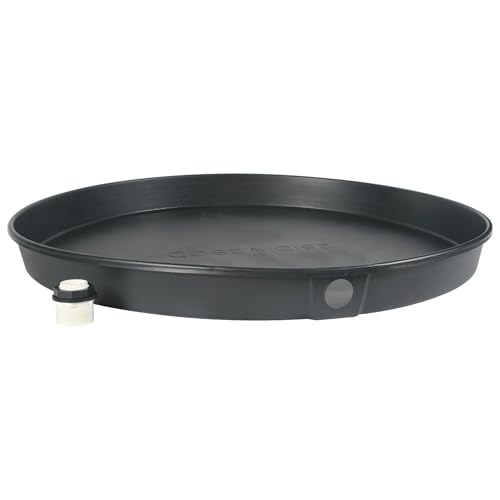
Camco 26 in Plastic Pan
$29.00Another 26 inch plastic option worth comparing on depth and price against the Oatey and Everflow equivalents.
Best for: An electric tank on concrete
Check price on Amazon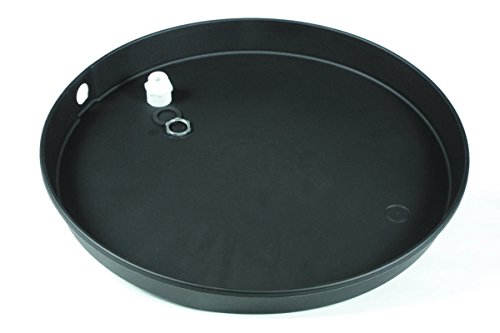
Camco 20 in Plastic Pan
$15.95A 20 inch plastic pan sized for small electric or point-of-use tanks.
Best for: A small point of use or lowboy tank
Check price on Amazon
Oatey 34084 26 in Aluminum Pan
$32.95The buy-once aluminum pan for a standard 40 to 50 gallon gas tank, holding up to burner compartment heat that would eventually warp a plastic pan.
Best for: A gas tank, or any pan that might see heat
Check price on Amazon Everflow AWHP26 26 in Aluminum Pan
$47.99A comparable 26 inch aluminum pan to the Oatey for the same gas tank footprint.
Best for: The standard 50 gallon tank
Check price on Amazon
Rheem AP13319 30 in Plastic Pan
$33.38A 30 inch aluminum pan matched to Rheem-sized tank bases, useful when replacing a Rheem or Ruud unit with the same footprint.
Best for: A Rheem tank where the pan should just fit
Check price on Amazon
Oatey 34103 28 in Aluminum Pan
$46.18A 28 inch aluminum pan for a mid-size gas tank base that falls between the standard 26 and the larger 30 inch sizes.
Best for: A 50 to 65 gallon tank
Check price on Amazon Everflow AWHP28 28 in Aluminum Pan
$25.99A 28 inch aluminum alternative to the Oatey for the same mid-size gas tank footprint.
Best for: A 50 to 65 gallon tank
Check price on Amazon
Camco 20860 30 in Aluminum Pan
$52.00A larger 30 inch aluminum pan with meaningful depth for a large-capacity gas tank, containing more volume before overflow than a shallow standard pan.
Best for: Large tanks where the drain may be slow
Check price on Amazon Everflow AWHP30 30 in Aluminum Pan
$59.99A 30 inch aluminum pan comparable to the Camco for the largest common gas tank footprints.
Best for: Heat pump water heaters and 75 to 80 gallon tanks
Check price on Amazon
Camco 20932 30 x 30 x 6 in Pan
$85.99A deep 6 inch aluminum pan for a large tank in a location where the extra depth genuinely matters, such as over finished space with no floor drain nearby.
Best for: Finished basements and upstairs closets
Check price on Amazon
Rheem 87095 Tough Pan 27 in
$47.82A heavy-duty pan built for a large-capacity commercial-adjacent installation rather than a standard residential tank.
Best for: Anywhere the tank will live a long time
Check price on Amazon
Camco 11470 Tankless Drain Pan
$49.34A pan sized and shaped for a wall-mounted tankless unit rather than a storage tank footprint.
Best for: A wall mounted tankless unit
Check price on Amazon
Camco 11430 Aluminum Tankless Pan
$78.11An aluminum tankless pan for a gas-fired wall-mounted unit where the standard plastic tankless pan sits too close to heat.
Best for: A condensing gas tankless
Check price on Amazon
Black Swan 22 in Aluminum Pan
$29.98A budget 22 inch aluminum pan for a small gas tank footprint, at a lower cost than the Everflow or Oatey equivalents.
Best for: A 30 gallon or lowboy tank
Check price on AmazonFrequently asked questions
- Should a drain pan be sized by inside or outside diameter?
- Inside diameter, since that is the actual clearance available for the tank to sit inside the pan wall. Some listings state outside diameter instead without making the distinction clear, which can read as a larger pan than it actually is. Measure your tank's base and check for "inside diameter" specifically in a listing's specifications before ordering.
- Do I need an aluminum or a plastic drain pan?
- Aluminum under a gas-fired tank, because heat from the burner compartment at the tank base can warp or degrade a plastic pan over time. Plastic is fine under an electric tank, which has no comparable heat source at its base, and costs less while doing the same containment job.
- Does a drain pan need to be connected to a drain line?
- Yes. A pan with no drain line routed to a floor drain, standpipe, or approved exterior discharge point functions only as a bucket: it holds water until full, then overflows exactly as if no pan were installed. Always connect the pan's outlet fitting to an actual drain.
- How deep should a water heater drain pan be?
- Standard pans run about 1.5 to 2 inches deep, which is adequate where a floor drain or drain line is close by. A deeper pan, up to 6 inches on some models, buys more time before overflow in a location with no nearby drain or infrequent monitoring, such as an attic or a vacation property.
- Is a drain pan required by code?
- Most residential and many commercial codes require a pan wherever a water heater sits above living space, in a finished area, or anywhere a leak would go unnoticed before causing damage, such as an attic. Requirements vary by jurisdiction, so check local code, but a pan is inexpensive insurance even where not strictly required.
- Can a drain pan replace a T&P valve or a shutoff valve?
- No. A drain pan only contains a slow leak long enough for it to be noticed; it does nothing to relieve excess pressure or stop an active failure. A working temperature and pressure relief valve and an accessible cold water shutoff remain necessary regardless of whether a pan is installed.
Measure the tank base first, check inside diameter second, and always connect the drain line. A pan that fits and drains is the whole job; a pan that is undersized or unconnected is decoration.