Converting to tankless · Beginner
Entry Gas Tankless Conversion
Quick answer
A gas tankless conversion is not a tank swap with a smaller box. It needs service valves so it can be descaled, a full port gas connector, a listed vent system, and a descaling kit from day one because every tankless owner flushes annually. The gas line is usually what decides the project.
Start with the honest framing: a tankless conversion is a harder and more expensive project than a tank replacement, not a natural upgrade from it. The unit is the cheap part. The gas line upsizing and the vent are what turn a straightforward job into a quote people do not expect.
Check the gas line before anything else. A 40,000 BTU tank and a 160,000 BTU tankless differ by a factor of four in gas demand, so a line that was generous for the tank can be badly undersized for the unit.
The complete parts list
Every line below is a real listing with a live link. Prices come from verified catalog data and change often.
The unit
$653.77A 160,000 BTU non-condensing indoor unit. Non-condensing means category III stainless venting rather than PVC, which is where the install cost difference sits.
-
 Rheem
RheemRheem RTG 7.0 GPM Natural Gas Indoor
The cheapest route into a brand name gas tankless with a dealer parts channel behind it.
Without these it cannot be serviced
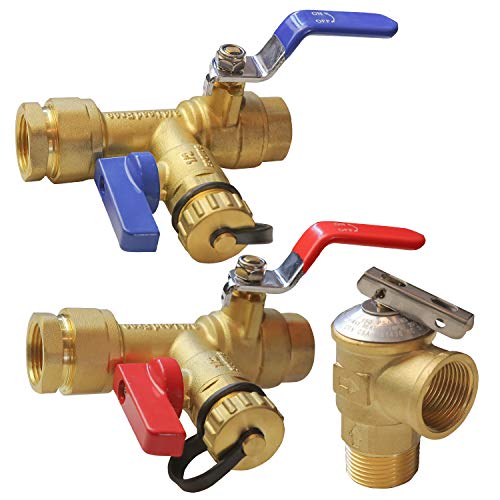
$76.98Service valves are the difference between a forty minute annual descale and a plumbing job. Fit them at installation, not at the first service.
-
 Hourleey
Hourleey 3/4 in IPS Isolator Valve Kit
A 3/4 inch IPS isolator set with the pressure relief valve included.
-
 EZ-FLUID
EZ-Fluid 24 in Full Port Gas Flex, 3/4 in
A full port 3/4 inch gas connector. A restricted connector throttles the input the whole sizing calculation assumed.
Venting
$143.93Vent components are listed with the appliance. A generic pipe that fits is not the same thing as a listed vent system, and this is the one item on the site where getting it wrong produces carbon monoxide.
-
 Rheem
RheemRheem RTG20320 Adjustable Concentric Vent Kit
A concentric vent brings combustion air in around the exhaust, so the unit is sealed from the room and cannot backdraft into it.
-
 Rheem
RheemRheem RTG20321 45 Degree Elbow Vent Kit
A 45 degree elbow costs less equivalent length than a 90, and is worth routing around for.
Annual maintenance, bought up front
$92.98-
 6699
66996699 Flushing Kit, 1/6 HP Pump
Pump, hoses and bucket. A sixth horsepower is enough circulation for a residential heat exchanger.
-
 Iberia
Distilled White Vinegar, 5 Percent, 1 Gallon
Five percent white vinegar is what most manufacturers specify. Never use concentrated vinegar above five percent.
Containment
$78.43-
 Camco
CamcoCamco 11470 Tankless Drain Pan
A wall mounted tankless unit still leaks, usually at the service valves. A rectangular pan catches what a round tank pan cannot.
-

-

Parts list total
$1046.0910 lines across 5 groups. Prices change often and are a guide only. This is the parts list, not the installation: gas, flue and electrical work belong to the licensed trade that signs the permit.
Parts list
Get this parts list as a checklist
One email with the full list, every item linked, so you can tick it off at the supplier or on your phone.
No spam. Unsubscribe whenever you like.
What you can skip
Telling you not to buy something is what makes the rest of the list credible.
- A condensate neutralizer. A non-condensing unit produces no condensate, so this one genuinely does not apply here.
- A recirculation pump. It interacts with a tankless unit in ways worth understanding first. Add it later if the far tap is genuinely slow.
- A scale inhibitor. Worth it in hard water. In soft water the annual flush is enough on its own.
What to upgrade first
- The service valves, without exception. A tankless unit without them cannot be descaled without cutting pipe, and an undescaled unit fails early.
- The gas line, if the calculator says so. It is the item most often missing from a quote and the one that stops the project.
The other tiers in this ladder
- Condensing Gas Tankless Conversion (Intermediate): The condensing tankless setup with PVC venting, a condensate neutralizer, service valves, scale protection and the desca
- Whole House Tankless Setup (Expert): The largest residential tankless setup, with a 199,000 BTU unit, full venting and condensate handling, recirculation, sc
The other way to do this
A like-for-like swap. The heater itself is often bought at a big box store with installation attached, and the accessory layer around it is where an online order genuinely makes sense.
- Budget Tank Water Heater Replacement (Beginner)
- Buy Once Tank Water Heater Setup (Intermediate)
- Long Life Tank Water Heater Setup (Expert)
Frequently asked questions
- Who is the entry tankless conversion for?
- A one to two bathroom house in a warm inlet climate, replacing an aging tank. Everything on the list is either required in most jurisdictions or is the item that prevents the next failure, and the "what to skip" section says plainly what is not needed.
- Do I need every item on this list?
- No, and the page says which ones. The required group covers what most jurisdictions ask for on any water heater installation. Everything after it is a judgment call, and the skip section explains which items genuinely do not apply to a straightforward installation on a concrete floor near a drain.
- Does this include the installation?
- No. This is the parts list. Gas line, flue and electrical work belongs to the licensed trade that signs the permit, and what that work costs is a different question that HouseProjectCalc covers. Buying the parts yourself and having them fitted is common and usually cheaper than a supplied-and-fitted quote.
- Are these prices current?
- They come from verified catalog data and they move often, especially on accessories. Treat the total as a planning figure rather than a quote, and check each listing before ordering. Availability on water heater accessories moves even faster than price does.
This is a parts list, not an installation guide. A water heater is a pressure vessel: never cap, plug or remove the temperature and pressure relief valve, and the discharge pipe runs to within six inches of the floor with no valve and no upward run. Gas line, flue and vent work belongs to a licensed plumber or gas fitter, because improper venting produces carbon monoxide. Turn the breaker off before touching an element and never energise one that is not submerged. Water at 140 F scalds a child in seconds, which is what a thermostatic mixing valve exists to prevent.