Tankless Electric
Rheem RTEX-18 Review: What the 18 kW Draw Actually Means
Researched from the DOE test procedures, NFPA 54 and NEC code tables, and manufacturer specifications. Updated .
Quick answer
An electric tankless water heater is an electrical service purchase before it is a water heater purchase. The kilowatt rating on the box sets the amperage the circuit has to carry, and the amperage decides whether the existing panel can take it at all. That question has to be answered before the flow rate, the brand, or the price.
The Rheem RTEX-18 sits at 18 kW and 240 V, which is roughly where a residential electric tankless install stops being a simple single-circuit swap. Below is the arithmetic behind that number, the flow it calculates to across a range of temperature rises, and who this specific unit suits.
What do the RTEX-18's specifications actually say?
| Specification | Value |
|---|---|
| Nameplate rating (published) | 18 kW at 240 V |
| Current draw (I = P / V) | 75 A |
| NEC 422.13 continuous-load factor | 125 percent of nameplate draw |
| Design load for circuit and breaker sizing | 93.75 A |
| Number of circuits | Specified in Rheem's installation manual, not published in this listing. Manufacturers typically split units above roughly 14 kW across two or three circuits. |
Published standard Source: Nameplate kW and V from the product listing; amperage and design load calculated with P = I x V and NEC 422.13's 125 percent continuous-load rule.. Design load is what an electrician sizes the breaker and wire to, not the 75 A running current alone.
How much flow does the RTEX-18 deliver, and what does temperature rise cost you?
| Temperature rise | Calculated flow (GPM) |
|---|---|
| 35°F | 3.44 |
| 45°F | 2.68 |
| 55°F | 2.19 |
| 65°F | 1.85 |
| 75°F | 1.61 |
Published standard Source: Calculated from the published 18 kW nameplate rating using GPM = kW x 3412 x 0.98 / (rise x 8.33 x 60). Not a manufacturer flow curve.. A cold-region groundwater inlet can sit well above a 55°F rise against a 120°F setpoint. Check your own inlet temperature with the temperature rise calculator before sizing to this table.
Who does the RTEX-18 suit?
This unit suits a one to two bathroom house on a service that has already been confirmed to have 93.75 A of spare design-load capacity, typically a 200 A panel without an electric range, electric dryer, and central air all stacked on it already. It suits a mild to moderate climate, where a 35°F to 55°F rise is realistic and the calculated flow of 2.19 to 3.44 GPM covers a shower plus a second low-flow fixture. It also suits a household replacing an aging tank that wants to stop paying to keep 50 gallons hot around the clock, without adding a gas line.
Who should not buy the RTEX-18?
Anyone who has not had an electrician run a load calculation on the panel should not buy this yet, because 93.75 A is a real number to find, not a guess. A cold-inlet household running a 65°F to 75°F rise should not expect more than 1.6 to 1.85 GPM calculated, which is closer to one fixture at a time than a whole house. And anyone comparing this against a gas tankless unit's flow numbers should not expect parity: gas units commonly deliver 7 to 9 GPM because BTU input scales far more cheaply than kilowatts on a residential electrical service.
What does installing the RTEX-18 actually involve?
An electrician runs a load calculation on the existing panel first, confirming the 93.75 A design load fits alongside every other continuous and non-continuous load already on it. The unit typically lands on more than one dedicated 240 V circuit, split according to Rheem's installation manual rather than a single large breaker, with conductor and breaker sized to NEC Table 310.16 ampacity for the wire run in question. If the panel does not have the spare capacity, the options are a subpanel or a full service upgrade, both of which are a licensed electrician's scope and quote, not a homeowner estimate; houseprojectcalc.com covers what that kind of electrical work costs. None of this is DIY panel work.
Never energize a heating element that is not fully submerged. Dry-firing destroys an electric tankless element in seconds, and both legs of a 240 V circuit are live even when one breaker looks off.
How we researched this
We did not test this heater in person. This page was compiled from Rheem's published nameplate rating on the product listing, the current and design-load figures calculated from that rating using Ohm's law and NEC 422.13, and the flow-by-rise table above, calculated the same way. Where a figure is not published, such as the exact circuit count or a UEF rating, we say so rather than estimate it. We also read the consensus of verified owner reviews for install and reliability patterns, which do not change the arithmetic above.
Recommended gear

Rheem RTEX-13 13kW
$278.00Thirteen kilowatts draws about 54 A, a smaller ask of an older or already-loaded panel, at the cost of flow in anything but a warm climate.
Best for: A single bathroom in a warm inlet climate
Check price on Amazon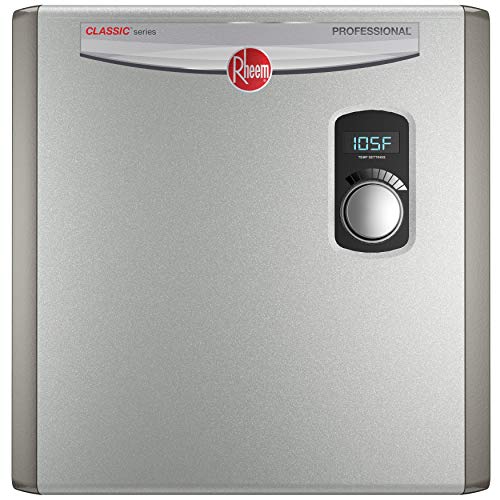
Rheem RTEX-24 24kW
$549.00Six more kilowatts buys real flow headroom in a colder climate, but it also raises the design load from 93.75 A to 125 A, so confirm the panel first.
Best for: Houses with service capacity already proven
Check price on Amazon
KleenWater Tankless Filter System
$89.95Hard water scales the inside of any tankless unit's heat exchanger, and a pre-filter slows that buildup between descaling cycles.
Best for: A well supply feeding a tankless unit
Check price on AmazonFrequently asked questions
- How many amps does the Rheem RTEX-18 draw?
- The RTEX-18 is rated 18 kW at 240 V, which works out to 75 A of continuous current draw using P = I x V. Under NEC 422.13's continuous-load rule, the circuit and breaker are sized to 125 percent of that figure, which is 93.75 A of design load. That design-load number, not the 75 A running current, is what an electrician uses to size the wire and breaker.
- Does the RTEX-18 run on one circuit or two?
- Rheem's installation manual specifies the exact circuit split for the RTEX-18, and that figure is not published in the product listing itself. Manufacturers commonly split electric tankless units above roughly 14 kW across two or three smaller circuits rather than one large one, so expect more than one breaker, and confirm the exact count against the manual before wiring.
- How many gallons per minute does the RTEX-18 deliver?
- Calculated from its published 18 kW rating, the RTEX-18 works out to about 3.44 GPM at a 35°F rise, 2.19 GPM at a 55°F rise, and 1.61 GPM at a 75°F rise. These are calculated ceilings, not a manufacturer flow curve, and the flow you actually get depends on your household's real inlet water temperature.
- Will an 18 kW electric tankless heater work on a 200 amp panel?
- Often, but not automatically. A 200 A panel needs 93.75 A of spare design-load capacity left over after every other continuous and non-continuous load on it is accounted for, and that is a load calculation a licensed electrician performs, not a homeowner estimate. Older panels already carrying an electric range, an electric dryer, and central air may not have that headroom.
- What is the RTEX-18's UEF rating?
- The product listing for the RTEX-18 does not publish a Uniform Energy Factor figure. Electric tankless heaters generally score high on the DOE UEF scale because they carry no standby loss and no flue loss, but a specific number for this model is not stated, so it should not be assumed or used to compare against a gas unit's published UEF.
- Is the Rheem RTEX-18 enough for a whole house?
- It depends entirely on climate and how many fixtures run at once. At a moderate 45°F rise it calculates to about 2.68 GPM, enough for one shower comfortably and two if both use low-flow fixtures. In a cold-inlet region with a 65°F to 75°F rise, calculated flow drops to 1.61 to 1.85 GPM, which is closer to one fixture at a time.
Turn the breaker off at the panel and verify with a meter before opening the box. Both legs of a 240 V circuit are live, so switching off only one pole leaves the unit energized. A service upgrade or added subpanel is an electrician's load calculation, and that calculation belongs before this unit is ordered, not after.