Expansion
What Size Expansion Tank for a 50 Gallon Water Heater at 40 PSI?
Researched from the DOE test procedures, NFPA 54 and NEC code tables, and manufacturer specifications. Updated .
Quick answer
Water expands when it is heated, and in a closed system it has nowhere to expand back into. A check valve, a pressure reducing valve or a backflow preventer between the street and the house makes the supply closed, and then pressure climbs every time the heater runs until the relief valve opens.
A 50 gallon tank produces about 0.84 gallons of expansion. Because the expansion tank is already partly compressed by the 40 psi supply, only 67 percent of its volume is available to accept water, which is why the required tank is larger than the expansion itself.
Why 1.26 gallons and not 0.84
The relation is Vt = Ve / (1 - Pi/Pf) with absolute pressures. Pi is the pre-charge, set to match the 40 psi static supply. Pf is the maximum the system may reach, taken as the 150 psi relief setting.
So (40 + 14.7) / (150 + 14.7) = 0.332, leaving an acceptance factor of 0.668. Dividing 0.84 gallons by that gives 1.26 gallons of tank. Higher static supply pressure means less of the tank is usable, which is why the same heater needs a bigger tank on a high pressure supply.
The same heater across the pressure range
| Static supply pressure | Acceptance factor | Required volume | Tank to buy |
|---|---|---|---|
| 40 psi | 0.668 | 1.26 gal | 2 gal |
| 50 psi | 0.607 | 1.38 gal | 2 gal |
| 60 psi | 0.546 | 1.54 gal | 2 gal |
| 70 psi | 0.486 | 1.73 gal | 2 gal |
| 80 psi | 0.425 | 1.98 gal | 2 gal |
Published standard Source: Expansion tank acceptance relation with absolute pressures, against a 150 psi relief setting. If the static supply pressure is at or above the relief setting, no expansion tank helps and the answer is a pressure reducing valve on the incoming main.
How much water actually expands
| Heater capacity | Expansion volume | As a fraction |
|---|---|---|
| 30 gal | 0.5 gal | 1.68% |
| 40 gal | 0.67 gal | 1.68% |
| 50 gal | 0.84 gal | 1.68% |
| 66 gal | 1.11 gal | 1.68% |
| 75 gal | 1.26 gal | 1.68% |
| 80 gal | 1.34 gal | 1.68% |
Published standard Source: Published density of liquid water at each temperature, rather than a fixed percentage rule of thumb. The often quoted "water expands about two percent" figure is close but depends on the temperatures. Computing it from the density table is exact for the range you actually use.
Setting the pre-charge, which is the step people skip
Expansion tanks ship pre-charged at about 40 psi, which is correct for very few houses. Check the static supply pressure with a gauge on a hose bibb with nothing running, then set the tank pre-charge to match it using a tyre gauge on the schrader valve, with the tank empty and off the system.
A tank fitted at its factory charge onto a 40 psi supply is over-charged and will not begin accepting water until the pressure climbs further than it should. This is the single most common expansion tank installation error.
Never cap, plug or remove the temperature and pressure relief valve to stop it weeping. A weeping relief valve is the system telling you something, and the answer is an expansion tank or a pressure reducing valve, never a cap. A water heater with a disabled relief valve is a pressure vessel with no last line of defence.
Expansion tanks and the fittings that go with them
Potable rated tanks only. Hydronic tanks appear in the same search results, their bladders are not rated for drinking water, and one common model says non-potable in its own title.

Eastman 2 Gallon Thermal Expansion Tank
$34.98A 2 gallon potable expansion tank with a 3/4 inch MIP connection, which is the size and the fitting that suits almost every 40 to 50 gallon residential tank.
Best for: The standard 40 or 50 gallon tank on a closed system
Check price on Amazon
GE 2.1 Gallon Expansion Tank
$42.99Pre-charged to 40 psi from the factory. That figure matters: the pre-charge has to be adjusted to match your static supply pressure before the tank goes on.
Best for: A supply near 40 psi, or anyone with a gauge and a bike pump
Check price on Amazon
EFIELD 2.1 Gallon Expansion Tank
$39.98The budget end of the 2.1 gallon size. An expansion tank is a bladder in a steel shell, and the failure mode is a waterlogged bladder rather than a leak.
Best for: A budget replacement of a failed tank
Check price on Amazon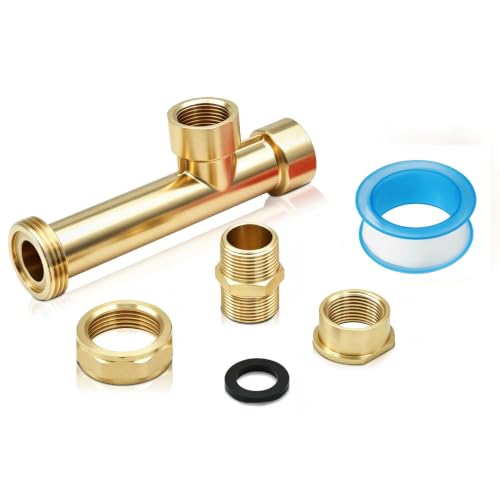
Brass Water Heater Expansion Tee, 3/4 in NPT
$31.59The tee that lets an expansion tank hang off the cold inlet without cutting the line twice. Brass rather than plated steel, on a potable line.
Best for: Adding an expansion tank to an existing install
Check price on AmazonFrequently asked questions
- What size expansion tank for a 50 gallon water heater?
- At 40 psi static supply pressure, about 1.26 gallons, which means a standard 2 gallon tank. The heater produces 0.84 gallons of thermal expansion between 50 F and 140 F, and the tank has to be larger than that because the supply pressure already compresses part of it.
- Do I actually need an expansion tank?
- You need one if the supply is a closed system, which it is whenever a check valve, a pressure reducing valve or a backflow preventer sits between the street and the house. The symptom is a relief valve that weeps after the heater runs. Many jurisdictions now require one on any new water heater installation regardless.
- What should the pre-charge be set to?
- Equal to your static supply pressure, so 40 psi in this case. Measure it with a gauge on a hose bibb with nothing running, then set the tank with a tyre gauge on the schrader valve while the tank is empty and off the system. A tank left at its factory 40 psi charge on a higher pressure supply accepts almost nothing.
- How do I know when an expansion tank has failed?
- Tap it: a healthy tank sounds hollow at the top and solid at the bottom. A waterlogged one sounds solid throughout and feels heavy, and the relief valve starts weeping again. Water coming out of the schrader valve when you press it is conclusive, because that means the bladder has split and the tank is just a steel vessel full of water.
- Can I fit a larger tank than needed?
- Yes, and it does no harm beyond cost and space. Going larger gives more acceptance volume and more margin if the supply pressure rises later. Going smaller does not work at all: an undersized tank fills and then the pressure climbs exactly as if nothing were fitted, which is the outcome people mistake for a faulty tank.
A water heater is a pressure vessel. The temperature and pressure relief valve is the one component on it that is never capped, plugged or removed, and a valve that will not open when you lift the test lever has failed and needs replacing rather than ignoring. If the valve weeps after the heater runs, that is thermal expansion in a closed system and the answer is an expansion tank or a pressure reducing valve, never a cap.