Point of Use
Best Point of Use Water Heaters
Researched from the DOE test procedures, NFPA 54 and NEC code tables, and manufacturer specifications. Updated .
Quick answer
The main water heater in a house is usually sized for the house, not for the one sink at the far end of it that takes a full minute to run warm. A point of use heater exists to fix that specific distance, not to add capacity the main system lacks. It sits at or near the fixture it serves and either stores a small volume ready to go or heats water instantly as it passes through, so the wait at that one sink disappears without any change to the main water heater.
The choice inside this category comes down to one electrical question: a mini tank on a standard 120 volt outlet, which needs no electrical work if an outlet already exists under the sink, or a point-of-use tankless unit, most of which need a dedicated 240 volt circuit to deliver a genuinely useful flow rate. That distinction matters more here than brand or capacity.
What problem does a point of use water heater actually solve?
Distance between a fixture and the main water heater, not the amount of hot water the fixture needs. A remote bathroom, a detached laundry sink, or a kitchenette far from the mechanical room can take a long time to deliver warm water simply because of how much pipe the water has to travel through and cool along the way, and that wasted water and wait exist regardless of how large or efficient the main tank is. A point of use heater sits at the fixture and removes the travel distance from the equation entirely.
Mini tank on a 120 volt plug or point-of-use tankless on a 240 volt circuit?
A mini tank stores a small volume and reheats it after each draw, which needs nothing more than a standard household outlet if one already exists under the fixture. A point-of-use tankless unit heats water only as it flows, with no storage and no wait to reheat, but most models above about 3 kW need a dedicated 240 volt circuit to deliver a flow rate worth having.
| Type | Example | Rated output | Circuit needed | Recovery behavior |
|---|---|---|---|---|
| Mini tank | ThermoMate 2.5 gallon | 2.5 gallons stored | 120V standard outlet | Delivers the tank volume, then waits to reheat |
| Mini tank | GE 10 gallon plug-in | 10 gallons stored | 120V standard outlet | Longer draw before running out, still limited by recovery |
| Point-of-use tankless | Rheem RTEX-06T | 6.5 kW | 240V dedicated circuit | Delivers hot water indefinitely at a modest flow rate |
| Point-of-use tankless | Stiebel Eltron DHX 12-2 | 12 kW | 240V dedicated circuit | Enough output for an actual shower |
Published standard Source: Manufacturer listing specifications in the product catalog for rated capacity, kilowatts and voltage.. A mini tank needs no electrician if a 120 volt outlet already exists under the fixture. A point-of-use tankless unit above about 3 kW needs a dedicated 240 volt circuit, which is electrical work and should be sized with the breaker size calculator.
How we chose these point of use water heaters
We did not install or run any of these units ourselves. The picks come from manufacturer published capacity, kilowatts and voltage, and the pattern of verified owner reviews for reliability at the fixture they were bought for. Tier placement follows capability and installation complexity rather than price, which is why a shower-capable 12 kW tankless unit and a specialty tank booster both sit in Expert despite serving very different purposes.
Buying tips for a point of use water heater
Start with the point of use water heater guide to confirm this is the right fix before buying, since a whole house recirculation loop solves a similar wait-for-hot-water complaint differently; compare the two approaches at recirculation pump vs point of use heater and whole house vs point of use tankless. Size any dedicated circuit with the breaker size calculator before assuming a spare outlet is enough.
A non-thermostatic point-of-use tankless unit can swing hotter as flow drops, which is a real scald risk at a single fixture. Favor a thermostatic model like the Rheem RTEX-06T near children or anyone sensitive to sudden temperature change, and never confuse a tank booster like the Eemax HATB007240, which only works downstream of an existing tank, with a standalone heater.
The picks, by tier
Beginner covers the smallest mini tanks and entry tankless units for a single basin. Intermediate is a genuinely useful remote sink or utility sink solution. Expert reaches into an actual shower-capable point-of-use tankless and a tank booster, which is a different device from everything else on this page.

ThermoMate 2.5 Gallon Mini Tank
$189.99A 2.5 gallon tank on a standard 120 volt outlet, the only option here that needs no electrical work at all if an outlet already exists under the fixture.
Best for: A sink far from the heater, with an outlet under it
Check price on Amazon
Eemax EMT1 1.5 Gallon Mini Tank
$191.73The smallest tank in this catalog at a gallon and a half, genuinely enough for a powder room basin and nothing beyond it.
Best for: A powder room basin
Check price on Amazon
Camplux ME25 2.5 Gallon
$170.99A budget shelf or wall mount 2.5 gallon tank for a straightforward under sink installation.
Best for: A budget under sink install
Check price on Amazon
Rheem RTEX-06T 6.5kW Point of Use
$189.00Thermostatic control on a dedicated 240 volt circuit, built specifically as a point-of-use unit rather than adapted from a whole house design.
Best for: A remote sink on a 240 volt circuit
Check price on Amazon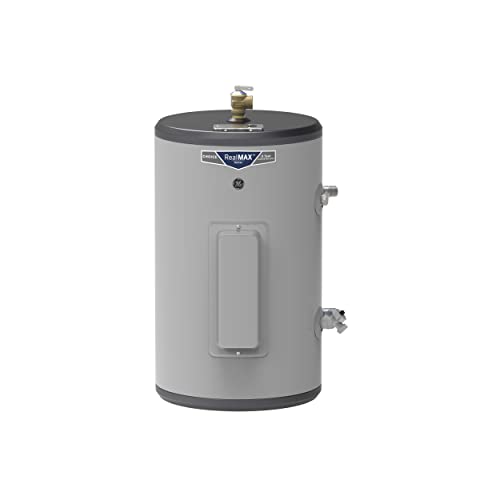
GE 10 Gallon Plug and Play
$329.00Ten gallons on a standard 120 volt plug handles a genuinely long draw at a remote fixture, where recovery rate rather than capacity becomes the real limit.
Best for: An outbuilding or a distant bathroom
Check price on Amazon
Eemax SPEX35 3.5kW 240V
$247.99Moving to a 240 volt circuit roughly doubles what a point-of-use tankless unit can deliver for the same current draw, worth the dedicated circuit where one already exists.
Best for: A remote sink where a 240 volt circuit already exists
Check price on Amazon
Stiebel Eltron DHX 12-2 Trend 12kW
$266.14Twelve kilowatts at the point of use is enough for an actual shower, which puts this in a different category from every mini tank on this page.
Best for: A remote shower with its own circuit
Check price on Amazon
Eemax HATB007240 Tank Booster 7.2kW
$327.15A booster is a different device entirely: it sits downstream of an existing tank and lifts the outlet temperature during a heavy draw rather than heating from cold.
Best for: A tank that runs out at the end of the second shower
Check price on AmazonFrequently asked questions
- What is the difference between a mini tank and a point-of-use tankless water heater?
- A mini tank stores a small volume of hot water, typically 1.5 to 10 gallons, and reheats it after each draw, needing only a standard 120 volt outlet in most cases. A point-of-use tankless unit heats water only as it flows with no storage, delivering hot water indefinitely at a lower flow rate, but most models above about 3 kW need a dedicated 240 volt circuit rather than a household plug.
- Can a point of use water heater run on a regular wall outlet?
- A mini tank generally can, since most are rated for a standard 120 volt outlet and need no electrical work if one already exists under the fixture. Most point-of-use tankless units above roughly 3 kW need a dedicated 240 volt circuit instead, which means an electrician rather than simply plugging the unit in.
- Is 2.5 gallons enough hot water for an under sink installation?
- For a hand wash basin, generally yes, since a 2.5 gallon mini tank like the ThermoMate delivers that volume before it needs to reheat, which covers a typical hand wash comfortably. It is not enough for a shower or for washing dishes at length; a larger mini tank or a point-of-use tankless unit suits those uses better.
- What is a tank booster like the Eemax HATB007240 and how is it different from a point of use heater?
- A booster sits downstream of an existing tank and raises the outlet temperature during a heavy draw rather than heating water from a cold start the way a standalone mini tank or tankless unit does. It solves the problem of a tank running lukewarm at the end of a long shower, a different issue from the distance problem a point-of-use heater is built to fix.
- Can a 6.5 kW point-of-use tankless heater run a full shower?
- Not comfortably in most cases. A 6.5 kW unit like the Rheem RTEX-06T suits a remote sink well but delivers a modest flow rate at a typical temperature rise, more of a warm trickle than a full shower. A 12 kW point-of-use unit like the Stiebel Eltron DHX 12-2 is the size built for an actual remote shower.
- Does a point of use water heater replace the main water heater?
- No. It solves a distance problem at one specific fixture, not the household's overall hot water capacity, and it runs alongside the main water heater rather than instead of it. A household still needs a properly sized main tank or tankless unit for the rest of the house; the point-of-use unit only fixes the wait at the fixture it serves.
Match the circuit to the unit before ordering, and keep a tank booster separate in your mind from a standalone point-of-use heater. A booster only works downstream of an existing tank, and a non-thermostatic tankless unit can swing hot as flow changes, worth knowing before it is installed near anyone sensitive to a sudden scald.